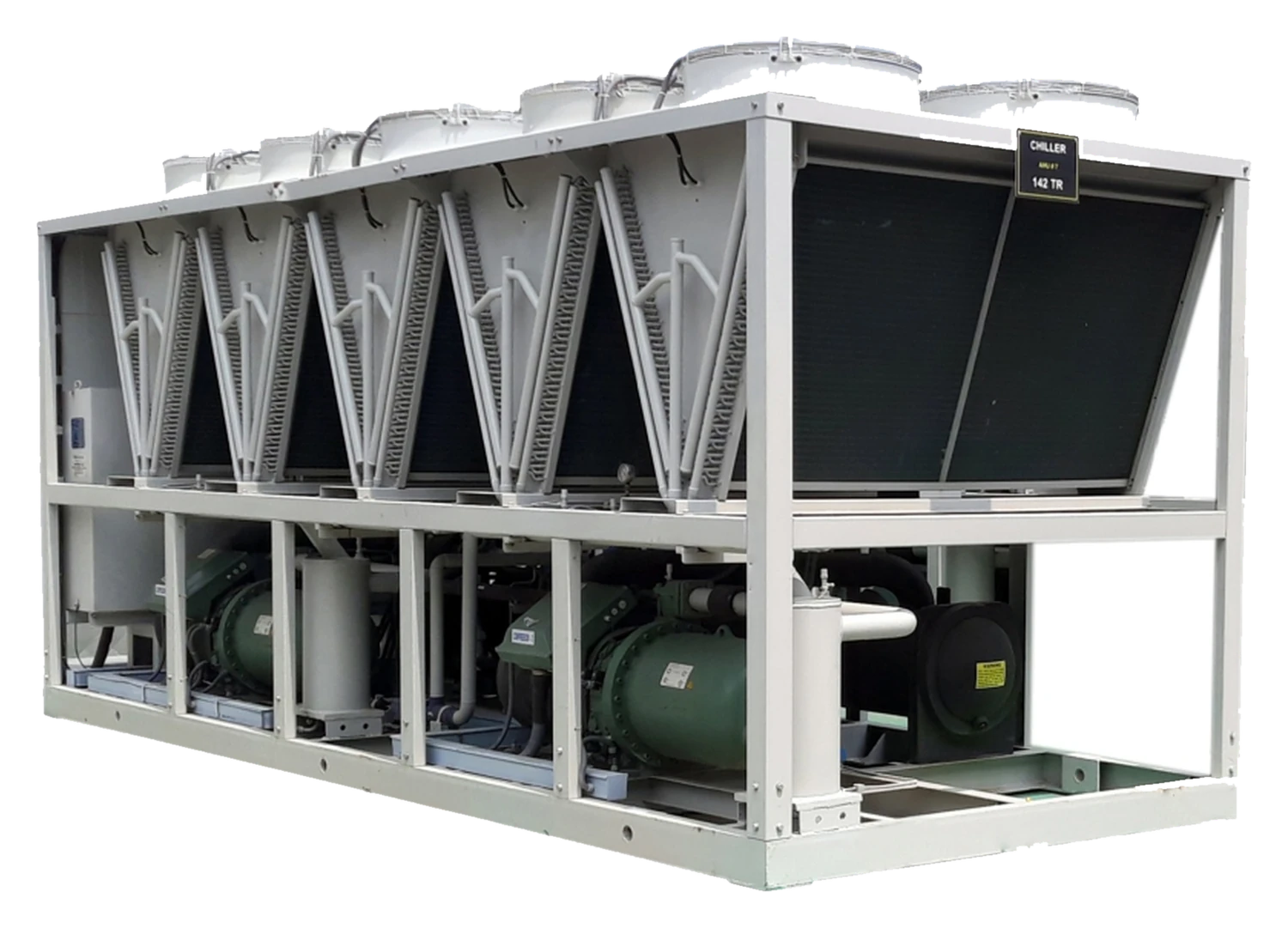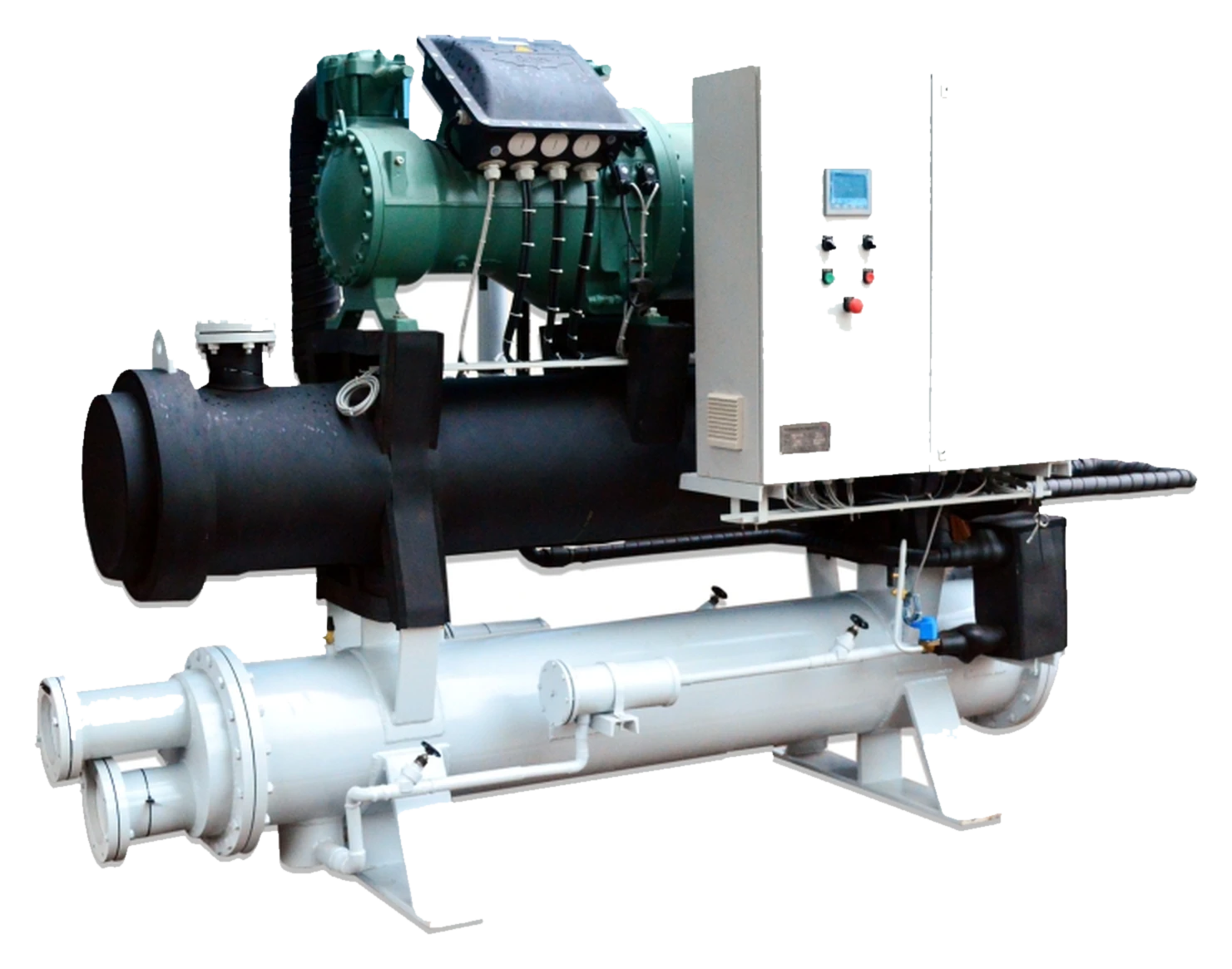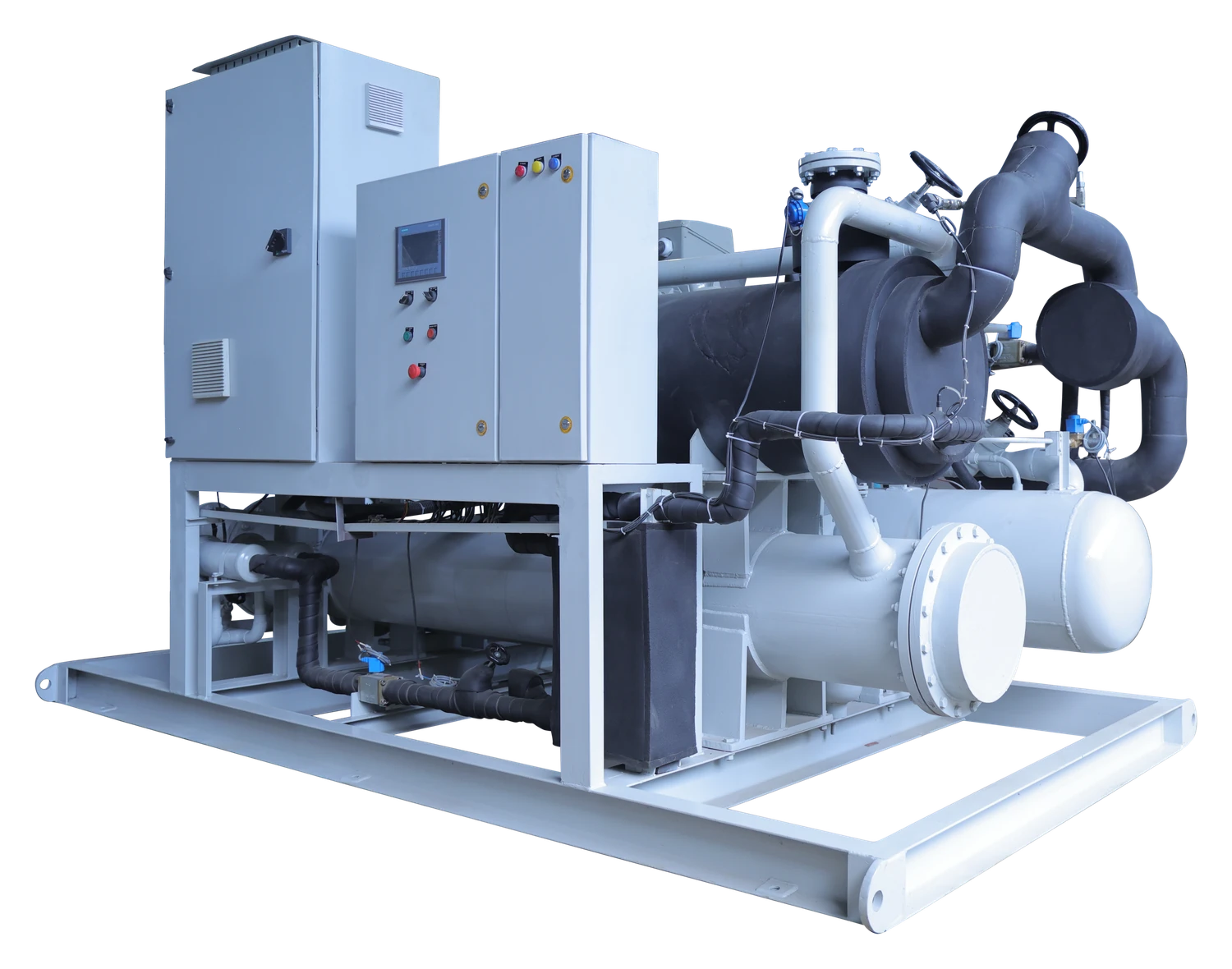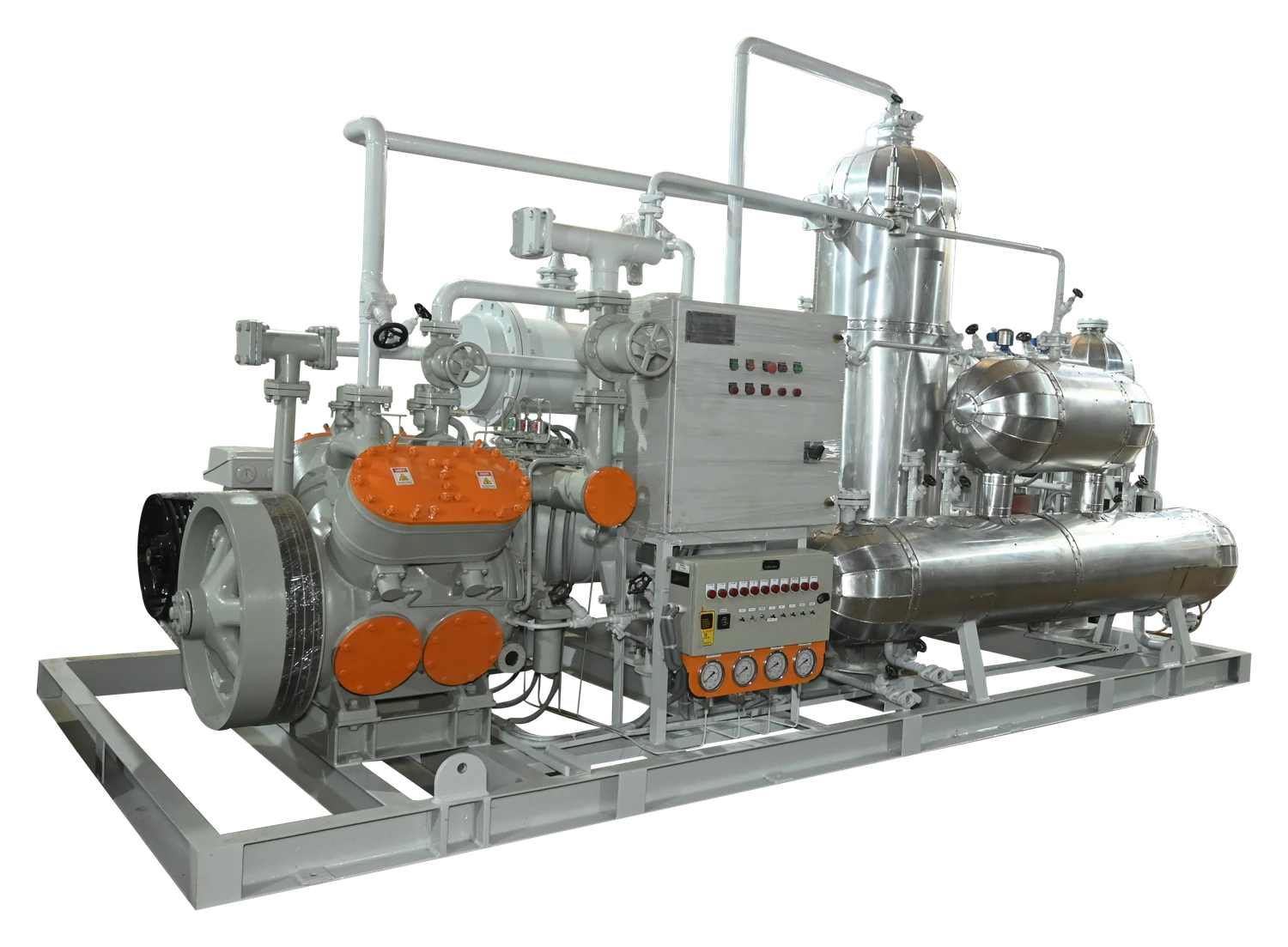
Industrial chillers keep production running at the right temperature. A moulding machine needs +12 °C water, a pharmaceutical reactor needs −30 °C brine, a dairy needs ice water at +1 °C and a batching plant needs +4 °C water for concrete. Each duty calls for a different compressor, evaporator, coolant and condenser. Teqtive designs and manufactures the full range in-house at Ghaziabad, near Delhi, and has supplied plants across India and abroad.
Teqtive industrial chiller range
| Teqtive range | Capacity | Temperature | Best for |
|---|---|---|---|
| Air cooled scroll chiller | 5 – 78 TR | +25 °C to −10 °C | Machine-side and small plant cooling, no cooling tower |
| Water cooled scroll chiller | 5 – 90 TR | +25 °C to −10 °C | Compact indoor units where a tower exists |
| Air cooled screw chiller | 40 – 500 TR | +25 °C to −10 °C | Central plant cooling without water |
| Water cooled screw chiller | 40 – 500 TR | +25 °C to −10 °C | Large continuous loads, lowest kW/TR |
| Air cooled reciprocating chiller | 1 – 120 TR | +25 °C to −35 °C | Low-temperature duty in small sizes |
| Water cooled reciprocating chiller | 1 – 120 TR | +30 °C to −40 °C | Rugged low-temperature process duty |
| Brine chiller | 1 – 500 TR | 0 °C to −40 °C | Pharma, chemical, glycol / methanol / CaCl₂ |
| Two-stage brine chiller | 1 – 200 TR | −25 °C to −45 °C | Efficient deep sub-zero duty |
| Cascade brine chiller | 1 – 100 TR | −35 °C to −70 °C | Ultra-low temperature synthesis and testing |
| Ammonia chiller | 20 – 1000 TR | 0 °C to −40 °C | Dairy, beverage, cold stores, large chemical plants |
| Batching plant chiller | 20 – 360 TR | +4 °C | Concrete cooling for dams, metros, mass pours |
| Falling film chiller | 100 – 50,000 LPH | down to +0.5 °C | Ice water for dairy, food and concrete |
| Oil chiller | 0.5 – 150 TR | +25 °C to +40 °C | Hydraulic and spindle oil cooling |
The four decisions that define an industrial chiller
1. Compressor: scroll, screw or reciprocating
Scroll compressors are hermetic, quiet and efficient at small sizes; several are combined for 5–90 TR. Screw compressors take over above about 40 TR and run continuously with smooth capacity control. Reciprocating compressors handle the high compression ratios of low-temperature duty in small and medium sizes. See screw chillers, scroll chillers and the screw vs scroll comparison.
2. Condenser: air cooled or water cooled
Water cooled chillers reject heat to a cooling tower and use less power; air cooled chillers reject heat to ambient air and need no water. In Indian summers air cooled units must be sized for 45 °C ambient. Read air cooled vs water cooled chiller.
3. Coolant and temperature
Plain water works down to about +5 °C. Below that the loop needs glycol, methanol or calcium chloride brine, and the machine becomes a brine chiller or glycol chiller. Below about −40 °C a two-stage or cascade circuit is needed. See brine temperature ranges and freezing points.
4. Refrigerant
Packaged chillers use HFC or HFO refrigerants. Large plants above about 100–150 TR often justify ammonia (R-717), a natural refrigerant with zero ozone-depletion and zero global-warming potential. Compare them in ammonia vs Freon.
Industrial chillers vs HVAC chillers
An HVAC chiller cools a building to a comfortable temperature and runs at part load most of the year. An industrial chiller serves a process that sets its own load and temperature, often 24 hours a day, sometimes below 0 °C, and the cost of a trip is lost production. That changes the design: larger evaporator surface, sub-zero-rated components, process-grade controls and redundancy. More in process chiller vs HVAC chiller.
Industries we build chillers for
- Pharmaceutical and API plants: reactor, crystalliser and condenser cooling from +5 °C to −70 °C.
- Chemical and specialty chemical plants: reaction control, solvent recovery, vent condensers.
- Dairy, food and beverage: ice water, glycol, ammonia refrigeration, flake ice.
- Plastics and rubber: injection, blow and extrusion moulding cooling.
- Construction: batching plant chillers and flake ice for concrete cooling.
- Gas, automobile, textile, paper, sugar, surface coating and electronics.
How to size an industrial chiller
Capacity in TR = heat load in kW ÷ 3.517. For a fluid loop, heat load (kcal/h) = flow (L/h) × specific heat × density × temperature drop, and 1 TR = 3,024 kcal/h. Then correct for the real outlet temperature, coolant and ambient: a compressor that delivers 50 TR at +7 °C water may deliver less than half that at −20 °C brine. Use our chiller tonnage calculator, then check budgets in the chiller price guide.
Why plants choose Teqtive
- Own manufacturing at Ghaziabad: fabrication, brazing, machining, painting and testing under one roof.
- One supplier from +90 °C to −70 °C: chillers, brine and ammonia plants, heat pumps, air dryers and ice machines.
- Process engineers, not just sales: every unit is selected on the actual process load, coolant and temperature.
- Service network across India for commissioning and maintenance.
Send us your load, temperature and site details for a selection and quotation.
Frequently asked questions
What is an industrial chiller?
An industrial chiller is a refrigeration machine that removes heat from a process fluid, usually water, glycol or brine, and pumps it back to machines, reactors, moulds or heat exchangers at a controlled temperature. Unlike comfort air-conditioning chillers, industrial chillers are built for continuous duty, tighter temperature control and, often, temperatures below 0 °C.
What capacity industrial chillers does Teqtive make?
Teqtive builds industrial chillers from 1 TR to 1000 TR. Scroll chillers cover 5 to 90 TR, reciprocating chillers 1 to 120 TR, screw chillers 40 to 500 TR, brine chillers 1 to 500 TR and ammonia chillers 20 to 1000 TR.
How cold can an industrial chiller go?
Standard chilled-water units work from +25 °C down to about −10 °C with glycol. Brine chillers reach −40 °C, two-stage chillers −45 °C and cascade chillers −70 °C.
Air cooled or water cooled industrial chiller — which is better?
Water cooled chillers use roughly 20–35 % less compressor power and suit large plants that already run a cooling tower. Air cooled chillers avoid the tower, make-up water and water treatment, so they are preferred where water is scarce or the plant wants a single outdoor unit. The full comparison is in our air cooled vs water cooled guide.
How much does an industrial chiller cost in India?
Price depends mainly on tonnage, outlet temperature, compressor type and condenser type. Our chiller price guide gives indicative market ranges by type and size; for a firm price send us your load and temperature.