Cement hydration generates heat, and Indian summers deliver cement, sand and aggregate that are already hot. Project specifications for bridges, metro works, dams, raft foundations and pavements therefore put a ceiling on the temperature of concrete at placing, commonly around 30–32 °C and considerably lower for mass concrete. The batching plant has to remove heat from the ingredients to meet it.
Where the heat is
The temperature of fresh concrete is the weighted average of its ingredients. Cement and aggregates have a specific heat of about 0.22 kcal/kg·°C; water is 1.0. The standard hot-weather concreting formula is:
T = [0.22 (TaWa + TcWc) + TwWw + TaWwa − 79.6 Wi] ÷ [0.22 (Wa + Wc) + Ww + Wwa + Wi]
where W is mass in kg and T is temperature in °C for aggregate (a), cement (c), added mixing water (w), free moisture on the aggregate (wa) and ice (i). The figure 79.6 is the latent heat of melting ice in kcal/kg.
Worked example for 1 m³
Take 400 kg cement at 50 °C, 1,850 kg aggregate at 35 °C carrying 40 kg of free moisture, and 140 kg of added water.
| Case | Concrete temperature | Reduction |
|---|---|---|
| Mixing water at 30 °C (no cooling) | 35.9 °C | — |
| Chilled mixing water at 4 °C | 30.5 °C | 5.4 °C |
| 70 kg chilled water at 4 °C + 70 kg flake ice | 21.9 °C | 14.0 °C |
| Aggregate cooled by 10 °C (water at 30 °C) | 29.3 °C | 6.6 °C |
Three lessons follow. Chilled water is cheap and effective but limited to about 5 °C because there is so little water in the mix. Ice is powerful because each kilogram absorbs about 80 kcal just by melting. And aggregate, although its specific heat is low, makes up three quarters of the mass, so every 10 °C taken out of it is worth 6–7 °C in the concrete.
The three cooling methods
| Method | Equipment | Typical concrete temperature drop | Best for |
|---|---|---|---|
| Chilled mixing water | Batching plant chiller at +4 °C with insulated tank | 4–6 °C | Ready-mix plants, pavement, building work in summer |
| Flake ice replacing part of the water | Flake ice machine, ice store, weighing and conveying | Up to 12–15 °C with chilled water | Mass concrete, rafts, hot-climate infrastructure |
| Aggregate cooling | Falling film chiller giving +0.5 °C to +1 °C water over a wet belt or bin; or chilled air | 6–10 °C | Dams and very large pours, usually combined with ice |
Chilled water: the batching plant chiller
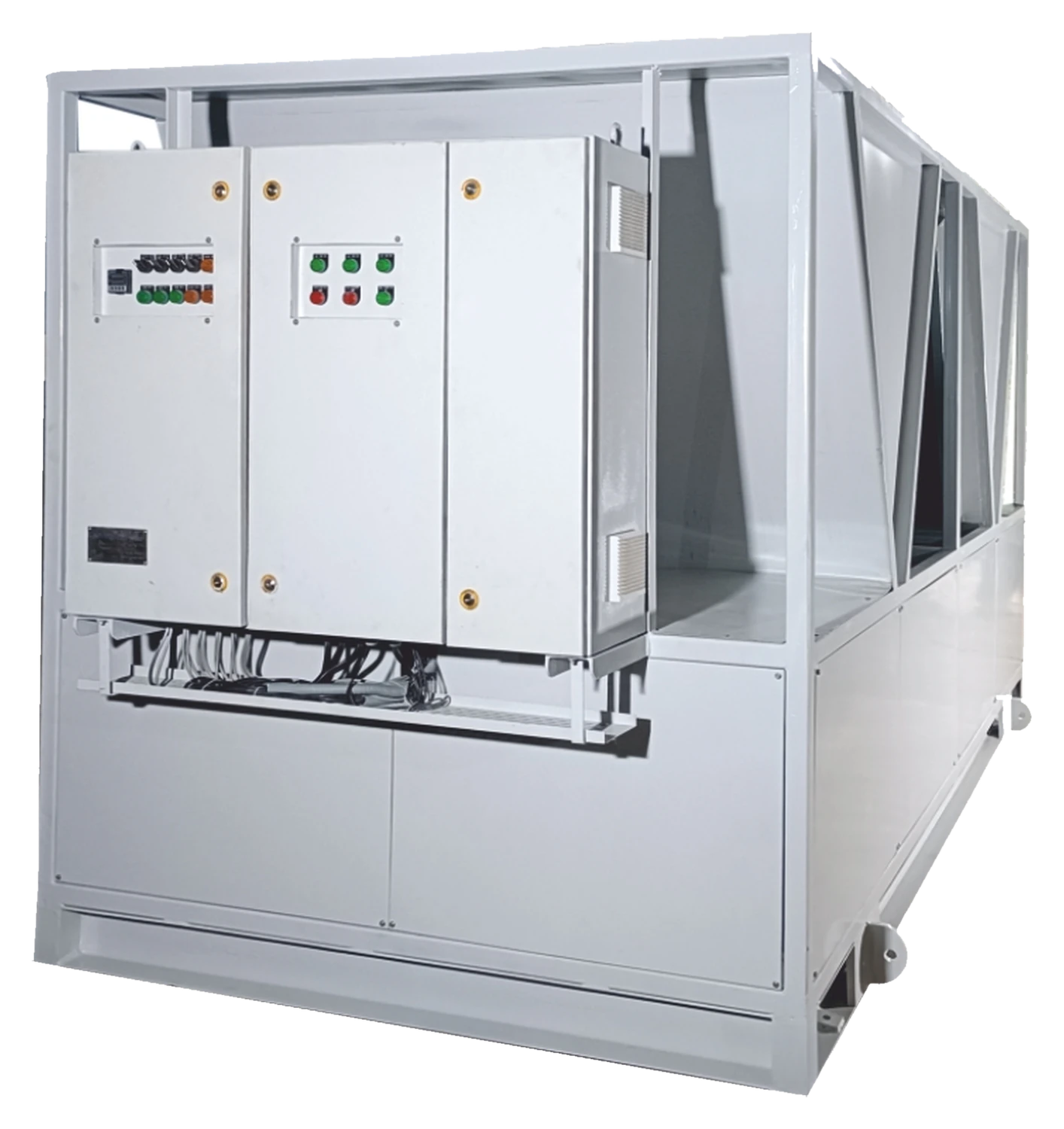
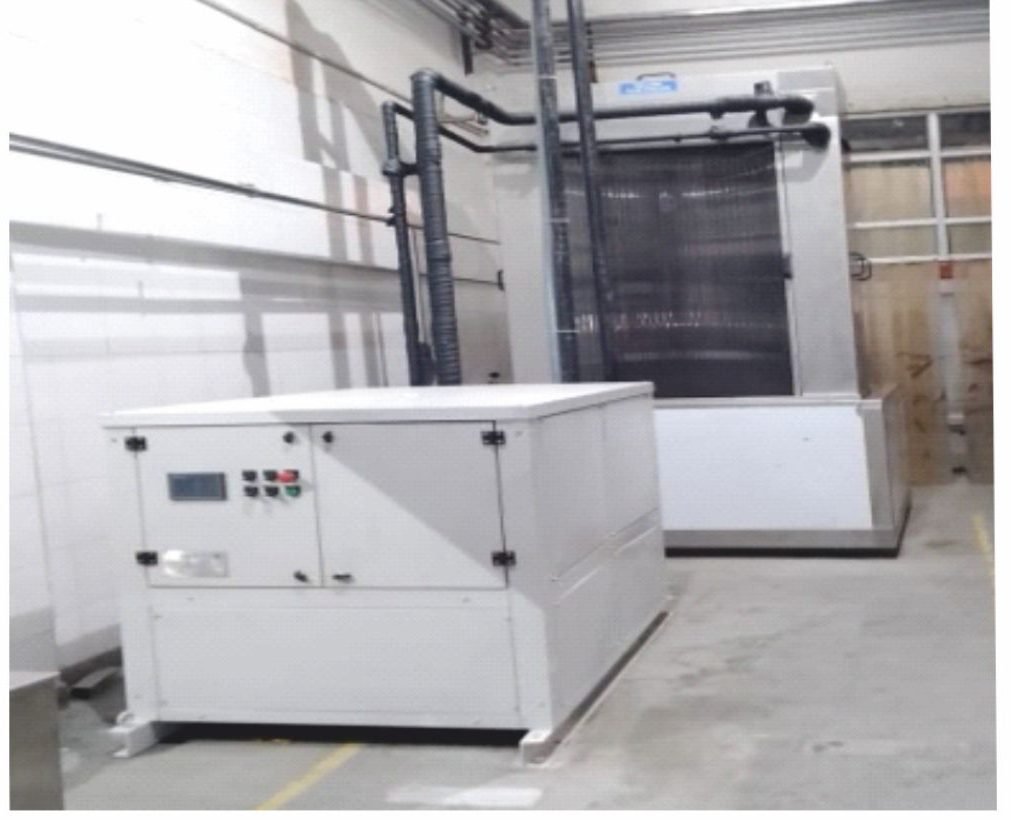
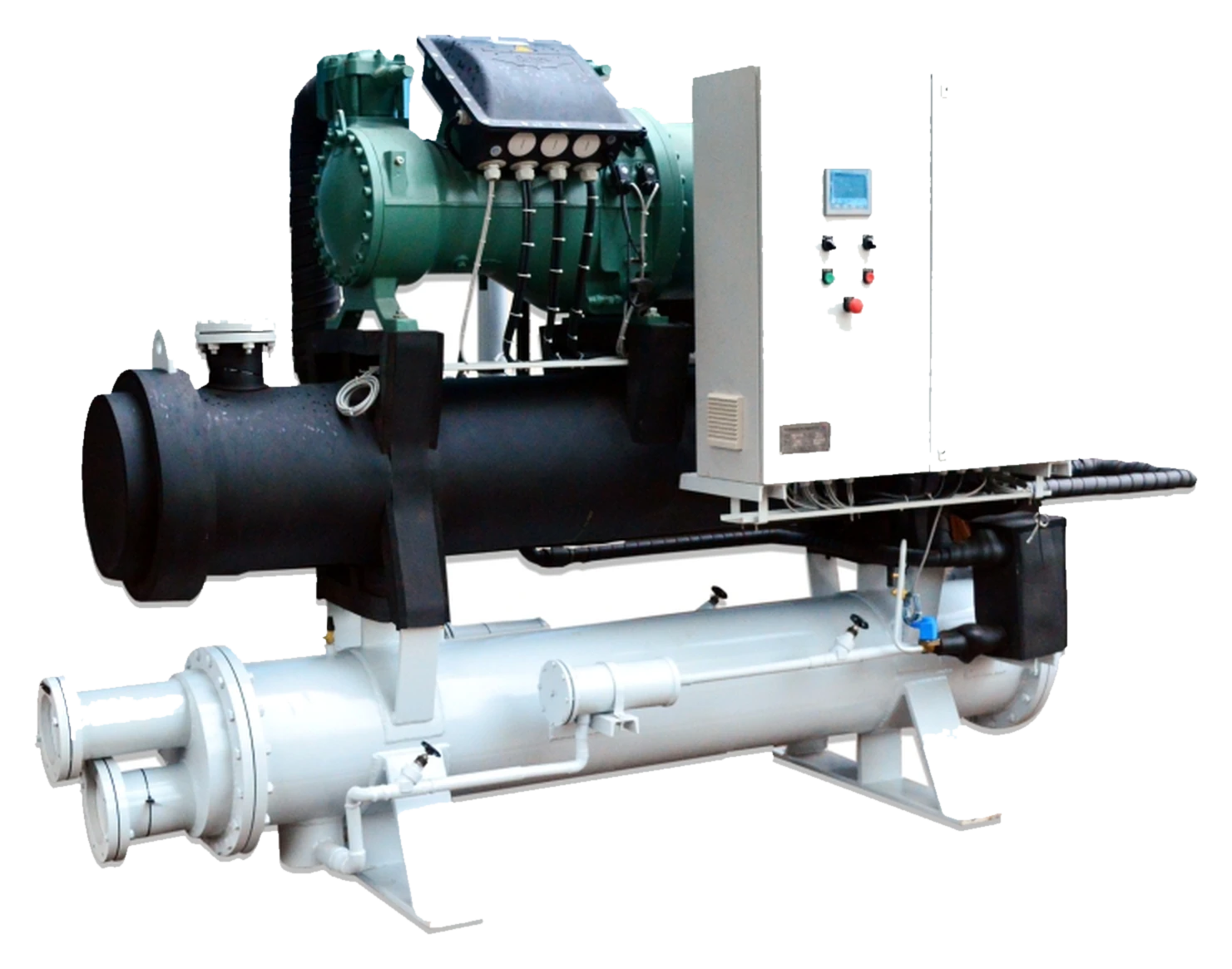
A batching plant chiller cools mixing water to about +4 °C and stores it in an insulated tank so that it can be drawn in batches. Plant water is rarely clean, so the evaporator must tolerate muddy water and be easy to clean. Air cooled units suit mobile and remote sites with no cooling tower; water cooled units use less power where water is available. See air cooled vs water cooled chillers.
Flake ice
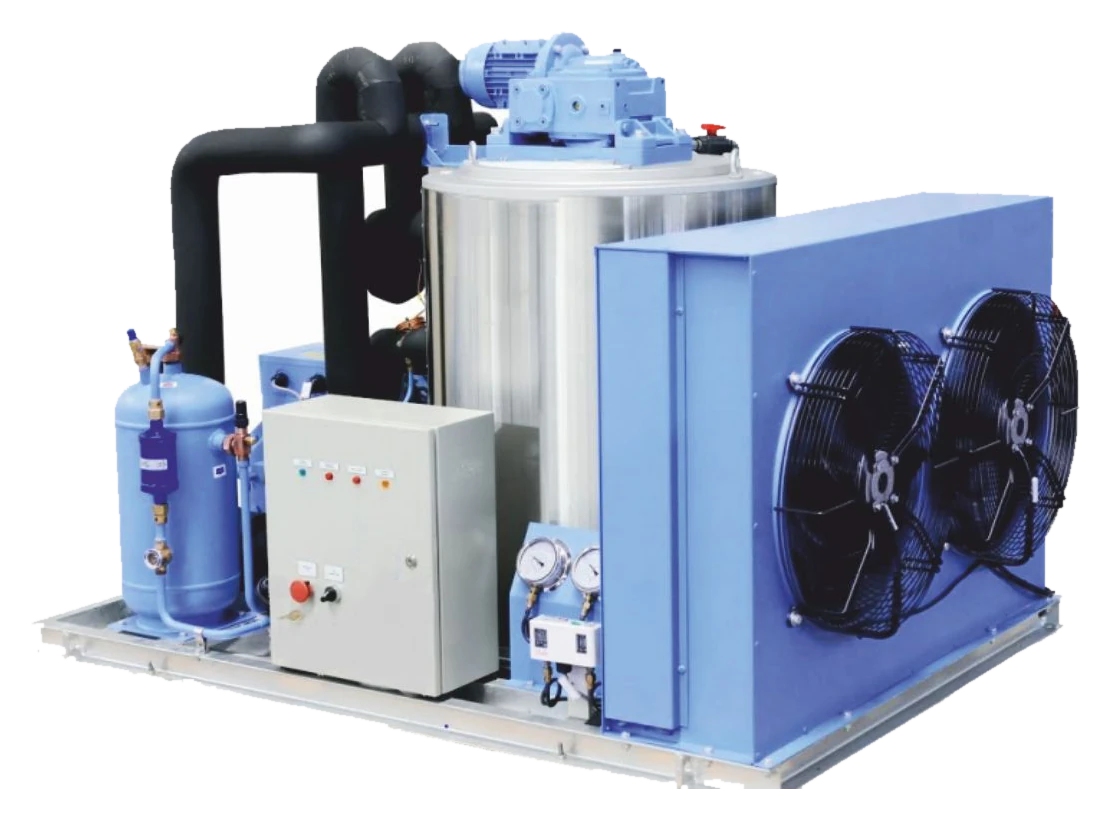
Flake ice is dry, sub-cooled and thin, so it melts completely during mixing and is easy to weigh. Up to about half to three quarters of the mixing water can be replaced, depending on the moisture already on the aggregate. A flake ice machine is rated in tonnes per day and is normally paired with an insulated ice store and screw or pneumatic delivery to the mixer.
Aggregate cooling with a falling film chiller
For the largest reductions the coarse aggregate itself is cooled, most often by flooding it with ice water on a slow conveyor (a wet belt) and then dewatering it on a screen. The return water carries fines and comes back several degrees warmer. A falling film chiller suits this duty because water falls as a film over refrigerated pillow plates in an open housing: it can cool to +0.5 °C without risk of freeze damage, and silt can be washed off instead of blocking tubes. A settling tank and screen ahead of the chiller remain essential.
Sizing the chiller
Chilled mixing water. Load (kcal/h) = concrete output (m³/h) × water per m³ (kg) × temperature drop (°C). For a 60 m³/h plant with 140 kg/m³ cooled from 30 °C to 4 °C: 60 × 140 × 26 = 218,400 kcal/h, and 218,400 ÷ 3,024 = 72 TR. Because batching is intermittent, a storage tank lets a smaller chiller run continuously and still meet peak hours.
Aggregate cooling. Load = aggregate throughput (kg/h) × 0.22 × temperature drop, plus the heat picked up by the water system. Cooling 100 tonnes per hour by 10 °C is 220,000 kcal/h, about 73 TR, before losses, and the wet-belt water flow is typically several times the mixing-water flow.
Ice. Ice demand (tonnes/day) = ice per m³ × daily concrete volume. At 70 kg/m³ and 600 m³ per day the plant needs 42 tonnes of ice per day.
Add 10–20 % for tank, pipe and ambient heat gain. The general method is explained in how to calculate chiller tonnage.
Practical points on site
- Shade and sprinkle aggregate stockpiles; it is the cheapest cooling available.
- Insulate and shade the chilled water tank and lines, and paint silos and mixer drums white.
- Size for the worst month's ambient, typically 45 °C, not for average conditions.
- Keep water strainers and the evaporator clean; batching water fouls quickly.
- Check the concrete temperature at the point of placing, since transit adds heat.
Teqtive equipment for concrete cooling
Teqtive manufactures batching chillers from 20 TR to 360 TR delivering water at +4 °C in air cooled and water cooled versions, falling film chillers from 100 to 50,000 LPH down to +0.5 °C, and ice machines from 1 to 60 tonnes per day. Share your plant output, mix design and target placing temperature and we will work out the combination for your project.
Frequently asked questions
Why is a chiller used in a concrete batching plant?
To lower the temperature of fresh concrete. Hot concrete loses slump quickly, needs more water, sets too fast and is prone to thermal cracking, especially in mass pours. Replacing ambient mixing water with chilled water at about +4 °C is the simplest way to bring the concrete temperature down, typically by 4–6 °C.
How much does chilled water reduce concrete temperature?
Using water at about +4 °C instead of 30 °C lowers a typical mix by roughly 4–6 °C. Water is only about 6–8 % of the mass of concrete, so there is a limit to what it can do. For larger reductions part of the water is replaced with flake ice or the coarse aggregate is cooled as well.
What is a falling film chiller used for in aggregate cooling?
A falling film chiller produces large flows of ice water at about +0.5 °C to +1 °C. In aggregate cooling this water is sprayed over coarse aggregate on a wet belt or in a soaking bin. Because the water runs over open pillow plates rather than through tubes, the chiller tolerates the sand and silt that return with the water and can work right down to the freezing point.
How do I size a batching plant chiller?
Multiply the plant's concrete output in m³/h by the mixing water per m³ to get kg/h of water, multiply by the temperature drop in °C to get kcal/h, and divide by 3,024 to get TR. A 60 m³/h plant using 140 kg of water per m³ cooled from 30 °C to 4 °C needs about 72 TR, before any allowance for storage tank and pipe heat gain.