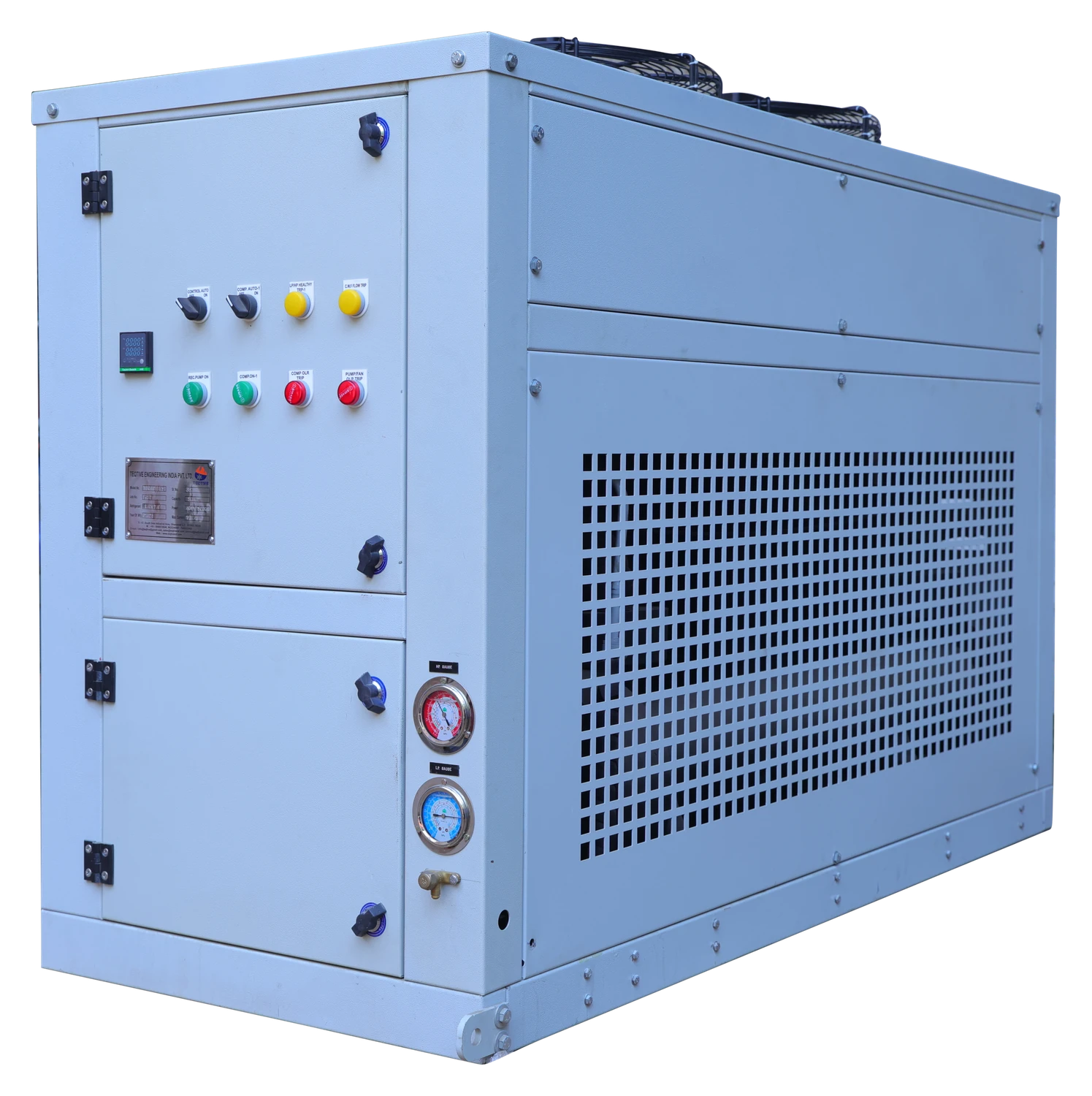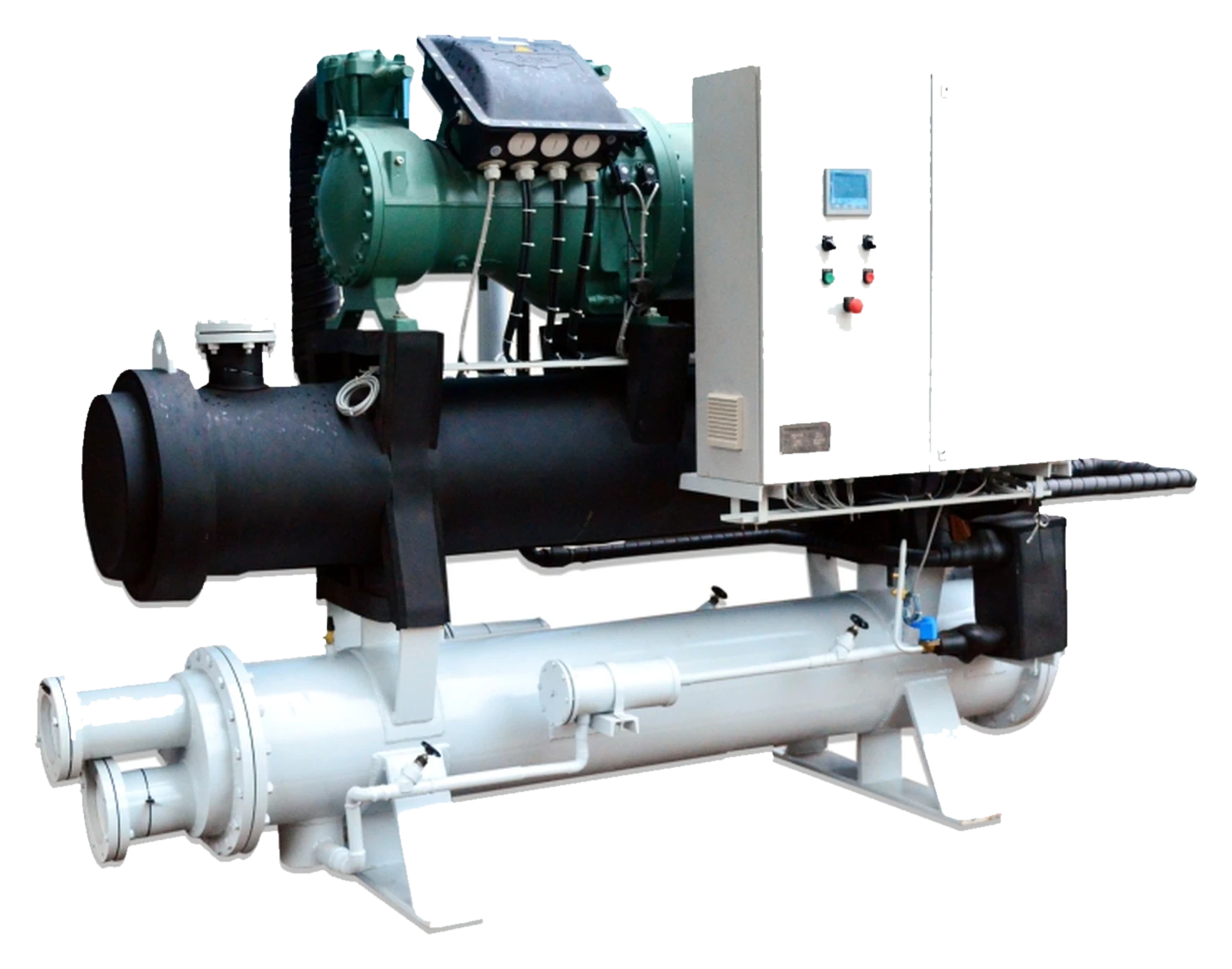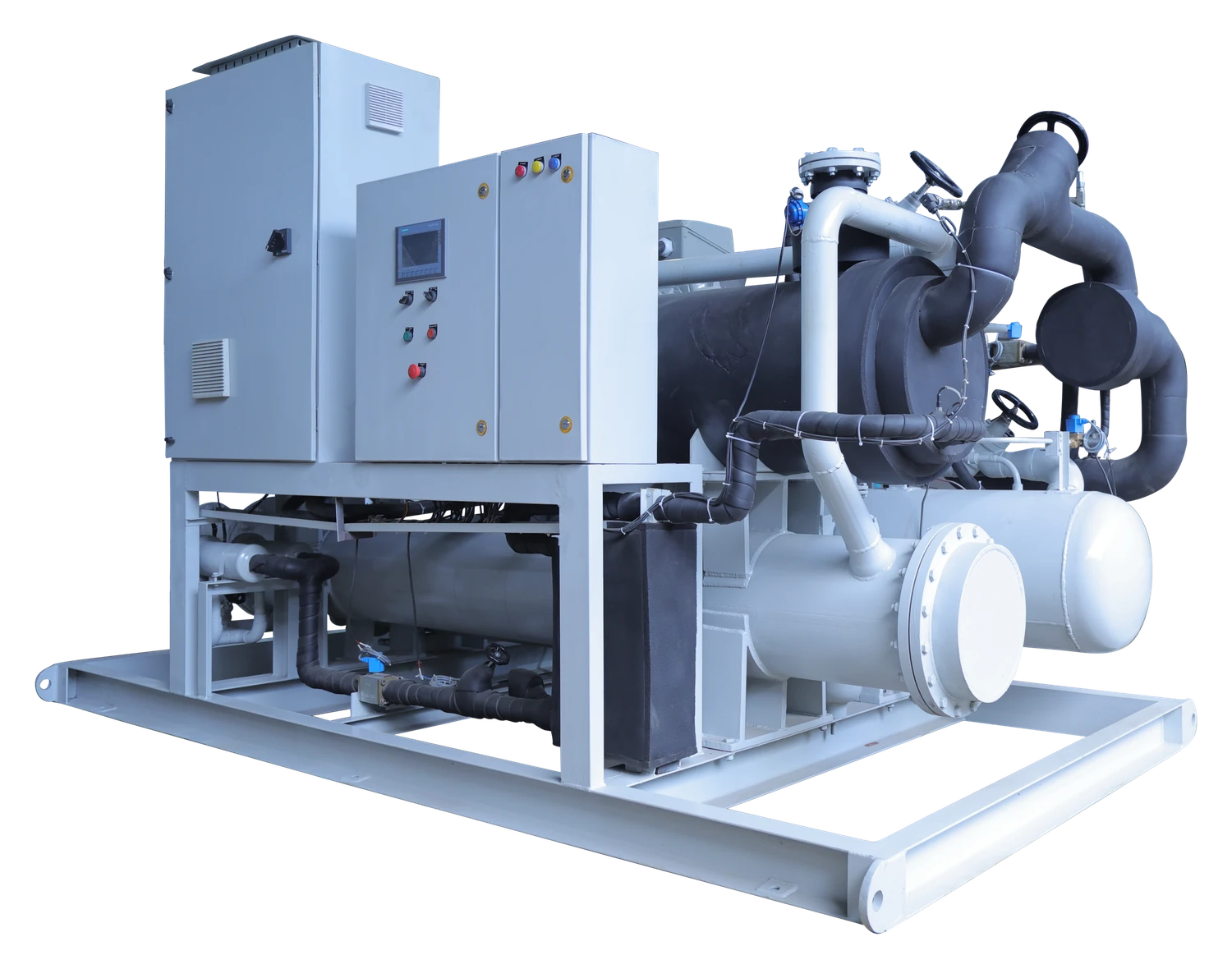
Chiller capacity is the rate at which heat must be removed from your process. In India it is usually quoted in tons of refrigeration (TR); in engineering calculations you will also see kW and kcal/h.
Units
| 1 TR equals | Value |
|---|---|
| kilowatts | 3.517 kW |
| kcal per hour | 3,024 kcal/h |
| BTU per hour | 12,000 BTU/h |
The formula
Q (kcal/h) = Flow (LPH) × Density (kg/L) × Specific heat (kcal/kg·°C) × ΔT (°C)
then TR = Q ÷ 3,024.
For water, density ≈ 1 kg/L and specific heat ≈ 1 kcal/kg·°C, so it simplifies to TR = LPH × ΔT ÷ 3,024. ΔT is the difference between the fluid temperature entering and leaving the chiller.
Example 1 — water
A moulding line needs 6,000 litres per hour of water cooled from 32 °C to 27 °C (ΔT = 5 °C).
Q = 6,000 × 1 × 1 × 5 = 30,000 kcal/h → 30,000 ÷ 3,024 = 9.9 TR. With a 15–20 % margin, select about 12 TR.
Example 2 — 30 % glycol
A reactor jacket needs 4,000 LPH of 30 % MEG cooled from −5 °C to −10 °C. For this mix use density ≈ 1.04 kg/L and specific heat ≈ 0.88 kcal/kg·°C.
Q = 4,000 × 1.04 × 0.88 × 5 = 18,304 kcal/h → 6.1 TR at −10 °C. Remember this is capacity at −10 °C; the chiller's rating at +7 °C will be much higher. See brine vs glycol.
Chiller tonnage calculator
Sizing from the process side
- Machine data — many injection moulding, laser and CNC machines state the heat to be removed in kW; divide by 3.517 for TR.
- Product cooling — Q = mass flow (kg/h) × specific heat × temperature drop, plus any latent heat.
- Ambient — air cooled chillers lose capacity in Indian summers; size on your design ambient (often 45 °C).
Need help?
Send us the numbers and our process team will confirm the size and recommend a scroll, screw or brine chiller. Get a sizing check · chiller price guide.