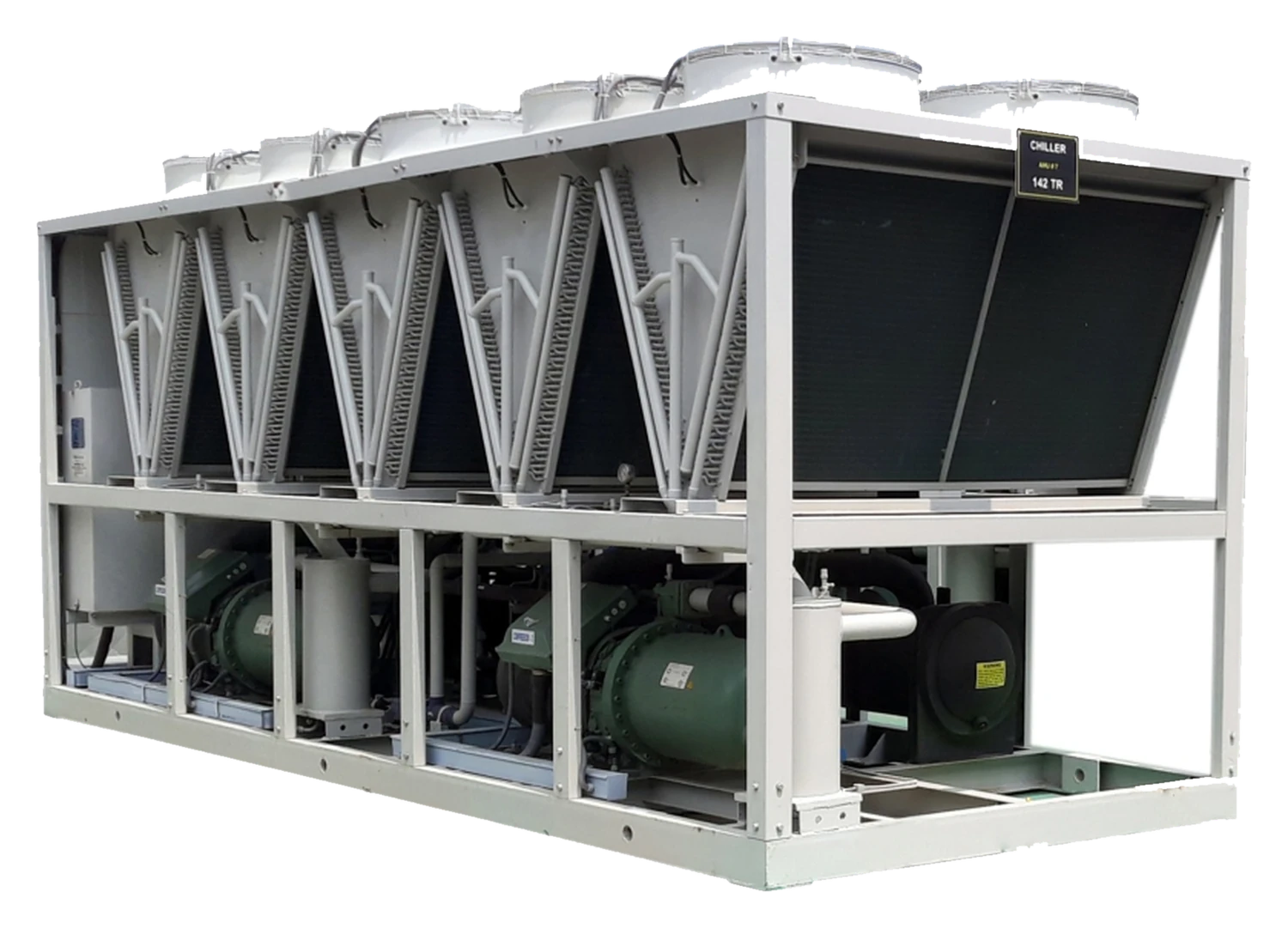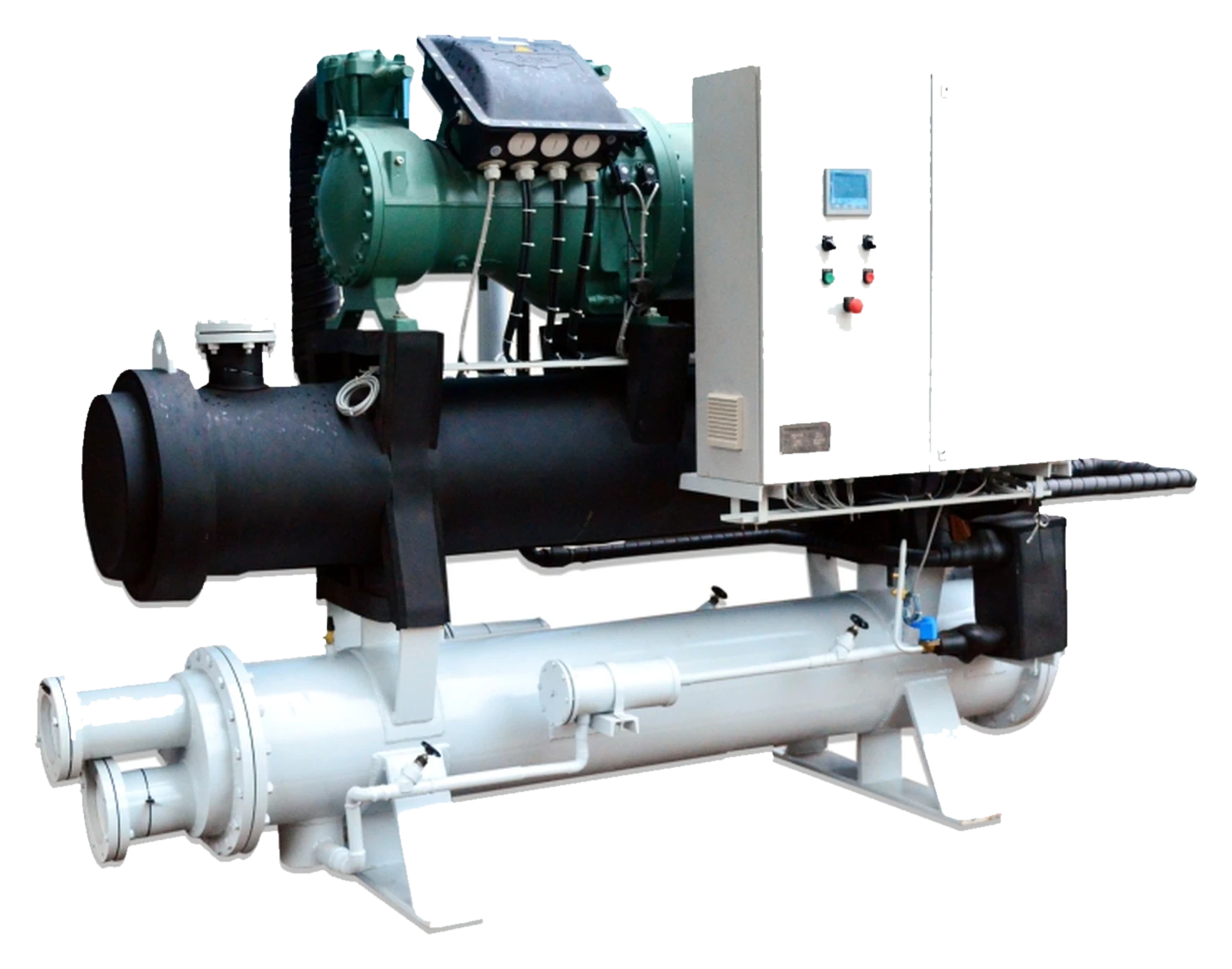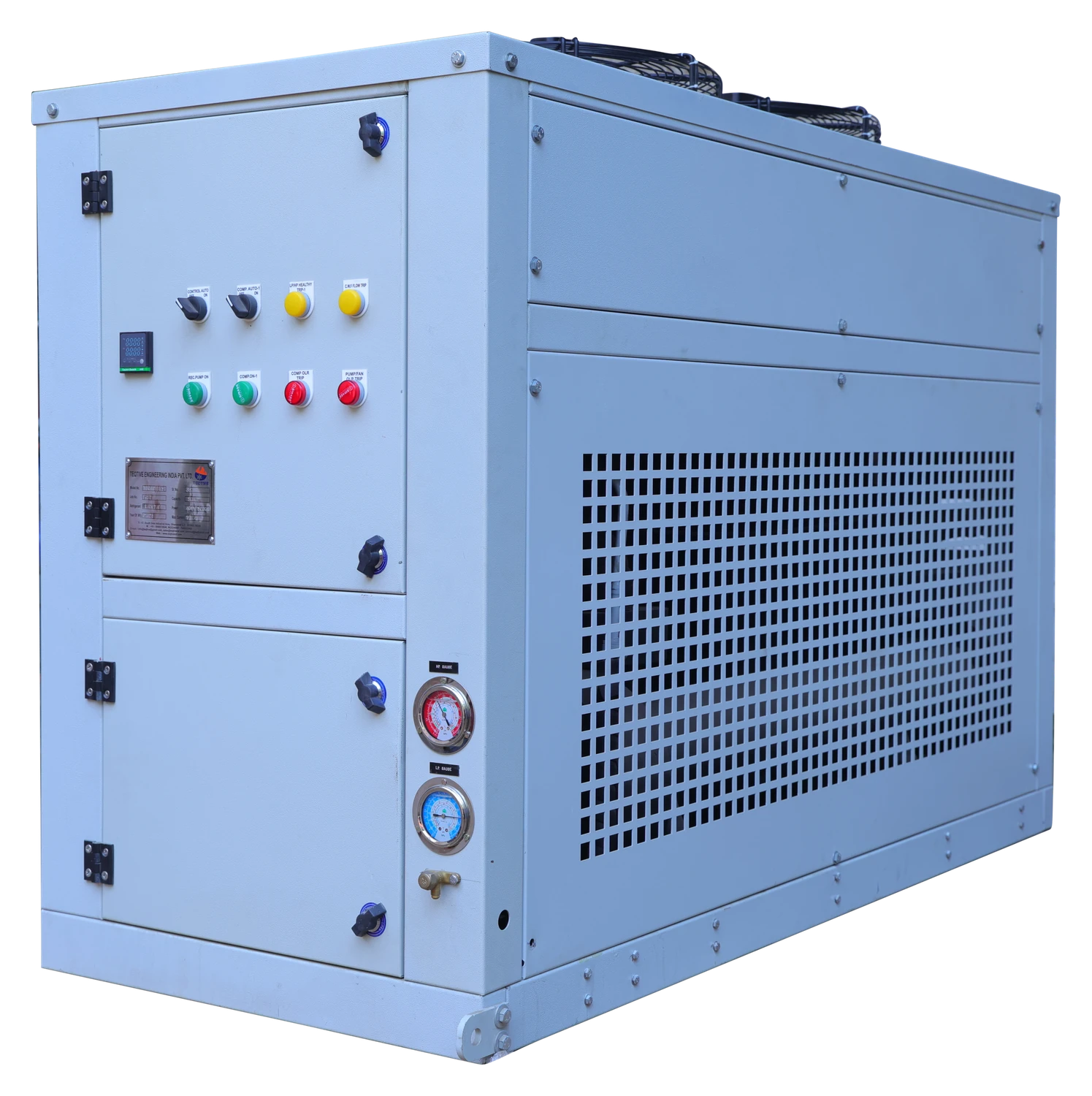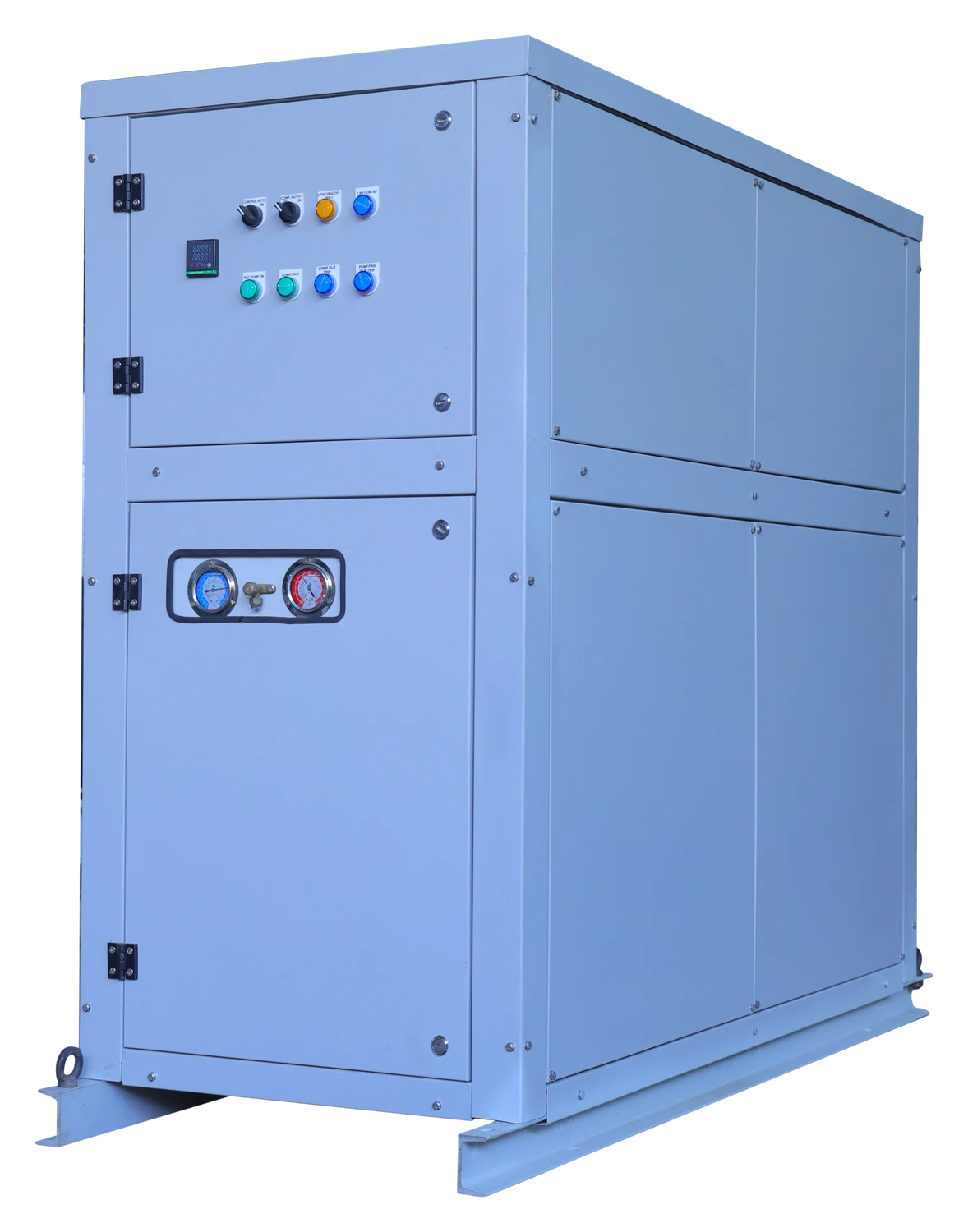
The condenser is the part of a chiller that throws the collected heat away. An air cooled chiller throws it into the air with fans; a water cooled chiller throws it into a stream of cooling-tower water. That one difference drives almost every other trade-off in the selection.
Side-by-side comparison
| Factor | Air cooled chiller | Water cooled chiller |
|---|---|---|
| Heat rejection | Finned coils + fans, to ambient air | Shell-and-tube condenser + cooling tower |
| Power per TR | Higher — condenses 10–15 °C above dry-bulb | Lower — condenses a few degrees above tower water, itself near wet-bulb |
| Typical saving | — | 20–30 % less kW/TR in Indian conditions |
| Capital cost | Lower overall (no tower, tower pumps or treatment) | Chiller slightly cheaper, but add tower, pumps, piping, treatment |
| Water consumption | None | ≈ 6–8 L/h per TR make-up |
| Footprint | Larger chiller, usually outdoor or on roof | Compact chiller indoors; tower outdoors |
| Noise | Fans — higher | Lower at the chiller; tower fans outdoors |
| Maintenance | Coil cleaning; fan motors | Tower cleaning, chemical dosing, condenser tube descaling |
| Summer performance | Capacity falls at 42–45 °C ambient | Stable — limited by wet-bulb, not dry-bulb |
| Typical size range | 1–200 TR | 40–1000 TR |
Where the break-even falls
In most Indian plants the crossover is between 60 and 120 TR. Below it, the extra kilowatts of an air cooled unit cost less over the machine's life than a tower, pumps, treatment contract and water bill. Above it, the energy saving of water cooling pays back the tower in two to four years, sooner where power tariffs are high or the plant runs round the clock. Three things pull the break-even down toward water cooling: 24-hour operation, ambient above 40 °C for several months, and an existing cooling-tower circuit with spare capacity. Three things push it up toward air cooling: water scarcity or hard water, a short operating season, and no space for a tower.
What Indian ambient conditions do to each
Ghaziabad, Delhi and much of North India see 44–46 °C dry-bulb in May and June. An air cooled chiller selected at a nominal 35 °C will be short of capacity on exactly the days the process needs it most — so always select at the real design ambient and allow for the condenser coils fouling with dust. A water cooled chiller rides on wet-bulb, which rarely exceeds 28–30 °C even in the worst weeks, so its capacity barely moves. In the humid monsoon the tower loses some approach, but the chiller still condenses cooler than an air cooled machine would.
Low-temperature duty changes the picture
For brine and glycol chillers at −20 °C and below, the compressor already works against a high pressure ratio. Adding a hot air cooled condenser on top raises discharge temperatures and pulls capacity down further. That is why Teqtive recommends water cooled condensing for most sub-zero duties above about 30 TR, and why two-stage and cascade chillers are almost always water cooled.
Evaporative condensers: the middle path
An evaporative condenser sprays water over the condenser coil and blows air through it, combining the tower and condenser in one unit. It gives water-cooled efficiency with less piping and a smaller water circuit, and is common on ammonia plants. It still needs make-up water and treatment.
Decision checklist
- Load under 60 TR, or water scarce or hard → air cooled (scroll below ~40 TR, screw above).
- Load over 120 TR, 24-hour running, or sub-zero duty → water cooled.
- In between → compare lifetime cost: use the kW/TR figures from both quotes, your tariff, and running hours per year; add tower, pumps and treatment to the water cooled side.
- Select at the real summer ambient (dry-bulb for air cooled, wet-bulb for water cooled).
Teqtive builds both on the same platform, so the choice is yours. For indicative costs see the chiller price guide, or send us your load for a like-for-like comparison.
Frequently asked questions
Which is more efficient, an air cooled or a water cooled chiller?
A water cooled chiller is more efficient. Cooling-tower water is close to the wet-bulb temperature, so the chiller condenses at a lower temperature and the compressor does less work — typically 20–30 % less power per TR than an air cooled unit in Indian conditions.
Why would anyone choose an air cooled chiller?
Lower capital cost, no cooling tower, no make-up water, no water treatment, and simpler installation. For plants below about 100 TR, or where water is scarce or expensive, the running-cost penalty is usually smaller than the saved tower, pumps and treatment.
Does an air cooled chiller lose capacity in summer?
Yes. Capacity and efficiency fall as ambient temperature rises, because the condensing temperature rises with it. A chiller selected for 35 °C ambient can lose 10–15 % of its capacity at 45 °C, so North Indian plants should be selected at the real summer ambient.
How much water does a water cooled chiller use?
Roughly 6–8 litres per hour per TR in make-up water for evaporation, drift and blowdown. A 100 TR plant can use around 15,000–20,000 litres a day in summer.