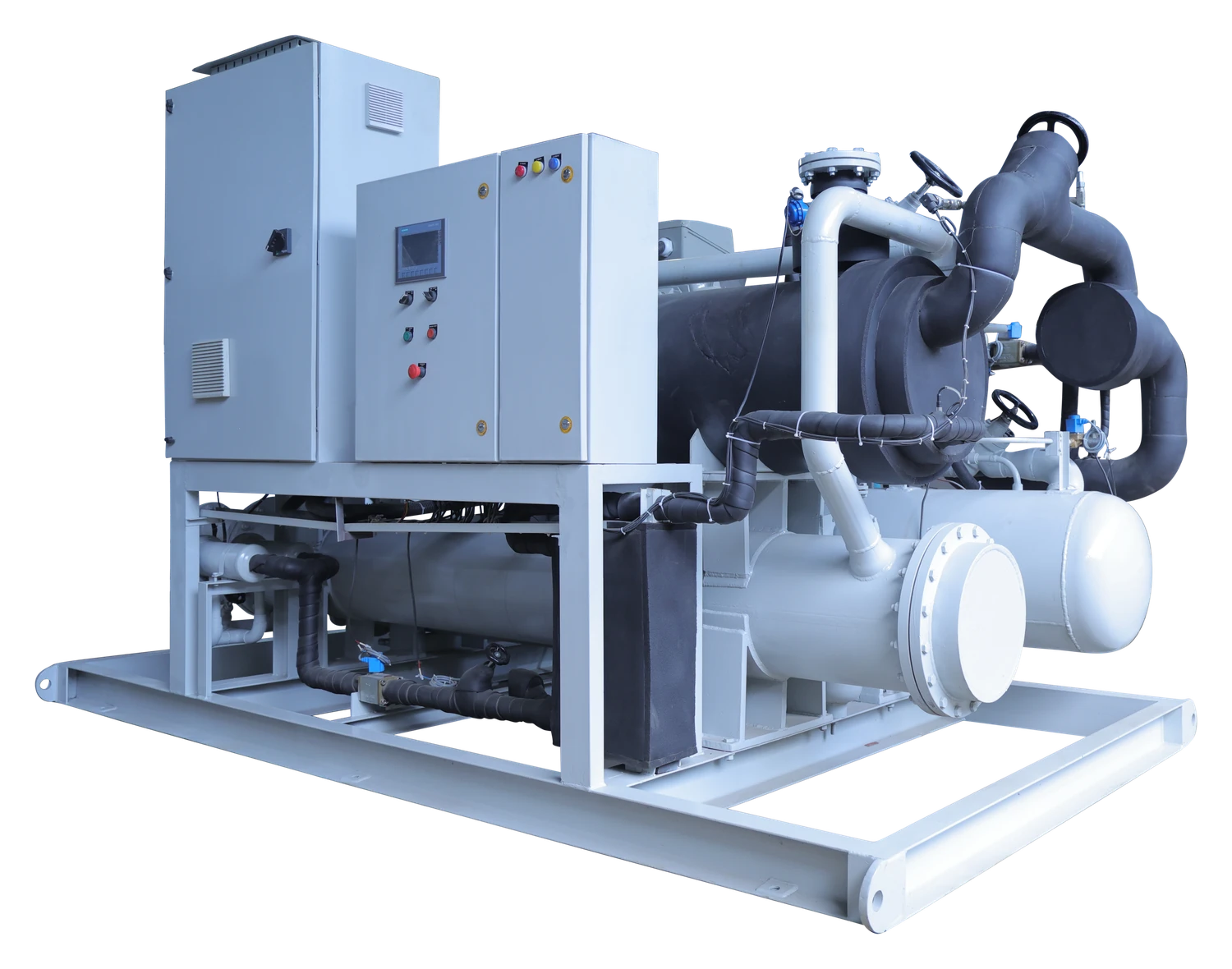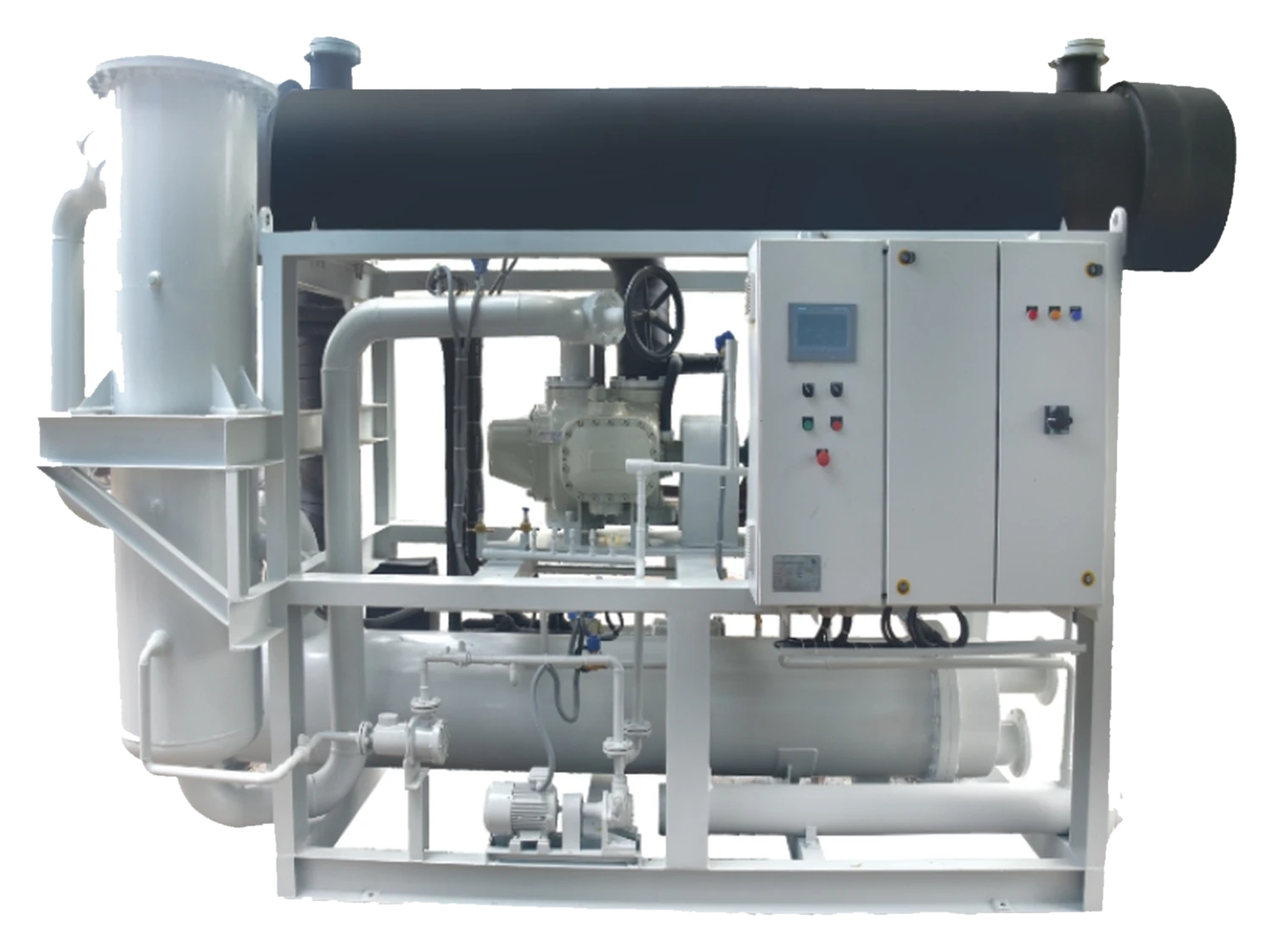
"Brine" in refrigeration means any water-based liquid that stays pumpable below 0 °C. It is the secondary coolant that carries cold from the brine chiller to reactor jackets, condensers, cold rooms and tanks. Each brine has a temperature below which it becomes too viscous or starts to freeze, and that sets the working range of the plant.
Working range by brine type
| Brine | Practical supply range | Lowest freezing point (eutectic) | Notes |
|---|---|---|---|
| Sodium chloride (NaCl) | 0 °C to −15 °C | −21 °C at about 23 % by weight | Cheap, food compatible, corrosive |
| Calcium chloride (CaCl₂) | −5 °C to −40 °C | −55 °C at about 30 % by weight | Good heat transfer, corrosive, needs inhibitor and pH control |
| Ethylene glycol (MEG) | +5 °C to −30 °C | About −50 °C near 60 % by volume | Standard industrial antifreeze; toxic |
| Propylene glycol (MPG) | +5 °C to −25 °C | About −50 °C near 60 % by volume | Food grade; more viscous than MEG |
| Methanol–water | −10 °C to −45 °C | Stays liquid far below −60 °C at high strength | Low viscosity; flammable and toxic |
| Specialist fluids (silicone oils, hydrocarbons) | −40 °C to −90 °C | Not water based | Used with cascade chillers |
Freezing point tables
Values are approximate and vary slightly between suppliers and inhibitor packages. Always confirm against the fluid supplier's data sheet.
Glycols (percent by volume)
| Concentration | Ethylene glycol | Propylene glycol |
|---|---|---|
| 20 % | −8 °C | −7 °C |
| 30 % | −15 °C | −13 °C |
| 40 % | −24 °C | −21 °C |
| 50 % | −36 °C | −33 °C |
Salt brines (percent by weight)
| Concentration | Calcium chloride | Sodium chloride |
|---|---|---|
| 10 % | −5 °C | −7 °C |
| 15 % | −10 °C | −11 °C |
| 20 % | −18 °C | −17 °C |
| 23 % | −25 °C | −21 °C (eutectic) |
| 25 % | −29 °C | Do not exceed 23 % |
| 30 % | −55 °C (eutectic) | — |
Methanol–water (percent by weight)
| Concentration | Approximate freezing point |
|---|---|
| 20 % | −15 °C |
| 30 % | −26 °C |
| 40 % | −39 °C |
| 50 % | −54 °C |
Salt brines have a eutectic point: past that concentration the freezing point rises again as salt crystallises out. Stronger is not always colder.
Choosing the concentration
The coldest place in the system is the evaporator tube wall, not the supply header. Refrigerant evaporates about 5 °C below the brine outlet temperature, so set the freezing point about 10 °C below the brine outlet. For −15 °C brine that means a freezing point near −25 °C: about 40 % MEG, 23 % CaCl₂ or 30 % methanol. Check strength monthly with a refractometer or hydrometer, because leaks topped up with water dilute the brine and lead straight to a frozen evaporator, one of the faults listed in the chiller troubleshooting guide.
What strength costs you
- Lower specific heat. 40 % glycol carries about 15 % less heat per kilogram than water, so flow rates must rise for the same duty.
- Higher viscosity. At −20 °C, 45 % MEG is many times thicker than water. Pump head rises and heat transfer falls, so evaporators and heat exchangers must be larger.
- Capacity correction. Chiller ratings must be for the actual fluid and concentration. Use the correct density and specific heat when you calculate tonnage.
How a brine circuit is laid out
- Brine chiller with evaporator sized for the fluid.
- Insulated brine tank, often divided into warm return and cold supply compartments, giving thermal storage for batch peaks.
- Primary pump circulating tank to chiller, and secondary pumps sending cold brine to users.
- Users: reactor jackets, condensers, heat exchangers, air coolers, each with a control valve.
- Return header to the warm side of the tank.
- Expansion and make-up arrangement, strainers, air vents, and insulation with a continuous vapour barrier on every cold surface.
Materials follow the brine: carbon steel with inhibitors is common for glycol and calcium chloride, stainless steel where corrosion or product purity matters, and no galvanised pipe with glycol. Open tanks let calcium chloride absorb air and become more corrosive, so closed tanks are preferred.
Typical plant utilities
| Utility | Supply temperature | Typical fluid | Chiller type |
|---|---|---|---|
| Chilled water | +5 °C to +10 °C | Water | Scroll or screw water chiller |
| Chilled brine | −5 °C to −20 °C | Glycol or CaCl₂ | Single-stage brine chiller |
| Low-temperature brine | −25 °C to −45 °C | Methanol–water or CaCl₂ | Two-stage brine chiller |
| Ultra-low temperature | −45 °C to −70 °C | Methanol or specialist fluid | Cascade brine chiller |
The fluid choice in more depth is in brine vs glycol chiller, and the machine itself in brine chiller working principle.
Teqtive brine chillers
Teqtive builds brine chillers for 0 °C to −40 °C, two-stage chillers for −25 °C to −45 °C and cascade chillers for −35 °C to −70 °C, for glycol, methanol and calcium chloride brines. Tell us the temperature you need at the user and we will recommend the brine, concentration and chiller.
Frequently asked questions
What is the temperature range of chilled brine?
Chilled brine is typically supplied between 0 °C and −40 °C. Sodium chloride brine works to about −15 °C, glycol solutions to about −30 °C, calcium chloride brine to about −40 °C and methanol–water to about −45 °C. With cascade refrigeration and suitable heat-transfer fluids the range extends to −70 °C and below.
What is the difference between chilled water and chilled brine?
Chilled water is plain water supplied at about +5 °C to +12 °C. Chilled brine is water with a freezing-point depressant, such as salt, glycol or methanol, so that it stays liquid below 0 °C. Plants usually name the utility by temperature: chilled water at +7 °C, chilled brine at −10 °C to −20 °C, and low-temperature brine at −35 °C to −40 °C.
How strong should the brine be?
Strong enough that its freezing point is about 10 °C below the brine outlet temperature. This covers the refrigerant inside the evaporator, which is typically 5 °C colder than the brine, with a further safety margin. Making the brine stronger than that wastes pump power and reduces heat transfer.
Which brine is best for −20 °C?
Calcium chloride brine at about 25 % is economical and has good heat transfer but is corrosive and needs inhibitors. Ethylene glycol at about 45 % is cleaner and less corrosive but more viscous. Methanol–water at about 30 % has the lowest viscosity but is flammable and toxic, so it suits plants already rated for solvents.