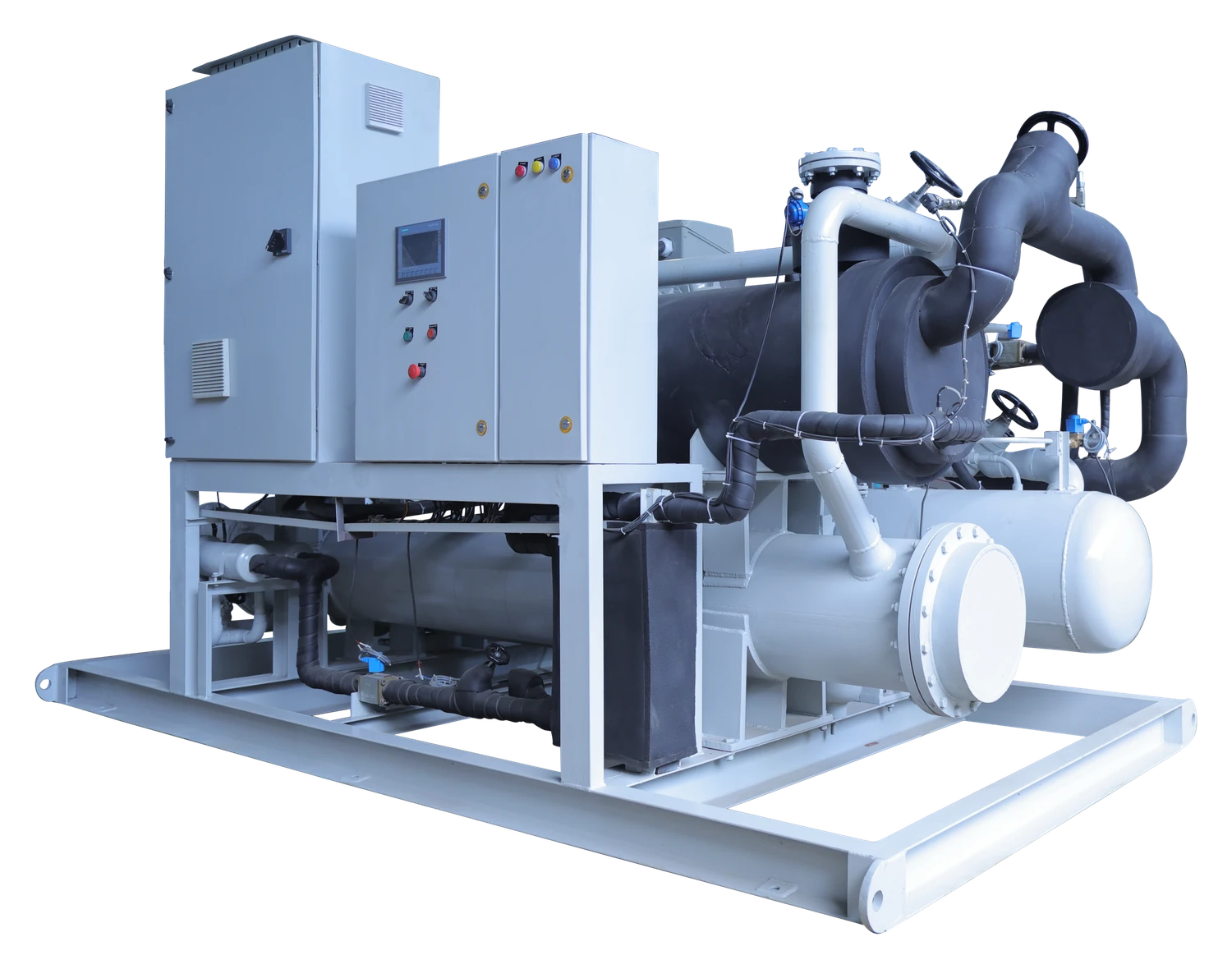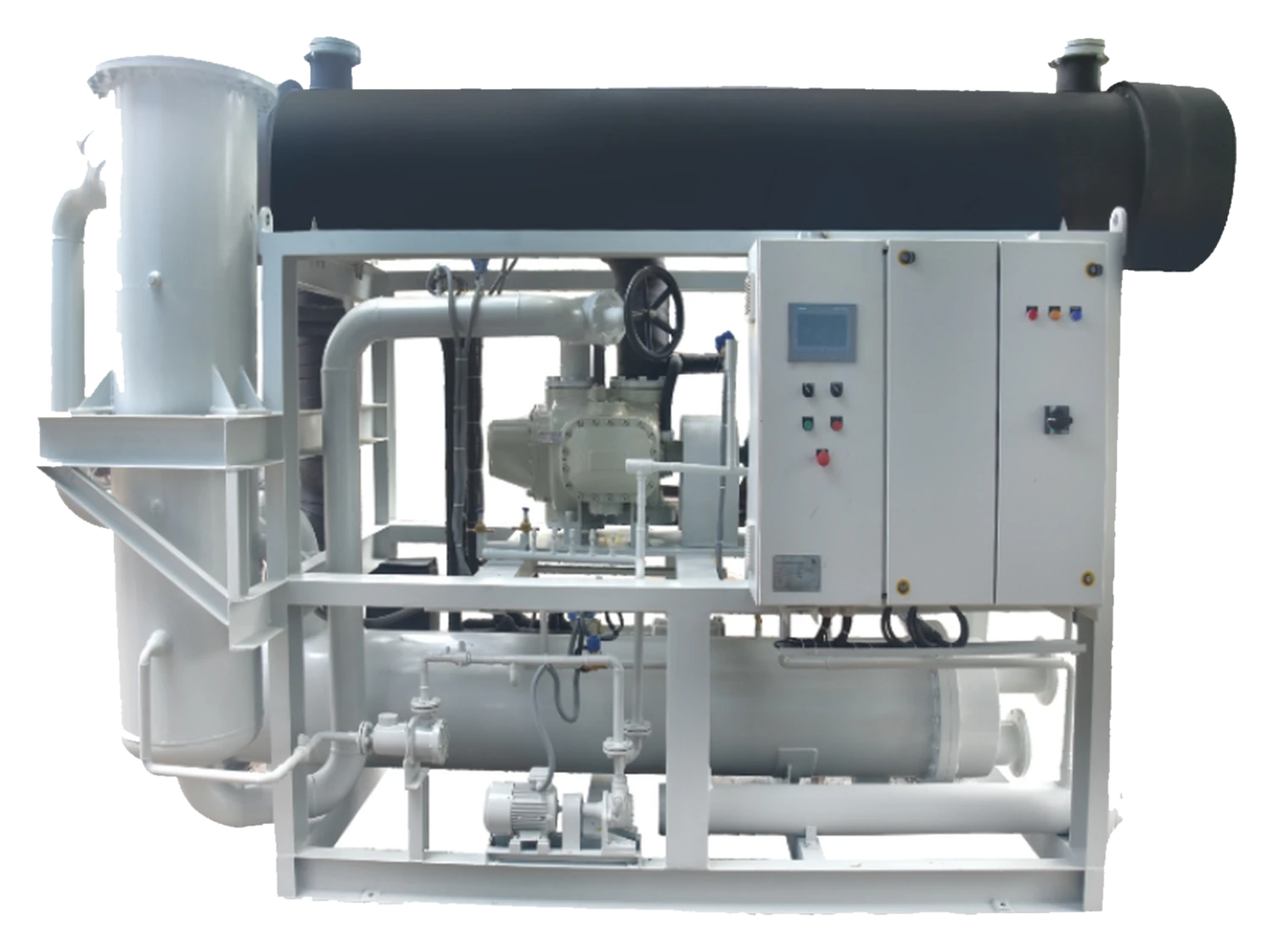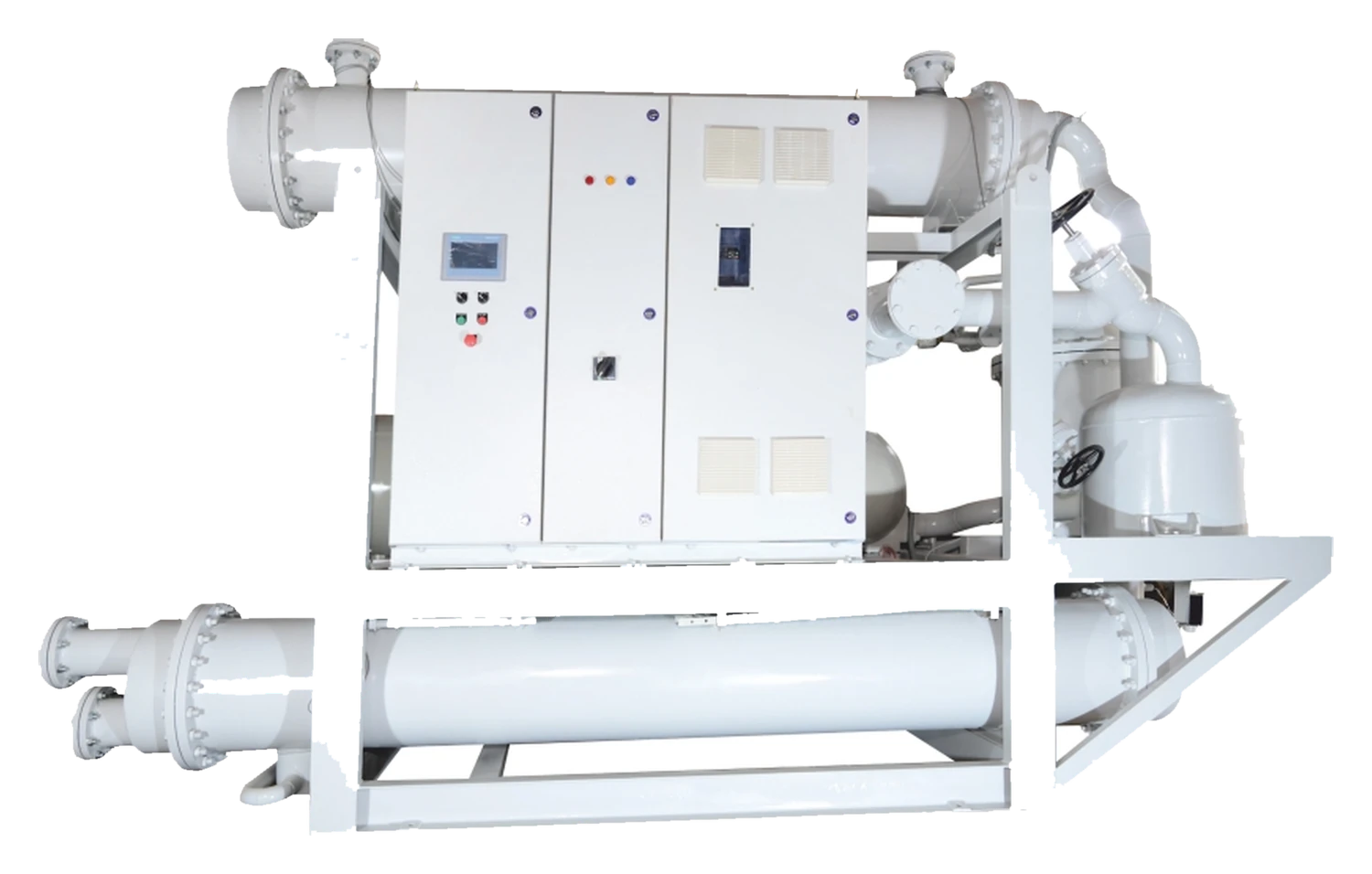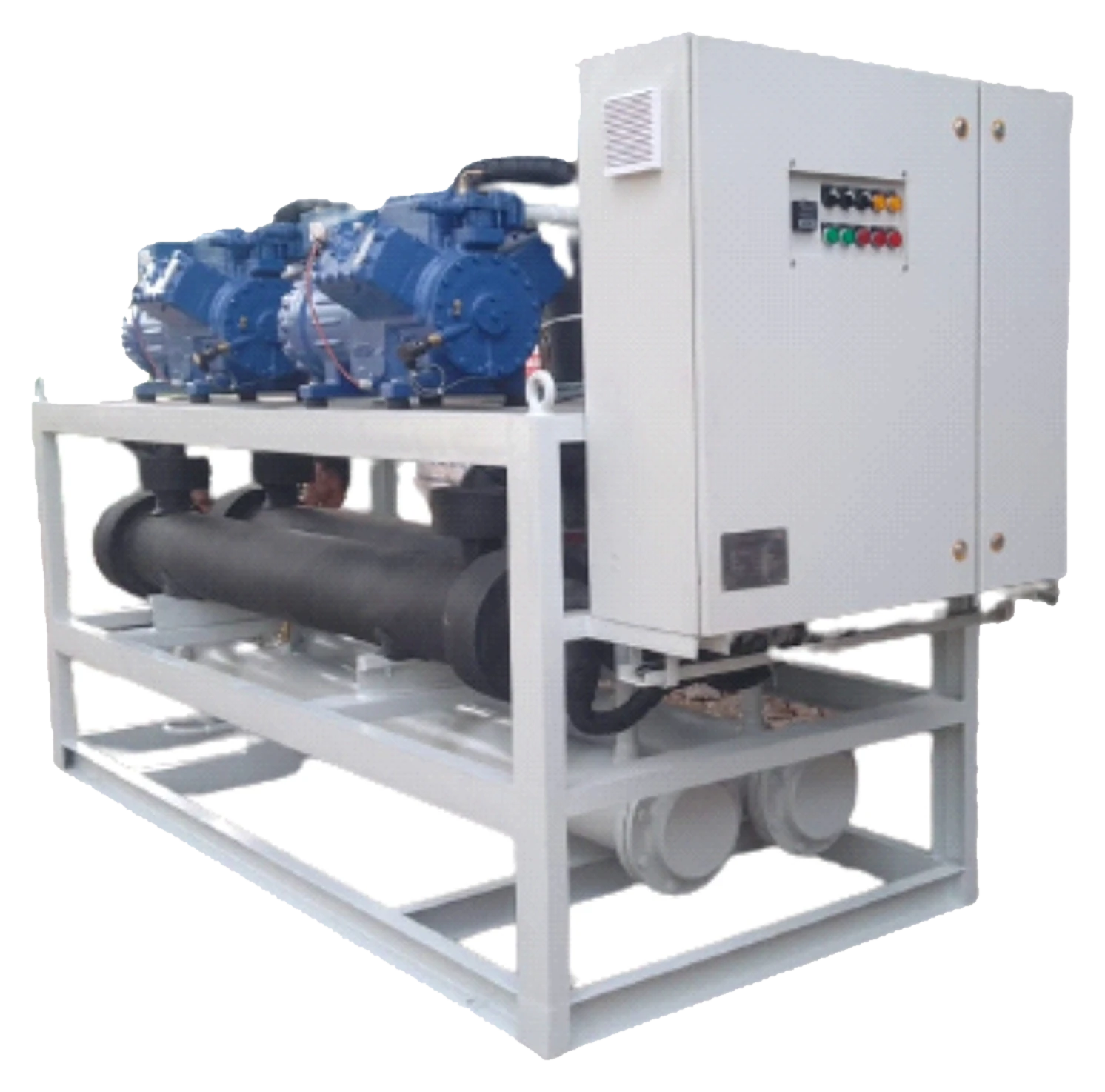
In Indian industry "brine chiller" is shorthand for any process chiller that works below the freezing point of water. The name comes from the salt brines that ice factories used a century ago, but today the "brine" is just as likely to be glycol or methanol. What all brine chillers share is a refrigeration circuit designed for low evaporating temperatures and a coolant loop built to carry a liquid that will not freeze.
What is inside a brine chiller
- Compressor — reciprocating (open or semi-hermetic) or screw, selected for the high pressure ratio of sub-zero duty. Scroll compressors are used only for small, mild duties above about −15 °C.
- Condenser — water cooled shell-and-tube in most sizes, or air cooled for small units; see air cooled vs water cooled.
- Expansion valve — thermostatic or electronic, sized for the low suction pressure.
- Evaporator — shell-and-tube with the brine inside the tubes (dry-expansion) or refrigerant flooded around them, in carbon steel, stainless steel or copper depending on the brine. An antifreeze thermostat and a flow switch protect it from freezing solid.
- Brine tank and pump — an insulated tank buffers the process load; a centrifugal pump with a low-temperature seal circulates the brine.
- Insulation — all cold surfaces are insulated with PUF or nitrile rubber and vapour-sealed, otherwise frost and ice form and heat leaks in.
How the cycle works at −25 °C
Take a chiller delivering brine at −25 °C. The refrigerant must boil colder than that — around −30 °C to −32 °C — so the evaporator runs at a low suction pressure. The compressor draws in this thin, cold vapour, compresses it to the condensing pressure (about 40 °C with tower water), and the hot gas is condensed back to liquid. The liquid passes through the expansion valve, flashes down to −30 °C, and re-enters the evaporator. Meanwhile the brine enters the evaporator at perhaps −20 °C from the process, leaves at −25 °C, and is pumped back to the reactor jacket or cold room. The full cycle is explained in how an industrial chiller works.
Why a brine chiller needs a bigger compressor
At −30 °C evaporating the refrigerant vapour is far less dense than at +2 °C, so each compressor stroke moves less mass and removes less heat, while the pressure ratio roughly doubles. The result is that the same compressor delivers only a fraction of its +5 °C tonnage — and the brine itself carries less heat per litre than water. Both effects are built into the selection, which is why a brine chiller must always be quoted as "X TR at Y °C brine outlet", never as a bare tonnage. Our tonnage guide shows how the numbers move.
The brines
| Brine | Usable to about | Where it is used |
|---|---|---|
| Calcium chloride (CaCl₂) | −45 °C | Ice plants, cold stores, fish freezing — cheap and effective but corrosive to carbon steel |
| Sodium chloride (NaCl) | −18 °C | Older ice plants; limited range |
| Monoethylene glycol (MEG) | −35 °C | Chemical, pharma, plastics, dairy utility loops |
| Monopropylene glycol (PEG/MPG) | −30 °C | Food, beverage and dairy where contact with product is possible |
| Methanol–water | −40 °C and below | Pharma API reactors and vent condensers |
Choosing between them is covered in brine vs glycol chiller. Dedicated pages: glycol chillers and methanol chillers.
Single stage, two stage or cascade?
- Single-stage brine chiller — 0 °C to about −40 °C. The standard Teqtive brine chiller.
- Two-stage brine chiller — −25 °C to −45 °C. Two compression stages with an intercooler keep discharge temperatures safe and recover efficiency: two-stage brine chiller.
- Cascade brine chiller — −35 °C to −70 °C. A high-temperature circuit condenses a separate low-temperature circuit running a different refrigerant: cascade brine chiller.
Typical applications
- Pharma reactor jackets & crystallisers
- Chemical vent & solvent condensers
- Cold stores & blast freezers
- Ice plants & fish processing
- Dairy & ice-cream hardening
- Plastic & rubber moulding at sub-zero
- Lyophilisers & freeze dryers
What to specify
Heat load in TR or kW, brine type and concentration, outlet temperature and ΔT, flow rate, condenser type and site ambient, and any hazardous-area or GMP requirement. With those, Teqtive's process team can select the compressor, evaporator material and insulation, and confirm whether single-stage, two-stage or cascade is right for you.
Frequently asked questions
What is a brine chiller?
A brine chiller is an industrial chiller that cools a secondary coolant with a freezing point below 0 °C — calcium chloride or sodium chloride brine, ethylene or propylene glycol, or methanol–water — and circulates it to reactors, condensers, cold rooms or freezers. Typical outlet temperatures run from 0 °C to −40 °C in a single stage.
How does a brine chiller work?
It runs the standard vapour-compression cycle, but with the evaporator held well below 0 °C. The refrigerant boils at, say, −30 °C inside a shell-and-tube evaporator while brine flowing through the tubes is cooled to −25 °C. The brine is pumped from an insulated tank to the process and returns warmer to be re-cooled.
What is the difference between a brine chiller and a water chiller?
A water chiller delivers +5 °C to +20 °C and uses plain water. A brine chiller delivers 0 °C to −40 °C, so it needs a freeze-proof coolant, a larger compressor for the same tonnage, thicker insulation, antifreeze protection on the evaporator, and corrosion-resistant materials where salt brine is used.
Which brine is used in a brine chiller?
Calcium chloride brine for −20 °C to −45 °C in ice plants and cold stores; ethylene glycol for +5 °C to −35 °C in chemical and pharma plants; propylene glycol where food contact is possible; and methanol–water for −30 °C to −40 °C and below in pharma API reactors.