Every industrial chiller, from a 1 TR scroll unit on an injection-moulding machine to a 500 TR ammonia plant, works on the same principle: a refrigerant is made to boil at a low temperature, where it absorbs heat from your process fluid, and then made to condense at a high temperature, where it gives that heat away. The compressor is what moves the refrigerant between those two states.
The four parts of the refrigeration cycle
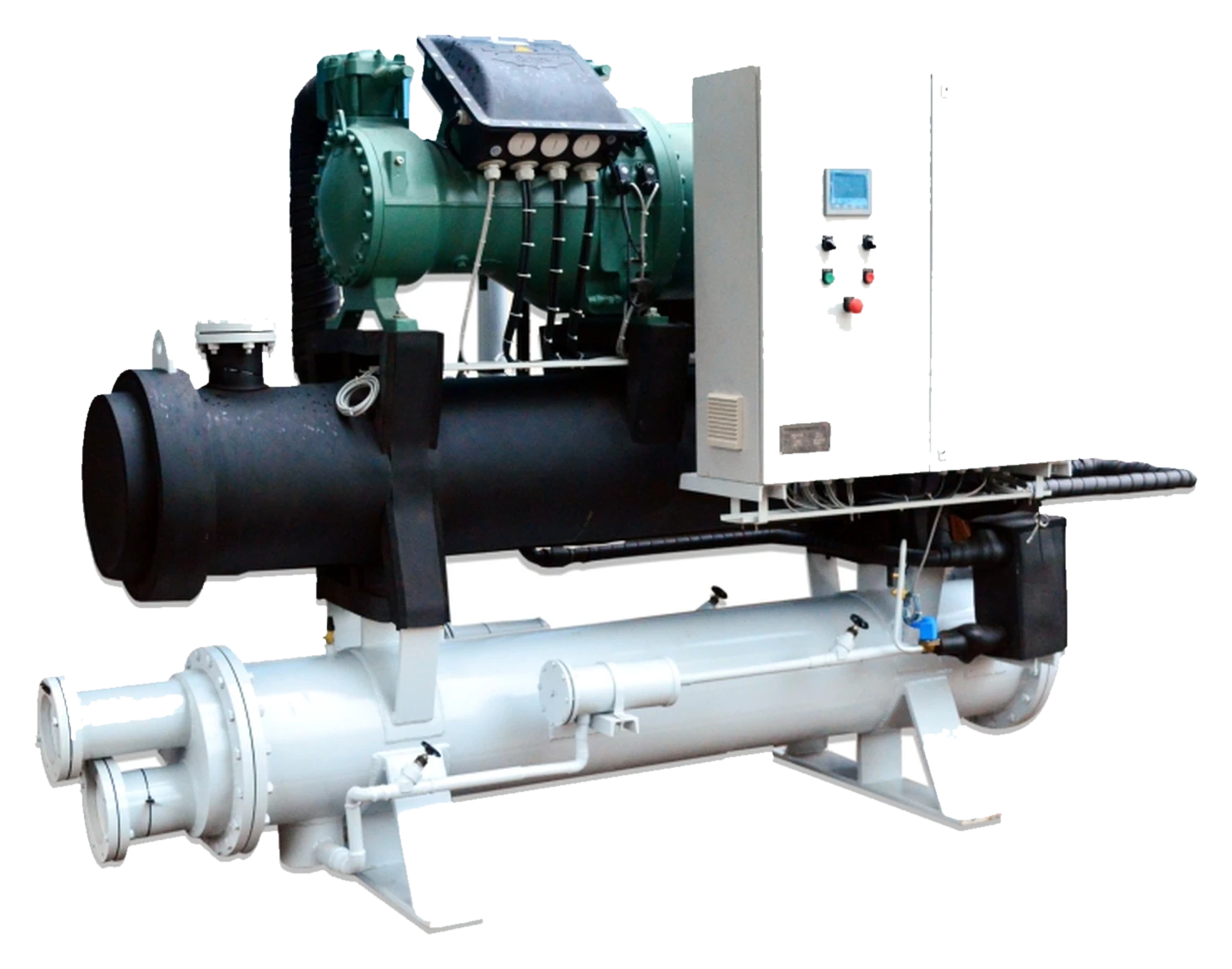
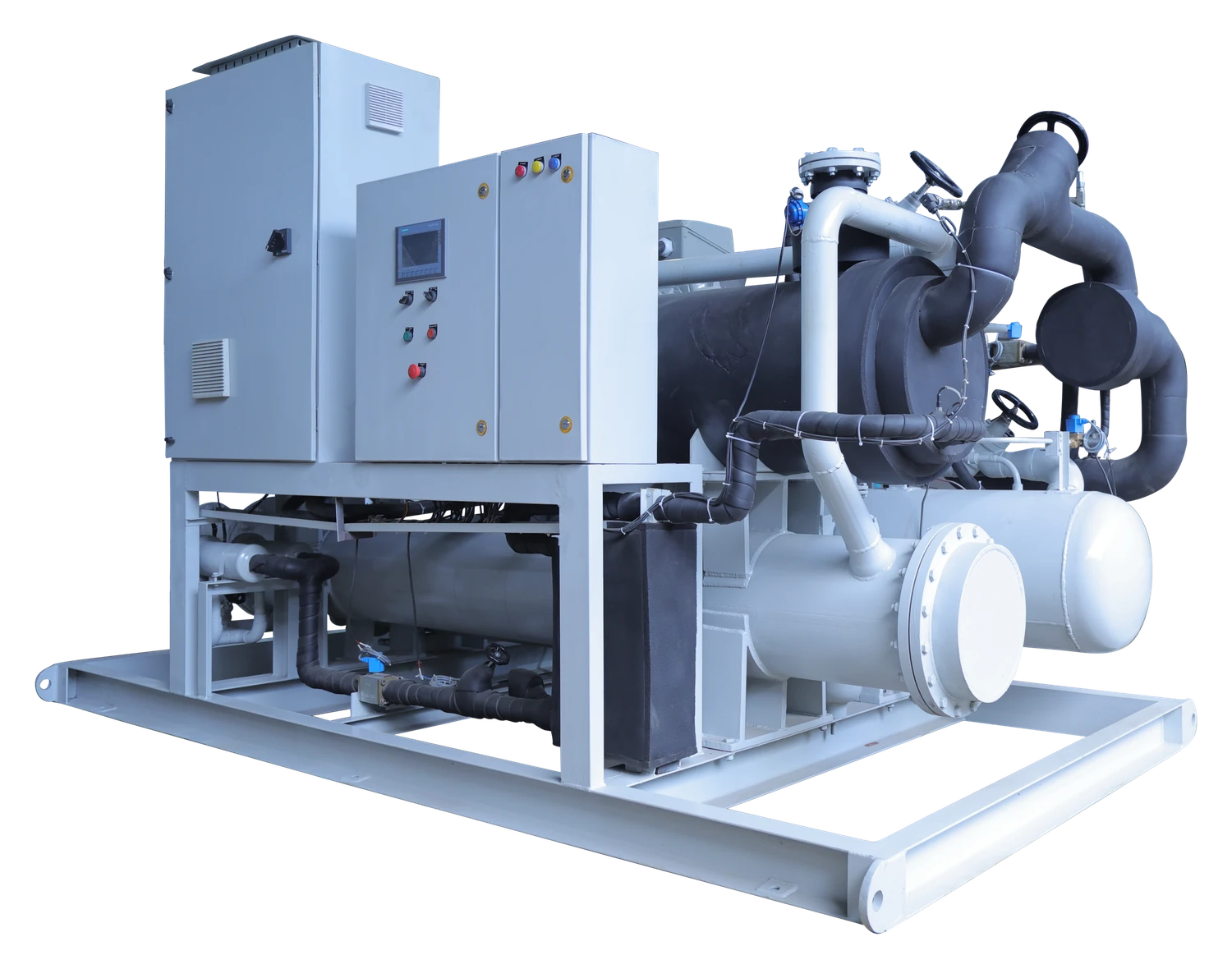
- Compressor. Draws in low-pressure refrigerant vapour from the evaporator and compresses it. Pressure and temperature both rise sharply — a hot gas at 60–90 °C leaves the discharge. Industrial chillers use scroll, screw or reciprocating compressors depending on size and duty.
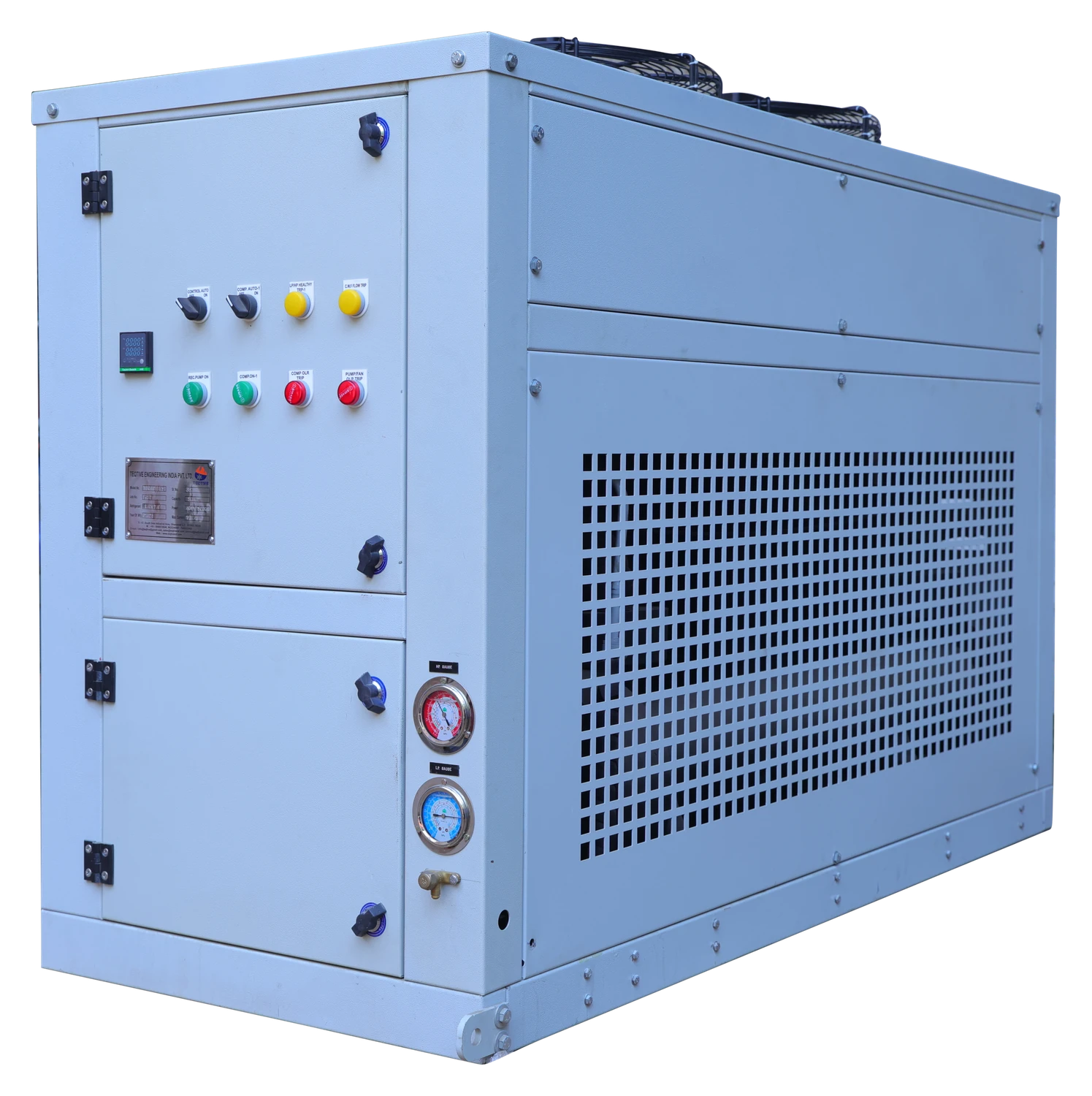
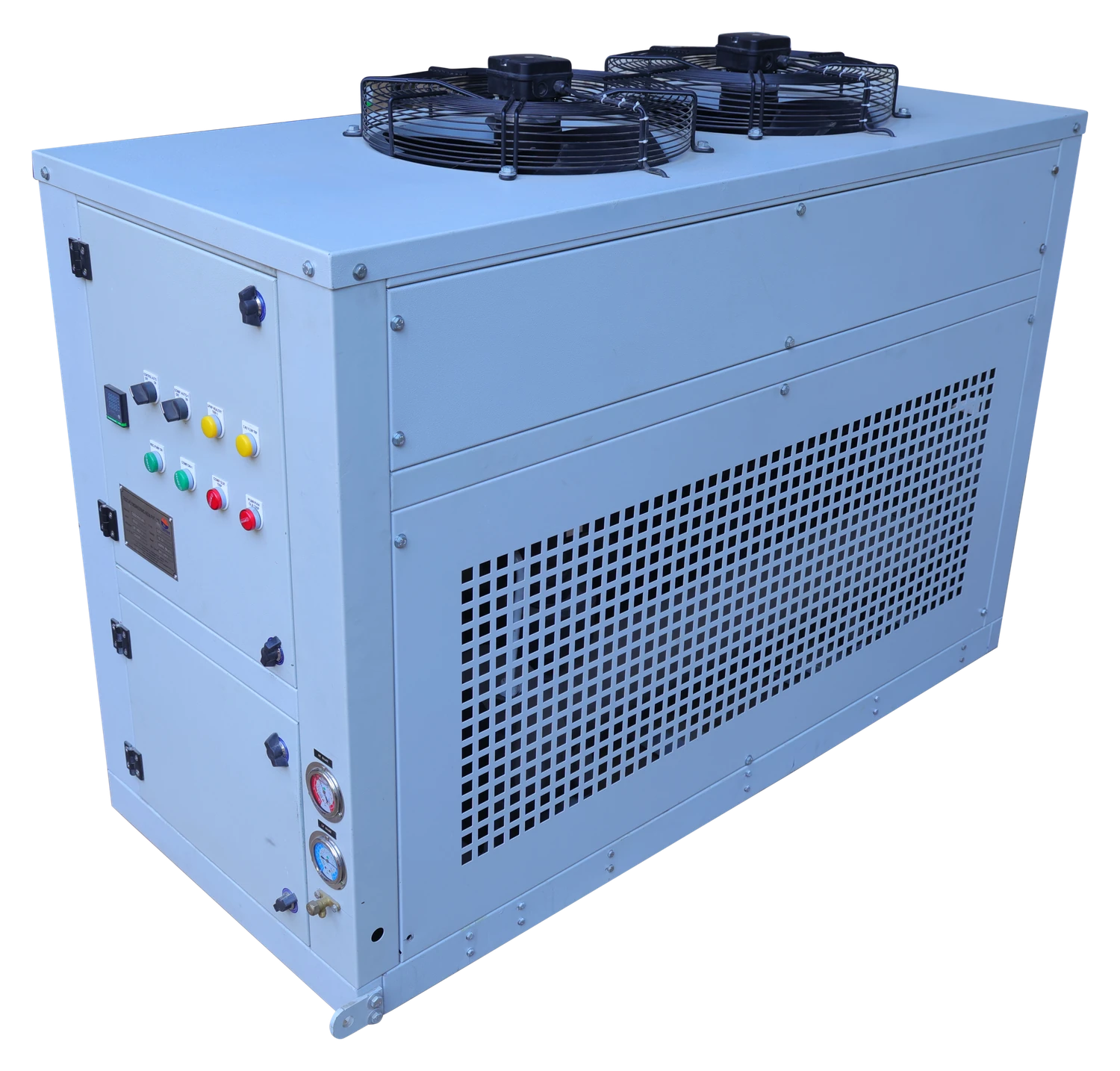
- Condenser. The hot gas is cooled until it condenses back to liquid. In an air-cooled chiller fans blow ambient air over finned coils; in a water-cooled chiller the gas condenses inside a shell-and-tube condenser fed by cooling-tower water. The heat removed here is the process heat plus the compressor's own work.
- Expansion valve. High-pressure liquid passes through a thermostatic or electronic expansion valve. The pressure drops suddenly, part of the liquid flashes to vapour, and the mixture leaves at the low evaporating temperature — for example −5 °C for a 0 °C brine duty.
- Evaporator. The cold refrigerant boils inside a shell-and-tube or brazed-plate heat exchanger while your process water, brine or glycol flows on the other side and is cooled. The vapour then returns to the compressor and the cycle repeats.
The second loop: the coolant circuit
The refrigerant never leaves the chiller. What reaches your process is the secondary coolant — chilled water, brine, glycol, methanol or oil — circulated by a pump from an insulated tank through the evaporator and out to the jackets, moulds, heat exchangers or condensers on the plant floor. This loop is what the chiller is actually sized on: flow rate, inlet temperature and outlet temperature. Our tonnage guide shows the arithmetic.
| Process requirement | Coolant used | Teqtive chiller type |
|---|---|---|
| +5 °C to +20 °C water | Plain water | Water chillers (scroll, screw, reciprocating) |
| 0 °C to −40 °C | Glycol, salt brine or methanol | Brine / glycol / methanol chillers |
| −35 °C to −70 °C | Methanol, CaCl₂ brine, silicone fluids | Two-stage and cascade chillers |
| Hydraulic / spindle oil | Oil itself | Oil chillers |
How a chiller controls its capacity
Process load is rarely constant, so the chiller has to throttle itself. The common methods, in order of refinement:
- On–off cycling of the compressor against a tank temperature band — simple scroll units.
- Staging several compressors or circuits, switching them in and out as load changes.
- Cylinder unloading on reciprocating compressors, which cuts capacity in steps of roughly 25 %.
- Slide-valve unloading on screw compressors, which modulates smoothly from about 25 % to 100 %.
- Variable-speed drives, which reduce compressor speed and give the best part-load efficiency.
Why evaporating temperature decides everything
The single most important number in a chiller is the evaporating temperature. The colder the refrigerant has to boil, the less dense its vapour, so each compressor stroke moves less refrigerant and removes less heat — while the pressure ratio the compressor must work against rises. That is why the same compressor can be rated 100 TR at +5 °C water and well under 40 TR at −30 °C brine, and why deep sub-zero duty moves to two-stage and cascade designs. It is also why a chiller must be specified on the real outlet temperature, not on a nominal catalogue tonnage.
Safeties and controls you will find on a Teqtive unit
- High / low pressure cut-outs
- Oil pressure or oil-level protection
- Antifreeze thermostat on the evaporator
- Flow switch on the coolant loop
- Phase-failure and overload relays
- PLC or microprocessor controller with alarms
Choosing the right type
Once you know the outlet temperature and heat load, the remaining choices are the condenser (air cooled vs water cooled), the compressor (screw vs scroll) and the coolant (brine vs glycol). Our guide to the types of industrial chillers puts them side by side, and the process team at Teqtive is happy to check a selection before you buy.
Frequently asked questions
What is the working principle of an industrial chiller?
An industrial chiller uses the vapour-compression refrigeration cycle. A compressor raises the pressure of refrigerant vapour, a condenser rejects heat and turns it into liquid, an expansion valve drops its pressure and temperature, and an evaporator absorbs heat from the process water, brine or glycol. The cooled fluid is then pumped to the process.
What is the difference between a chiller and an air conditioner?
Both use the same refrigeration cycle. An air conditioner cools air directly; a chiller cools a liquid (water, brine, glycol or oil) that is piped to machines, reactors or heat exchangers. Chillers also run across a much wider temperature range, from +25 °C down to −70 °C.
What temperature can an industrial chiller reach?
Standard water chillers deliver +5 °C to +20 °C. Brine and glycol chillers run from 0 °C to about −40 °C in a single stage, two-stage systems reach about −45 °C, and cascade chillers go to −70 °C.
Why does chiller capacity fall at lower temperatures?
At a lower evaporating temperature the refrigerant vapour is less dense, so each compressor stroke moves less refrigerant mass and removes less heat. A compressor rated 100 TR at +5 °C may deliver less than 40 TR at −30 °C.