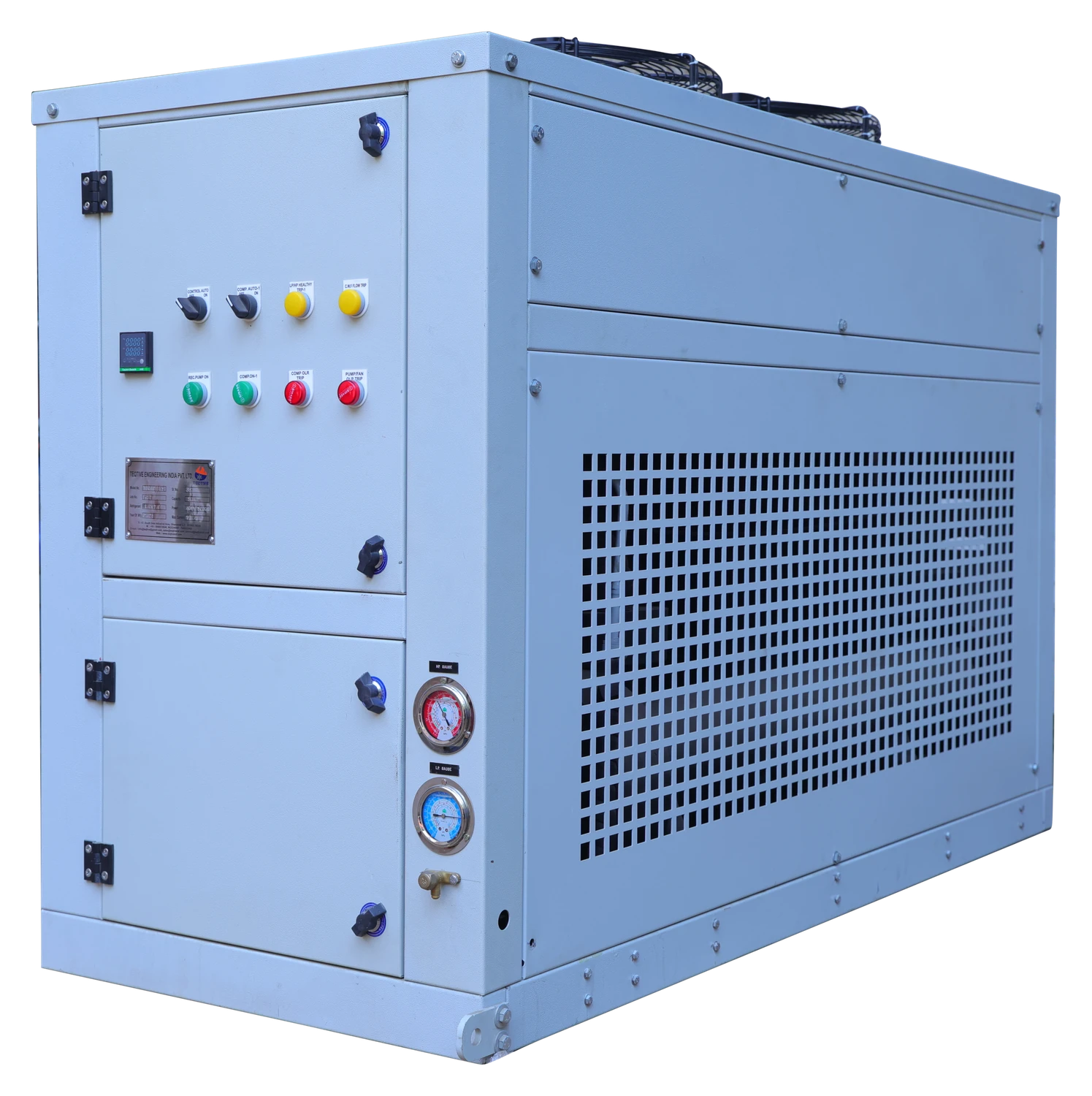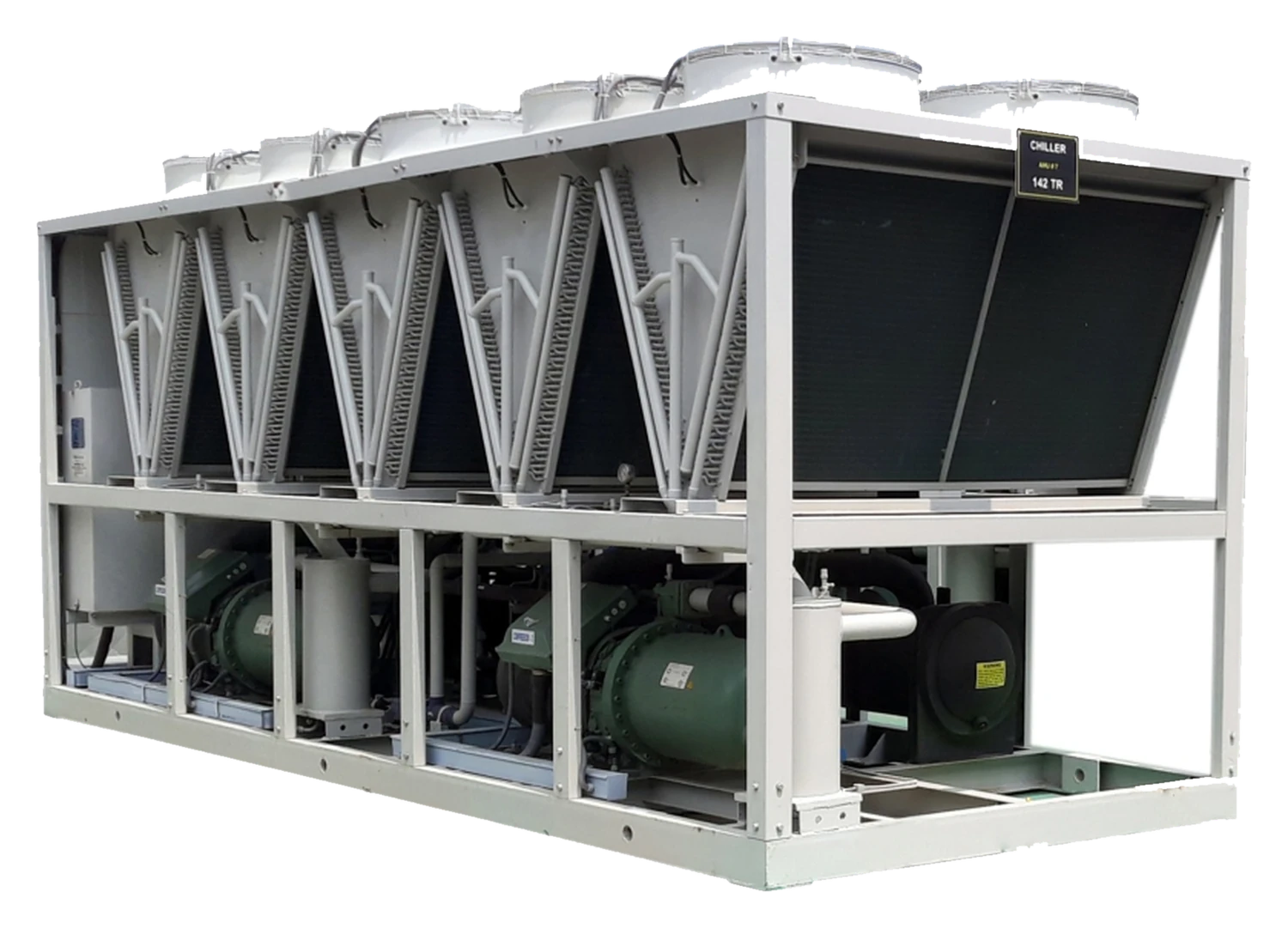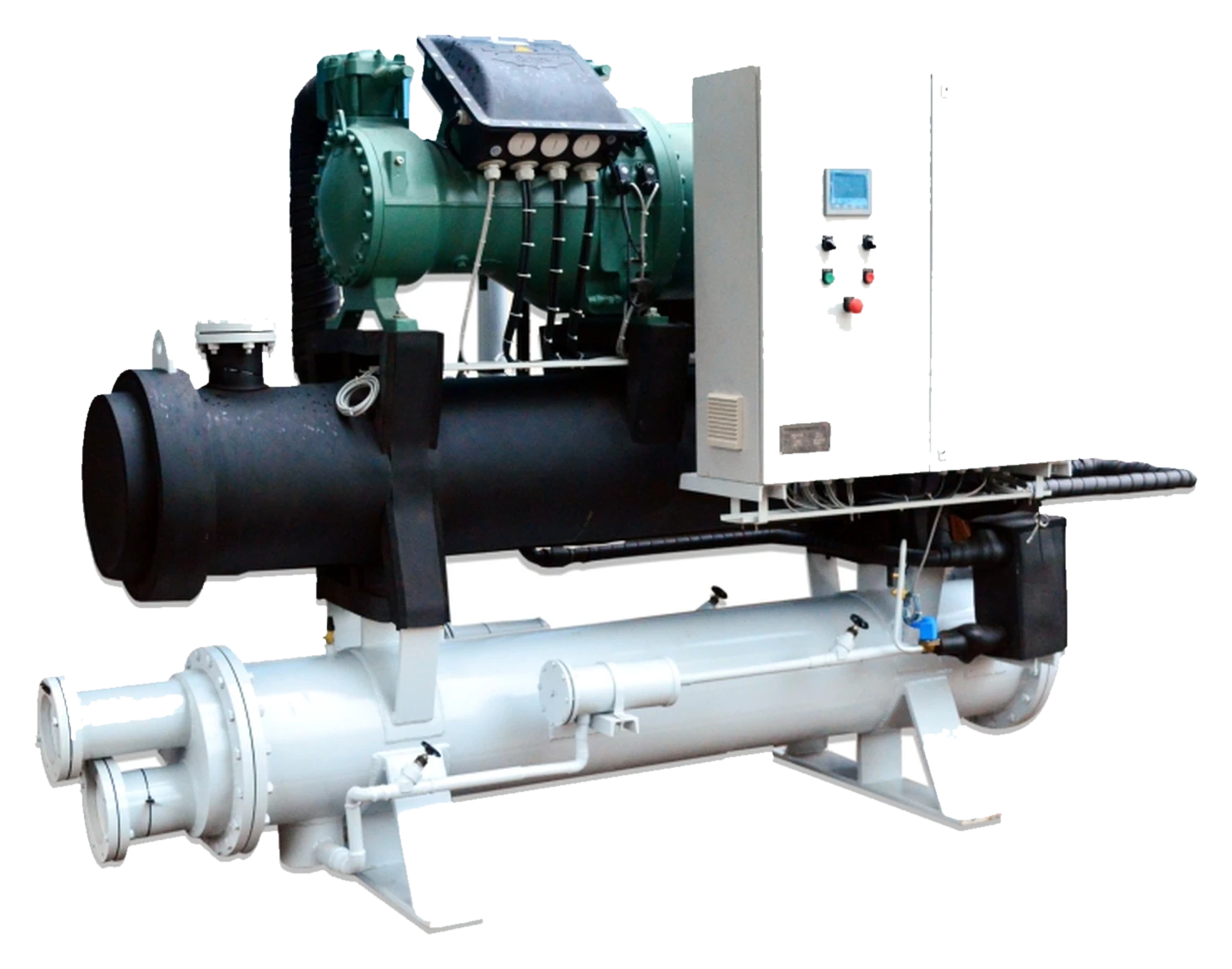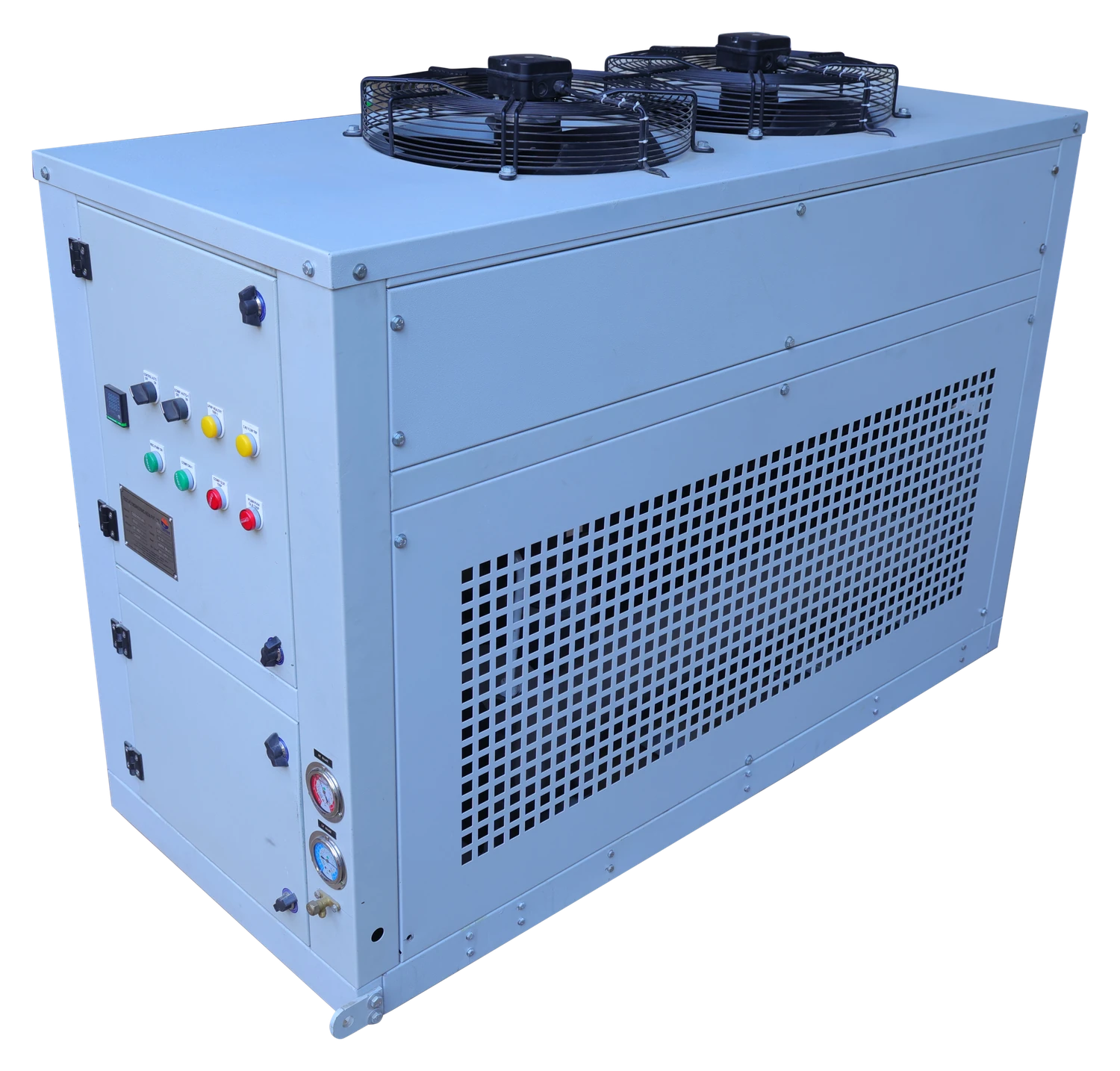
Once the condenser type is decided (air cooled vs water cooled), the next big choice in a chiller is the compressor. Scroll and screw cover most of the market; reciprocating is the third option that Indian process plants should not ignore.
How each compressor works
- Scroll. Two interleaved spiral scrolls — one fixed, one orbiting — trap pockets of gas and squeeze them toward the centre. Hermetic, no valves, very few moving parts, 1–30 TR per compressor. Capacity control is by switching compressors on and off (tandem or trio sets), or with a digital/variable-speed scroll.
- Screw. Two meshing helical rotors carry gas along their length while the space between the lobes shrinks. Semi-hermetic or open, 40–500 TR per compressor. A slide valve lets the compressor unload smoothly from 100 % to about 25 %; an economiser port can add capacity at low temperatures.
- Reciprocating. Pistons in cylinders with suction and discharge valves, 5–120 TR per compressor. Capacity control by unloading cylinder banks in steps. Open-drive machines can be rebuilt almost indefinitely.
Comparison table
| Factor | Scroll chiller | Screw chiller | Reciprocating chiller |
|---|---|---|---|
| Capacity per compressor | 1–30 TR | 40–500 TR | 5–120 TR |
| Typical chiller size | 2–120 TR (multi-scroll) | 60–1000 TR | 10–200 TR |
| Full-load efficiency | Good | Best above ~60 TR | Good; falls at high pressure ratio |
| Part-load control | Steps, by switching scrolls | Smooth 25–100 % slide valve or VFD | Steps of ~25 % by cylinder unloading |
| Low-temperature capability | To ≈ −20 °C (small sizes) | To ≈ −45 °C single stage with economiser | To ≈ −40 °C single stage; two-stage to −45 °C |
| Noise and vibration | Low | Low; steady tone | Higher |
| Maintenance | Replace, don't repair | Trained technician; long service intervals | Field-repairable with local parts |
| Capital cost per TR | Lowest | Higher, but falls with size | Moderate |
| Best fit | Small, steady water-chilling loads | Large, continuous loads; central plants | Sub-zero brine duty; sites needing in-house repair |
Part-load behaviour: the hidden cost
Most process chillers run at part load for most of the year. A four-scroll chiller at 50 % load simply runs two scrolls at full efficiency. A fixed-speed screw at 50 % slides its valve and loses several points of efficiency; below 40 % the loss grows quickly. If your load swings widely, either specify a variable-speed screw, split the duty across two smaller screws, or accept that a multi-scroll machine may use less energy over the year despite a lower nameplate efficiency.
Low-temperature duty
Below about −15 °C the pressure ratio climbs and the scroll runs out of room. Reciprocating and screw compressors handle the ratio comfortably and, on screws, the economiser port recovers capacity that would otherwise be lost. This is why Teqtive builds its brine chillers with reciprocating or screw compressors, and its two-stage and cascade machines for −45 °C to −70 °C on the same basis. For the coolant side of the same decision see brine vs glycol chiller.
Recommendations by application
- Injection moulding, extrusion, lasers, welders, small HVAC — 2 to 40 TR at +7 °C to +20 °C: air cooled scroll chiller.
- Central plants, large process lines, 24-hour duty — 60 TR and up: water cooled screw chiller, or air cooled screw where water is short.
- Pharma and chemical brine at −10 °C to −40 °C: reciprocating below ~60 TR, screw above; see brine chillers.
- Remote sites, or plants with their own maintenance team: reciprocating for serviceability.
Teqtive builds all three compressor types in both air cooled and water cooled form. Send us the load, temperature and running hours and we will show you the selection on paper before you buy.
Frequently asked questions
What is the difference between a screw chiller and a scroll chiller?
The compressor. A scroll compressor traps refrigerant between two spiral scrolls, one orbiting inside the other, and is a small hermetic unit of 1–30 TR. A screw compressor compresses gas between two meshing helical rotors and comes in 40–500 TR sizes with smooth slide-valve capacity control.
Which is more energy efficient, screw or scroll?
At full load a well-selected screw chiller is usually a little more efficient per TR above about 60 TR. At light part-load a multi-scroll chiller can match or beat it because unused scrolls simply switch off, whereas a screw unloads less efficiently below about 50 %. Variable-speed screws close that gap.
Can a scroll chiller be used for brine or glycol below zero?
Yes, with low-temperature scroll models down to about −15 °C to −20 °C in smaller sizes. Below that, reciprocating and screw compressors are the standard choice because of their better pressure-ratio capability.
Which compressor is easiest to maintain in India?
Reciprocating compressors — open or semi-hermetic — can be overhauled in the field with locally available parts, which is why they remain popular for brine chillers in pharma and chemical plants. Scrolls are replaced, not repaired. Screws need a trained technician but run for very long intervals.