1 TR = 3.517 kW of cooling capacity. To convert TR to kW multiply by 3.517; to convert kW to TR divide by 3.517 (or multiply by 0.2843). The same ton is 12,000 BTU/h and 3,024 kcal/h. All of these are rates of heat removal. None of them is the electricity the chiller draws.
TR to kW converter
The formulas
- kW (cooling) = TR × 3.517
- TR = kW (cooling) ÷ 3.517
- TR = kcal/h ÷ 3,024
- TR = BTU/h ÷ 12,000
| Unit | Equals |
|---|---|
| 1 TR | 3.517 kW = 12,000 BTU/h = 3,024 kcal/h |
| 1 kW | 0.2843 TR = 3,412 BTU/h = 860 kcal/h |
| 1,000 kcal/h | 0.331 TR = 1.163 kW |
| 12,000 BTU/h | 1 TR |
TR to kW conversion table (1 to 1000 TR)
| Capacity (TR) | Cooling kW | BTU/h | kcal/h |
|---|---|---|---|
| 1 TR | 3.52 kW | 12,000 | 3,024 |
| 1.5 TR | 5.28 kW | 18,000 | 4,536 |
| 2 TR | 7.03 kW | 24,000 | 6,048 |
| 3 TR | 10.55 kW | 36,000 | 9,072 |
| 5 TR | 17.59 kW | 60,000 | 15,120 |
| 7.5 TR | 26.38 kW | 90,000 | 22,680 |
| 10 TR | 35.2 kW | 120,000 | 30,240 |
| 15 TR | 52.8 kW | 180,000 | 45,360 |
| 20 TR | 70.3 kW | 240,000 | 60,480 |
| 25 TR | 87.9 kW | 300,000 | 75,600 |
| 30 TR | 105.5 kW | 360,000 | 90,720 |
| 40 TR | 140.7 kW | 480,000 | 120,960 |
| 50 TR | 175.8 kW | 600,000 | 151,200 |
| 60 TR | 211.0 kW | 720,000 | 181,440 |
| 75 TR | 263.8 kW | 900,000 | 226,800 |
| 100 TR | 351.7 kW | 1,200,000 | 302,400 |
| 150 TR | 527.5 kW | 1,800,000 | 453,600 |
| 200 TR | 703.4 kW | 2,400,000 | 604,800 |
| 250 TR | 879.2 kW | 3,000,000 | 756,000 |
| 300 TR | 1,055.1 kW | 3,600,000 | 907,200 |
| 400 TR | 1,406.8 kW | 4,800,000 | 1,209,600 |
| 500 TR | 1,758.5 kW | 6,000,000 | 1,512,000 |
| 750 TR | 2,637.8 kW | 9,000,000 | 2,268,000 |
| 1,000 TR | 3,517.0 kW | 12,000,000 | 3,024,000 |
kW to TR conversion table
| Cooling capacity | Tons of refrigeration | kcal/h |
|---|---|---|
| 1 kW | 0.28 TR | 860 |
| 5 kW | 1.42 TR | 4,300 |
| 10 kW | 2.84 TR | 8,600 |
| 25 kW | 7.11 TR | 21,500 |
| 50 kW | 14.22 TR | 43,000 |
| 100 kW | 28.4 TR | 86,000 |
| 250 kW | 71.1 TR | 215,000 |
| 500 kW | 142.2 TR | 430,000 |
| 1,000 kW | 284.3 TR | 860,000 |
| 2,000 kW | 568.7 TR | 1,720,000 |
Where the ton comes from
Before mechanical refrigeration, cooling was bought as blocks of ice. When compressors replaced ice, buyers wanted to know how much ice a machine was equal to. One ton of refrigeration was defined as the cooling effect of one short ton (2,000 lb) of ice melting at 0 °C over 24 hours. Ice absorbs 144 BTU/lb as it melts, so:
2,000 lb × 144 BTU/lb = 288,000 BTU per 24 hours = 12,000 BTU/h = 3.517 kW.
The unit survived because it gives convenient numbers for industrial plant, and in India almost every chiller enquiry, data sheet and nameplate is still written in TR. European and many Asian catalogues use kW, so the conversion is needed every time you compare quotations.
Cooling kW is not electrical kW
This is the most common mistake with the conversion. A chiller data sheet carries two different kW figures:
- Cooling capacity (kW or TR): the heat the evaporator removes from the water or brine.
- Power input (kW): the electricity taken by the compressor, and on a packaged unit the fans and controls as well.
The ratio between them is the efficiency. COP = cooling kW ÷ input kW, and kW/TR = input kW ÷ TR. The two are linked by kW/TR = 3.517 ÷ COP. A 100 TR chiller delivers 351.7 kW of cooling. If its efficiency is 0.70 kW/TR it draws 70 kW from the supply, and its COP is 351.7 ÷ 70 = 5.02. The 3.517 factor converts the cooling side only. See chiller efficiency, COP and kW/TR for typical values by chiller type, and chiller power consumption calculation for turning those values into units per month.
Worked examples
1. TR to kW
A plant needs a 60 TR chiller and the supplier's catalogue is in kW. 60 × 3.517 = 211 kW of cooling. Select the model whose capacity at your water temperature and your ambient is at least 211 kW, not the model whose nominal rating is 211 kW at catalogue conditions.
2. kW to TR
An imported machine lists a heat load of 85 kW to cooling water. 85 ÷ 3.517 = 24.2 TR. With a 10–15 % margin for pipe and pump heat, a 27–28 TR requirement results, so a 30 TR unit is the practical selection.
3. From a process heat load in kcal/h
A reactor jacket must remove 180,000 kcal/h. 180,000 ÷ 3,024 = 59.5 TR. In kW that is 180,000 ÷ 860 = 209.3 kW, and 59.5 × 3.517 gives the same 209.3 kW. The full method for arriving at the heat load is in how to calculate chiller tonnage.
4. From flow and temperature difference
Water at 30 m³/h is cooled from 12 °C to 7 °C. Heat removed = 30,000 kg/h × 5 °C = 150,000 kcal/h = 49.6 TR = 174.4 kW. The flow side of this relationship is covered in chilled water flow rate calculation.
Points that cause confusion
- Nominal TR versus actual TR. A chiller sold as 100 TR at +7 °C water gives far less at −10 °C brine, and an air cooled unit rated at 35 °C ambient gives less at 45 °C. Always ask for capacity in TR or kW at your own conditions.
- Compressor HP is not TR. The old rule of one HP per ton is roughly true only for air cooled chilled-water duty. At low temperatures a compressor may need 2 to 3 HP for each TR delivered.
- Other tons exist. The figure 3.517 kW is the US refrigeration ton used in India. The Japanese refrigeration ton (JRT), seen on some Asian compressor data, is 3,320 kcal/h or 3.861 kW. Check which one a foreign data sheet uses.
- kWh is energy, kW is rate. A 100 TR chiller running fully loaded for one hour removes 351.7 kWh of heat. That is sometimes written as 100 TR-hours, the unit used for thermal storage tanks and ice banks.
Using the conversion when comparing quotations
When two offers state capacity in different units, convert both to TR at the same leaving temperature, the same fluid and the same ambient or condenser water temperature, then compare input power at that point. An offer of 352 kW cooling at 35 °C ambient is not equal to 100 TR at 45 °C ambient. For Indian plants the realistic design ambient is 45 °C for air cooled chillers, and about 32 °C condenser water for water cooled chillers. The differences between the main machine types are set out in types of industrial chillers.
Teqtive chillers in TR and kW
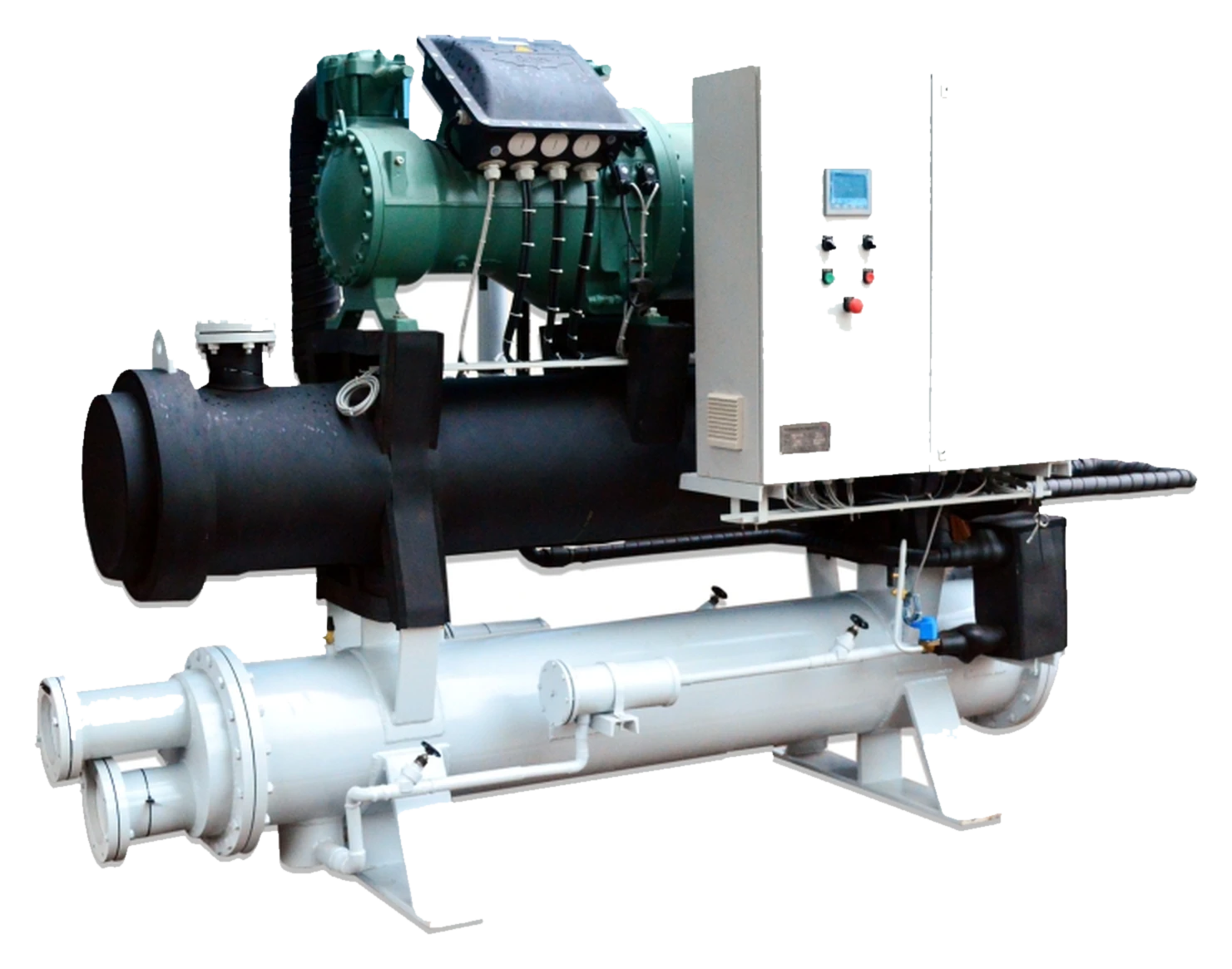
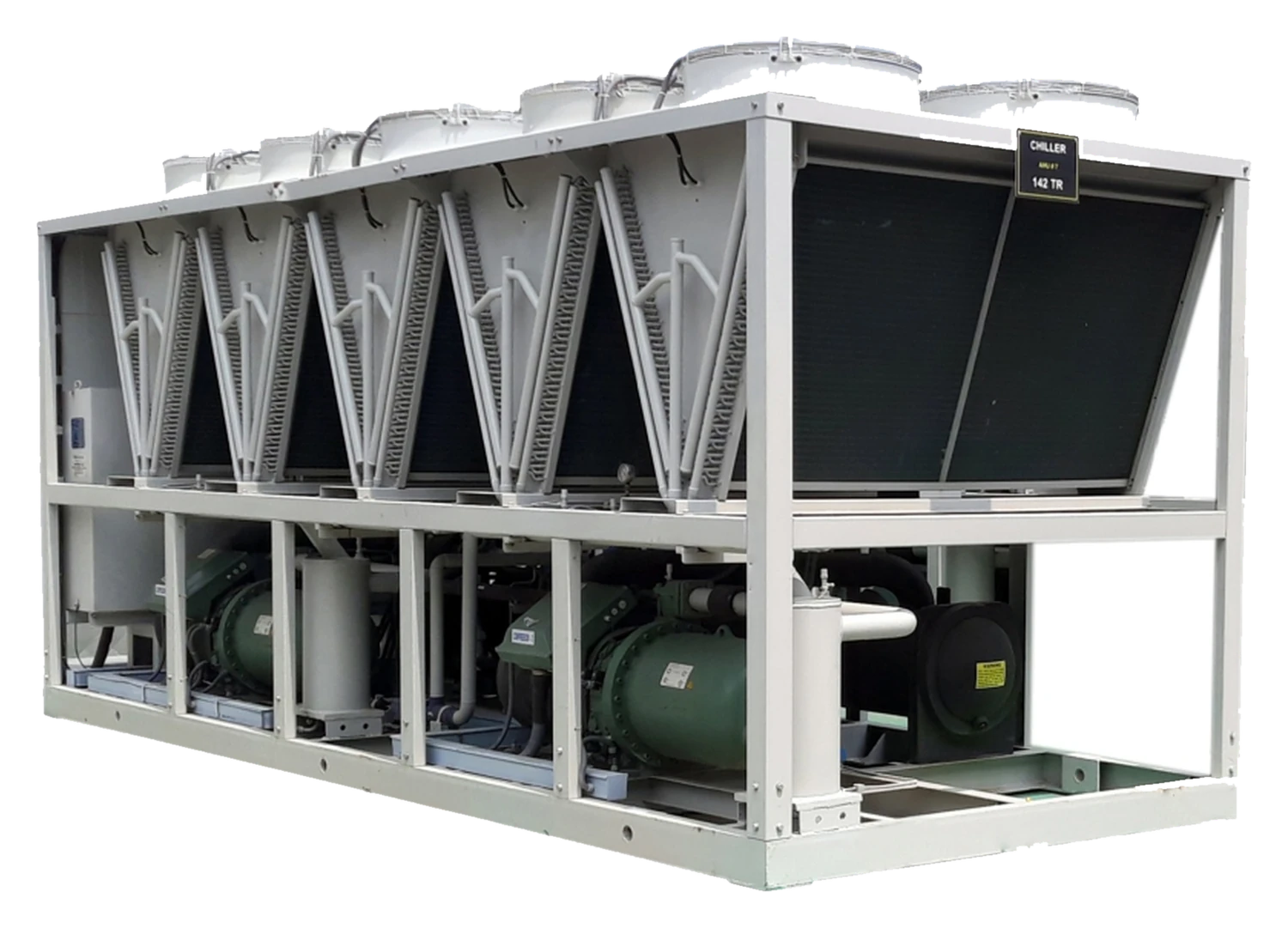
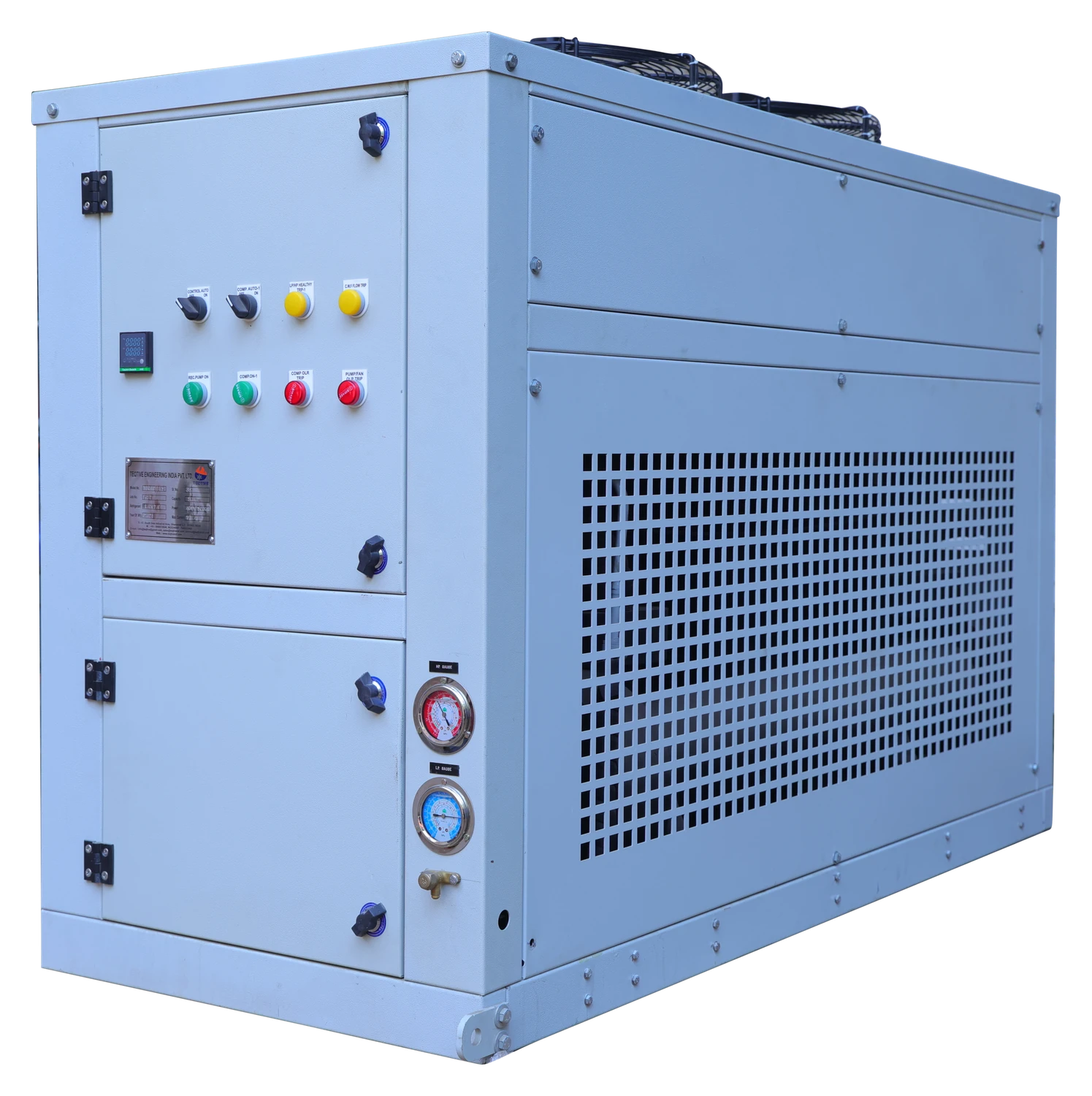
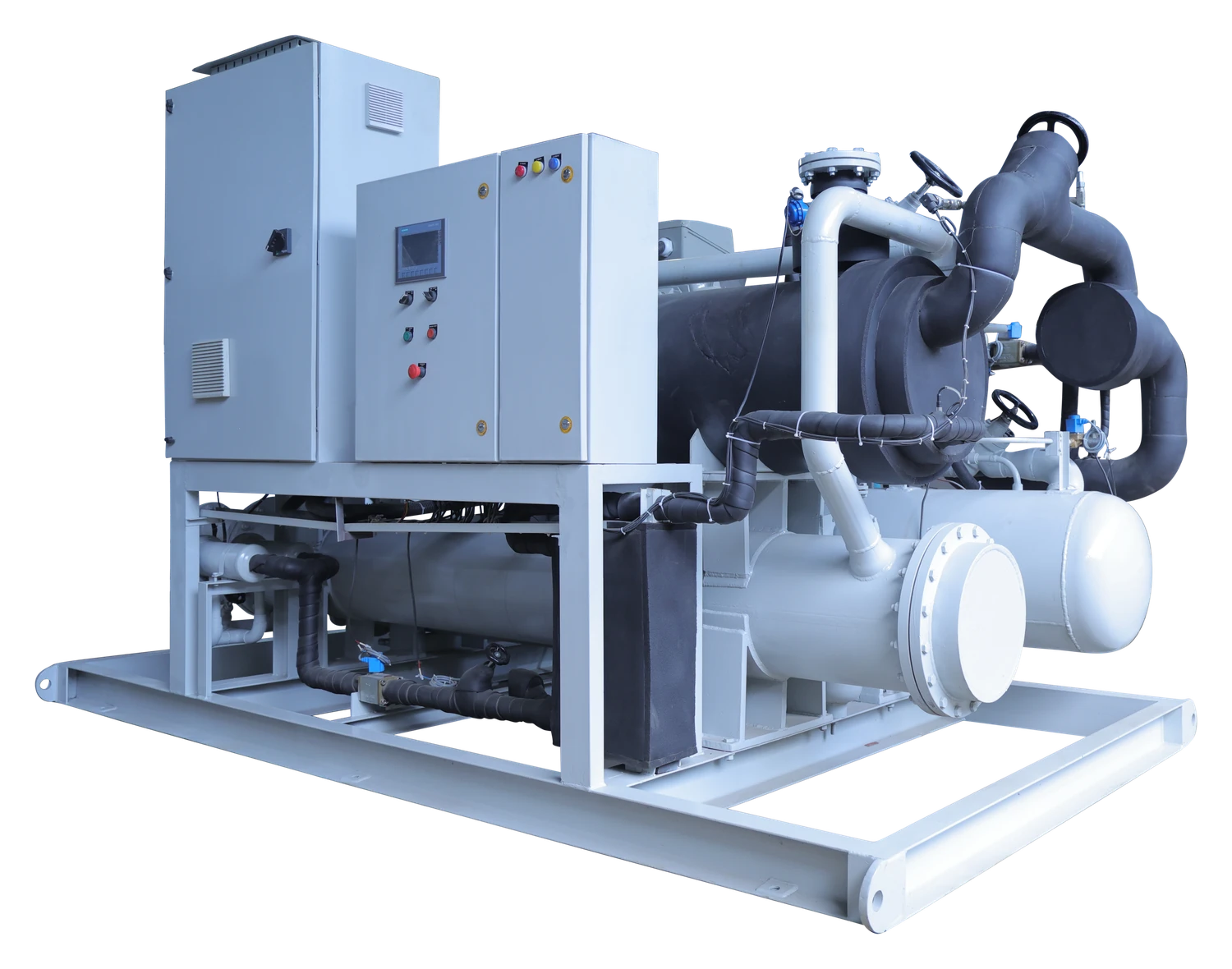
Teqtive builds industrial chillers from 1 TR to 1000 TR, which is about 3.5 kW to 3,517 kW of cooling. Scroll chillers cover 5 to 90 TR, screw chillers 40 to 500 TR and brine chillers 1 to 500 TR. Send your load in TR, kW or kcal/h along with the required temperature, and our engineers will confirm the capacity at your site conditions.
Frequently asked questions
How many kW is 1 TR?
1 TR (ton of refrigeration) equals 3.517 kW of cooling capacity. It is also 12,000 BTU/h or 3,024 kcal/h. This is heat removed, not electricity used. The electrical input for 1 TR is much smaller, typically 0.6 to 1.6 kW for chilled-water duty depending on whether the chiller is water cooled or air cooled and on the ambient temperature.
How do I convert kW to TR in a chiller?
Divide the cooling capacity in kW by 3.517, or multiply by 0.2843. A chiller rated at 350 kW of cooling is 350 ÷ 3.517 = 99.5 TR. Make sure the kW figure is cooling capacity. If it is the motor or input power, the conversion does not apply and you need the kW/TR or COP of the machine instead.
Why is it called a ton of refrigeration?
The unit comes from the ice trade. One ton of refrigeration is the rate of heat removal that freezes, or is absorbed by melting, one short ton (2,000 lb) of ice at 0 °C in 24 hours. Ice has a latent heat of 144 BTU/lb, so 2,000 × 144 = 288,000 BTU per day, which is 12,000 BTU/h.
Is 1 TR equal to 1 HP or 1 kW of power?
No. TR measures cooling delivered, while HP and electrical kW measure power consumed. The link between them is the efficiency of the chiller. A water cooled screw chiller may need about 0.7 kW of electricity per TR, an air cooled chiller at 45 °C ambient 1.25 to 1.6 kW per TR, and a low-temperature brine chiller 2 kW per TR or more.
How many kcal/h is 1 TR?
1 TR is 3,024 kcal/h. This is the most convenient form for process calculations in metric units, because water has a specific heat of 1 kcal/kg·°C. Cooling 1,000 kg/h of water by 3 °C is 3,000 kcal/h, which is almost exactly 1 TR.