Chiller power consumption per hour is input kW = load in TR × kW/TR. A 100 TR water cooled screw chiller at 0.70 kW/TR draws about 70 kW, or 70 units an hour at full load. Multiply by running hours and your tariff for the running cost, then add the pumps and cooling tower fans.
Chiller power consumption calculator
The tariff is your own figure: replace the default with the rate on your electricity bill. Pumps and cooling tower fans are extra.
The basic calculation
- Input power (kW) = cooling load (TR) × efficiency (kW/TR).
- Energy per day (kWh) = input power × running hours per day.
- Energy per month = energy per day × working days.
- Running cost = energy × tariff per kWh.
The load in step 1 is the cooling actually delivered, not the nameplate tonnage. If efficiency is quoted as COP, convert with kW/TR = 3.517 ÷ COP. The conversions are explained in TR to kW conversion and chiller efficiency, COP and kW/TR.
Typical kW per TR by chiller type
| Chiller and duty | Conditions | Typical kW/TR (chiller only) | Input for 100 TR |
|---|---|---|---|
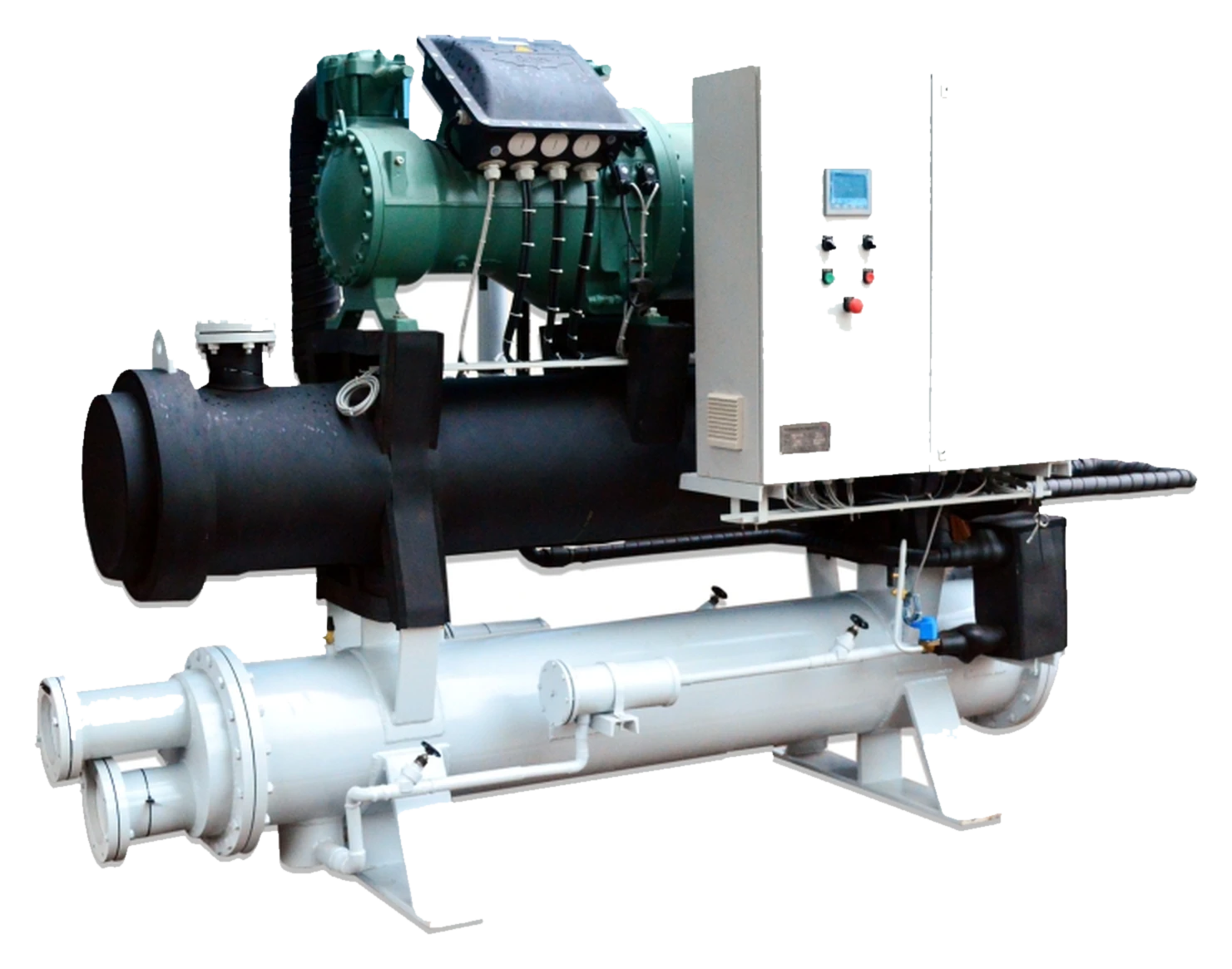
| Water cooled screw | +7 °C water, 30 °C tower water | 0.6 – 0.8 | 60 – 80 kW |
| Water cooled scroll or reciprocating | +7 °C water | 0.75 – 0.95 | 75 – 95 kW |
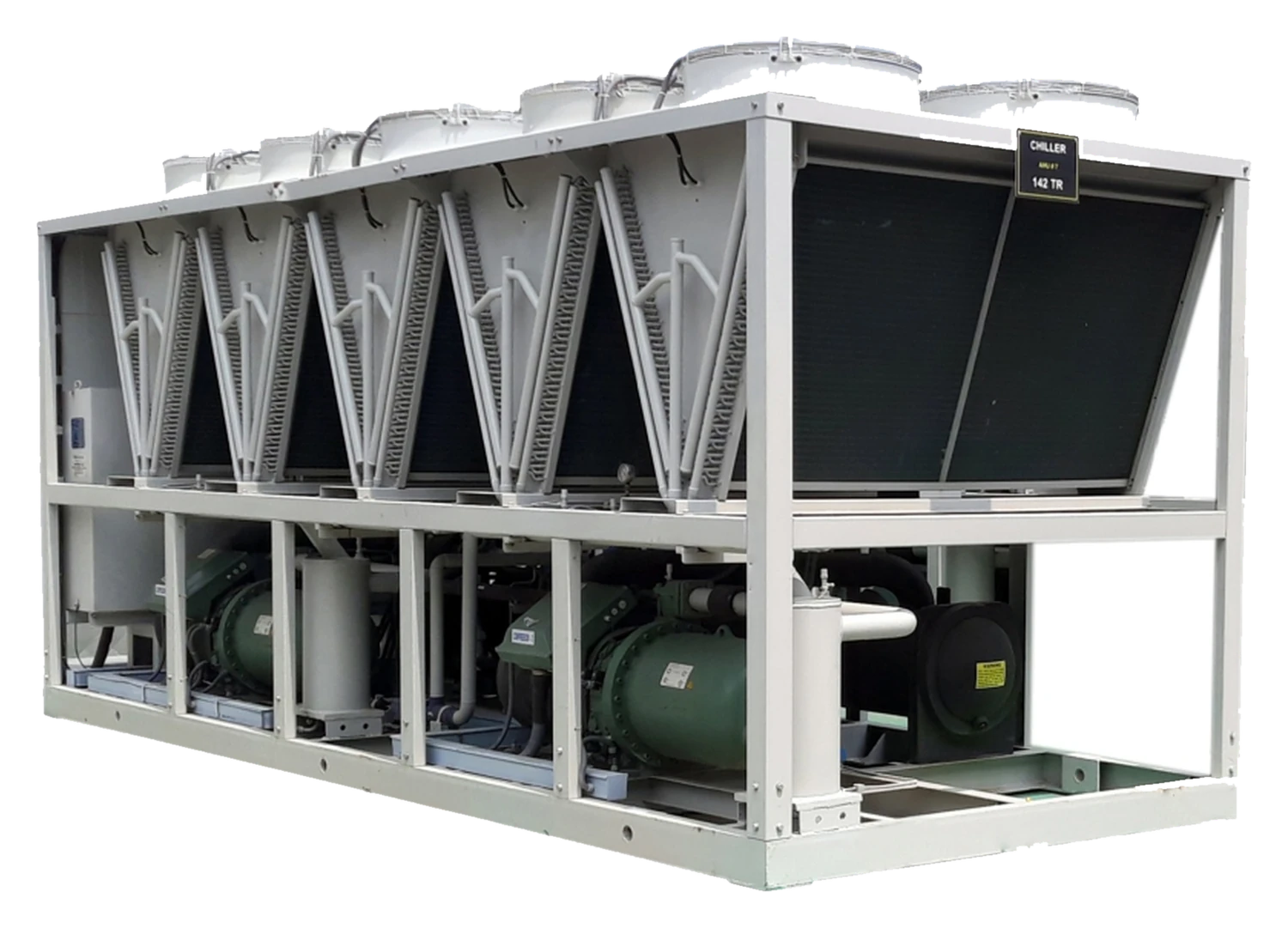
| Air cooled screw or scroll | +7 °C water, 35 °C ambient | 1.0 – 1.3 | 100 – 130 kW |
| Air cooled screw or scroll | +7 °C water, 45 °C ambient | 1.25 – 1.6 | 125 – 160 kW |
| Brine or glycol chiller, water cooled | −10 °C brine | 1.3 – 1.6 | 130 – 160 kW |
| Brine or glycol chiller, water cooled | −25 °C brine | 2.0 – 2.5 | 200 – 250 kW |
| Two-stage brine chiller | −40 °C brine | 2.7 – 3.5 | 270 – 350 kW |
These are typical ranges for well-selected equipment, not guaranteed figures. The actual value depends on refrigerant, compressor, heat exchanger sizing, leaving temperature and ambient. Use the figure on the manufacturer's data sheet at your own conditions.
Two things stand out. Air cooled machines use noticeably more power than water cooled ones, more so at the 45 °C ambient that Indian plants must design for. And power per ton rises steeply as the leaving temperature falls, because the compressor has to lift heat through a larger temperature difference. A 50 TR load at −25 °C can draw 110 kW, more than a 150 TR chilled-water load on a good water cooled chiller.
Worked example: monthly units and running cost
Take a 100 TR water cooled screw chiller with a data-sheet efficiency of 0.70 kW/TR. The process load averages 75 TR, and the plant runs 20 hours a day for 26 days a month. For simplicity the kW/TR is taken as constant at this load.
The tariff used below, ₹8 per kWh, is an assumption for illustration only. Industrial tariffs differ by state, supply voltage and time of day. Replace it with the energy charge on your own bill.
| Item | Calculation | Result |
|---|---|---|
| Chiller input | 75 TR × 0.70 kW/TR | 52.5 kW |
| Chiller energy per day | 52.5 kW × 20 h | 1,050 kWh |
| Chilled water pump | assumed motor load | 7.5 kW |
| Condenser water pump | assumed motor load | 7.5 kW |
| Cooling tower fan | assumed motor load | 3.7 kW |
| Auxiliaries per day | 18.7 kW × 20 h | 374 kWh |
| Plant energy per day | 1,050 + 374 | 1,424 kWh |
| Plant energy per month | 1,424 × 26 days | 37,024 kWh |
| Monthly energy cost at the assumed ₹8/kWh | 37,024 × 8 | ₹2,96,192 |
The chiller alone accounts for 27,300 kWh a month (₹2,18,400 at the assumed tariff). The pumps and tower fan add 9,724 kWh, about 36 % on top in this example because they run at full speed while the chiller is at part load. The overall plant figure is (52.5 + 18.7) ÷ 75 = 0.95 kW/TR, against 0.70 for the chiller alone. When comparing offers or auditing a plant, be clear which of the two you are quoting.
Checking against the ammeter
For a three-phase motor, kW = 1.732 × volts × amps × power factor ÷ 1,000. A compressor drawing 70 kW at 415 V and 0.85 power factor takes 70,000 ÷ (1.732 × 415 × 0.85) = about 115 A. If the panel shows much more than the data sheet current at the same load, look for high condensing pressure before blaming the meter.
The part-load effect
Few process chillers sit at 100 % load. What happens to kW/TR at reduced load depends on the capacity control and on whether the condenser gets cooler water or air at the same time.
- Slide-valve screw compressors unload smoothly but lose efficiency: at 50 % capacity a fixed-speed screw typically still draws around 60–65 % of full-load power when the condensing temperature stays the same.
- Multiple scroll or reciprocating compressors step off one at a time, so the running compressors stay near their best point and the heat exchangers are lightly loaded. Part-load efficiency is usually good.
- Variable speed drives give the best part-load figures, especially when ambient or tower water temperature falls.
- Short cycling at very low load wastes energy and wears contactors and compressors. A buffer tank or a smaller lead chiller is the cure.
For duty that varies through the day and year, use a load-weighted efficiency instead of the full-load figure. The method is described in IPLV and NPLV explained. For a steady 24-hour process load, the full-load kW/TR at design conditions is the honest number.
Auxiliaries: pumps and tower fans
Auxiliary power is easy to overlook because it is spread over several small motors.
- Chilled water or brine pumps run whenever the plant runs, usually at constant speed. Glycol and brine need more flow and head than water.
- Condenser water pump and cooling tower fan apply only to water cooled chillers. On an air cooled chiller the condenser fans are normally already inside the quoted kW/TR.
- Pump heat ends up in the chilled water, so an oversized pump costs twice: once at its motor and again at the compressor.
Getting the flow right is the first step; see chilled water flow rate calculation.
Ways to cut consumption
- Raise the chilled water set point to the warmest the process accepts. Each 1 °C higher evaporating temperature saves roughly 2–3 % of compressor power.
- Lower the condensing temperature. Clean condenser tubes and coils, maintain the tower, and let condenser water run cooler in winter within the chiller's limits. Each 1 °C is again worth roughly 2–3 %.
- Watch the approach temperatures. A rising approach is the earliest sign of fouling; see chiller approach temperature explained.
- Fix low ΔT in the water circuit so that one chiller and one pump can carry the load.
- Sequence chillers so that running machines are well loaded, and avoid two machines idling at 30–40 %.
- Fit variable speed drives on pumps with variable demand. Reducing pump speed by 20 % cuts its power by nearly half.
- Maintain the machine. Correct charge, clean strainers and calibrated sensors all show up on the meter. Use the maintenance checklist.
Purchase price and running cost should be weighed together over the life of the plant; indicative market ranges are in the chiller price guide.
Teqtive chillers and power data
Teqtive supplies water cooled screw chillers and air cooled screw chillers from 40 to 500 TR, with scroll chillers for smaller loads. Each offer states capacity and input power at your leaving temperature and ambient. Send your load profile and running hours and we will estimate the power consumption for the options that suit your plant.
Frequently asked questions
How do you calculate chiller power consumption per hour?
Multiply the cooling load in TR by the chiller's efficiency in kW/TR. A 100 TR chiller at 0.70 kW/TR draws 70 kW, which is 70 units (kWh) for each hour at full load. At part load, use the actual load in TR and the kW/TR at that load. Add pumps and cooling tower fans to get the consumption of the whole plant.
How many kW per ton of cooling does a chiller use?
For chilled water at +7 °C, typical full-load figures are 0.6 to 0.8 kW per ton for water cooled screw chillers, 1.0 to 1.3 for air cooled chillers at 35 °C ambient and 1.25 to 1.6 at 45 °C ambient. Low-temperature brine chillers use far more: about 2.0 to 2.5 kW per ton at −25 °C.
How much electricity does a 100 TR chiller consume per day?
It depends on type, load and hours. As an illustration, a 100 TR water cooled screw chiller at 0.70 kW/TR, running 20 hours a day at an average 75 % load, uses 75 × 0.70 × 20 = 1,050 kWh per day for the chiller alone. An air cooled unit on the same duty at 1.3 kW/TR would use 1,950 kWh per day.
How do I calculate chiller running cost?
Running cost = average load in TR × kW/TR × running hours × electricity tariff. Work out the units per day, multiply by working days per month and by your energy charge per unit. Include chilled water pumps, condenser pumps and tower fans, which commonly add 15 to 35 % or more to the chiller's own consumption, and check your bill for demand charges.
How can I reduce chiller power consumption?
Run the highest chilled water temperature the process accepts, keep condenser tubes or coils clean, hold condenser water as cool as the tower allows, fix low temperature difference in the water circuit, and avoid running several chillers at low load. Each 1 °C change in evaporating or condensing temperature is worth roughly 2 to 3 % of compressor power.