Chilled water flow in m³/h = TR × 3,024 ÷ (ΔT in °C × 1,000). At the usual 5 °C temperature difference that is 0.605 m³/h per TR. In US units, GPM = TR × 24 ÷ ΔT in °F, which gives 2.4 GPM per ton at 10 °F. Glycol and brine need more flow than water for the same duty.
Chilled water flow rate calculator
Where the formula comes from
Heat removed = mass flow × specific heat × temperature difference. One TR is 3,024 kcal/h, water has a specific heat of 1 kcal/kg·°C and a density of about 1,000 kg/m³, so:
Flow (m³/h) = Load (kcal/h) ÷ (1,000 × ΔT) and Load (TR) = Flow (m³/h) × ΔT × 1,000 ÷ 3,024
In US units one TR is 12,000 BTU/h and one US gallon per minute of water carries about 500 BTU/h per °F, so GPM = TR × 12,000 ÷ (500 × ΔT) = TR × 24 ÷ ΔT. If you are starting from kW, convert first: see TR to kW conversion.
Flow per TR at different temperature differences
| ΔT across evaporator | m³/h per TR | Litres/min per TR | US GPM per TR |
|---|---|---|---|
| 3 °C (5.4 °F) | 1.008 | 16.8 | 4.44 |
| 4 °C (7.2 °F) | 0.756 | 12.6 | 3.33 |
| 5 °C (9.0 °F) | 0.605 | 10.1 | 2.67 |
| 6 °C (10.8 °F) | 0.504 | 8.4 | 2.22 |
| 7 °C (12.6 °F) | 0.432 | 7.2 | 1.90 |
| 8 °C (14.4 °F) | 0.378 | 6.3 | 1.67 |
| 10 °C (18.0 °F) | 0.302 | 5.0 | 1.33 |
Halving the temperature difference doubles the flow. That is why the design ΔT has such a large effect on pump and pipe size.
Worked example: 120 TR water chiller
A 120 TR chiller cools water from 12 °C to 7 °C, a ΔT of 5 °C.
- Load = 120 × 3,024 = 362,880 kcal/h.
- Flow = 362,880 ÷ (1,000 × 5) = 72.6 m³/h.
- That is 72.6 × 1,000 ÷ 60 = 1,210 litres per minute, or about 320 US GPM.
Check with the per-TR figure: 120 × 0.605 = 72.6 m³/h. If the plant were designed for a 4 °C difference instead, the flow would be 120 × 0.756 = 90.7 m³/h, a quarter more water through every pipe and pump.
Correction for glycol and brine
Antifreeze solutions are denser than water but have a lower specific heat, and the net effect is less heat carried per litre. The general formula is:
Flow (m³/h) = Load (kcal/h) ÷ (density in kg/m³ × specific heat in kcal/kg·°C × ΔT)
| Fluid | Density (kg/m³) | Specific heat (kcal/kg·°C) | Flow compared with water | m³/h per TR at 5 °C ΔT |
|---|---|---|---|---|
| Water | 1,000 | 1.00 | 1.00 | 0.605 |
| 30 % ethylene glycol (by volume) | about 1,050 | about 0.87 | about 1.09 | 0.66 |
| 40 % ethylene glycol (by volume) | about 1,070 | about 0.82 | about 1.14 | 0.69 |
| 40 % propylene glycol (by volume) | about 1,045 | about 0.87 | about 1.10 | 0.67 |
| 25 % calcium chloride (by weight) | about 1,240 | about 0.68 | about 1.19 | 0.72 |
Property values are approximate, taken near the working temperature of each fluid, and change with temperature and supplier. Use the fluid data sheet for final pump selection.
Example. A 60 TR glycol chiller circulates 40 % ethylene glycol with a 4 °C difference. Load = 60 × 3,024 = 181,440 kcal/h. Flow = 181,440 ÷ (1,070 × 0.82 × 4) = 181,440 ÷ 3,510 = 51.7 m³/h. Plain water would need only 45.4 m³/h. Glycol is also more viscous, so the pump head rises as well as the flow. Choosing the strength is covered in the glycol concentration and freezing point chart, and salt brines in chilled brine temperature range.
Condenser water flow
A water cooled condenser rejects the cooling load plus the compressor power, roughly 1.25 times the evaporator load for chilled-water duty. The usual allowance is 3 US GPM per TR at a 10 °F range, which is 0.68 m³/h per TR at 5.6 °C. At a 5 °C range the same heat needs about 0.76 m³/h per TR. For the 120 TR chiller above, 3 GPM per TR is 360 GPM or about 82 m³/h. Low-temperature brine chillers reject more heat per TR because the compressor works harder, so use the manufacturer's heat rejection figure for those. The choice between tower and air cooling is discussed in air cooled vs water cooled chillers.
Pipe velocity guidance
Once the flow is known, pick a pipe size that keeps velocity in a sensible band. Common practice for closed chilled water circuits is about 1.2 to 2.4 m/s in mains, 0.9 to 1.5 m/s in small branches of 50 mm and below, and not more than about 1.5 m/s in pump suction lines. Higher velocity means noise, erosion and pump power; very low velocity lets air and dirt settle.
| Nominal pipe size | Inside diameter (schedule 40) | Flow at 1.5 m/s (m³/h) | Flow at 2.0 m/s (m³/h) |
|---|---|---|---|
| 25 mm | 26.6 mm | 3.0 | 4.0 |
| 40 mm | 40.9 mm | 7.1 | 9.5 |
| 50 mm | 52.5 mm | 11.7 | 15.6 |
| 65 mm | 62.7 mm | 16.7 | 22.2 |
| 80 mm | 77.9 mm | 25.7 | 34.3 |
| 100 mm | 102.3 mm | 44.4 | 59.2 |
| 125 mm | 128.2 mm | 69.7 | 92.9 |
| 150 mm | 154.1 mm | 100.7 | 134.3 |
| 200 mm | 202.7 mm | 174.3 | 232.3 |
For the 72.6 m³/h example, a 125 mm main runs at about 1.6 m/s, which is comfortable. A 100 mm pipe would run at about 2.5 m/s, on the high side for continuous duty.
Checking a running chiller
The same equation tells you what a chiller is actually delivering. Measure flow with a flow meter, or estimate it from the pump curve and the differential pressure, and read inlet and outlet temperatures. If a plant measures 50 m³/h and a 3.5 °C difference, the delivered capacity is 50 × 3.5 × 1,000 ÷ 3,024 = 57.9 TR, whatever the nameplate says.
Flow also has limits. Every evaporator has a minimum flow, below which the flow switch trips or the tubes can freeze, and a maximum, above which tube erosion and pressure drop become excessive. Keep the flow within the range on the chiller data sheet, and treat a low-flow or freeze trip as described in the chiller troubleshooting guide.
Low-ΔT syndrome
A plant designed for 5 °C often runs at 2.5 to 3 °C. The water returns too cold, so for the same load the pumps must move up to twice the flow. A chiller held to its design flow then cannot load beyond about 50–60 % even though the process is short of cooling, and operators start a second chiller and pump that should not be needed. Typical causes:
- Three-way or bypass valves that send supply water straight back to the return header.
- Oversized or leaking control valves, and users left open when the machine is idle.
- Fouled coils and heat exchangers that cannot transfer the design heat.
- Chilled water set point lowered to mask a problem elsewhere.
- Process equipment designed for a smaller ΔT than the chiller plant.
Fixing ΔT usually saves more pump and chiller energy than any change to the chiller itself.
Teqtive chillers and flow data
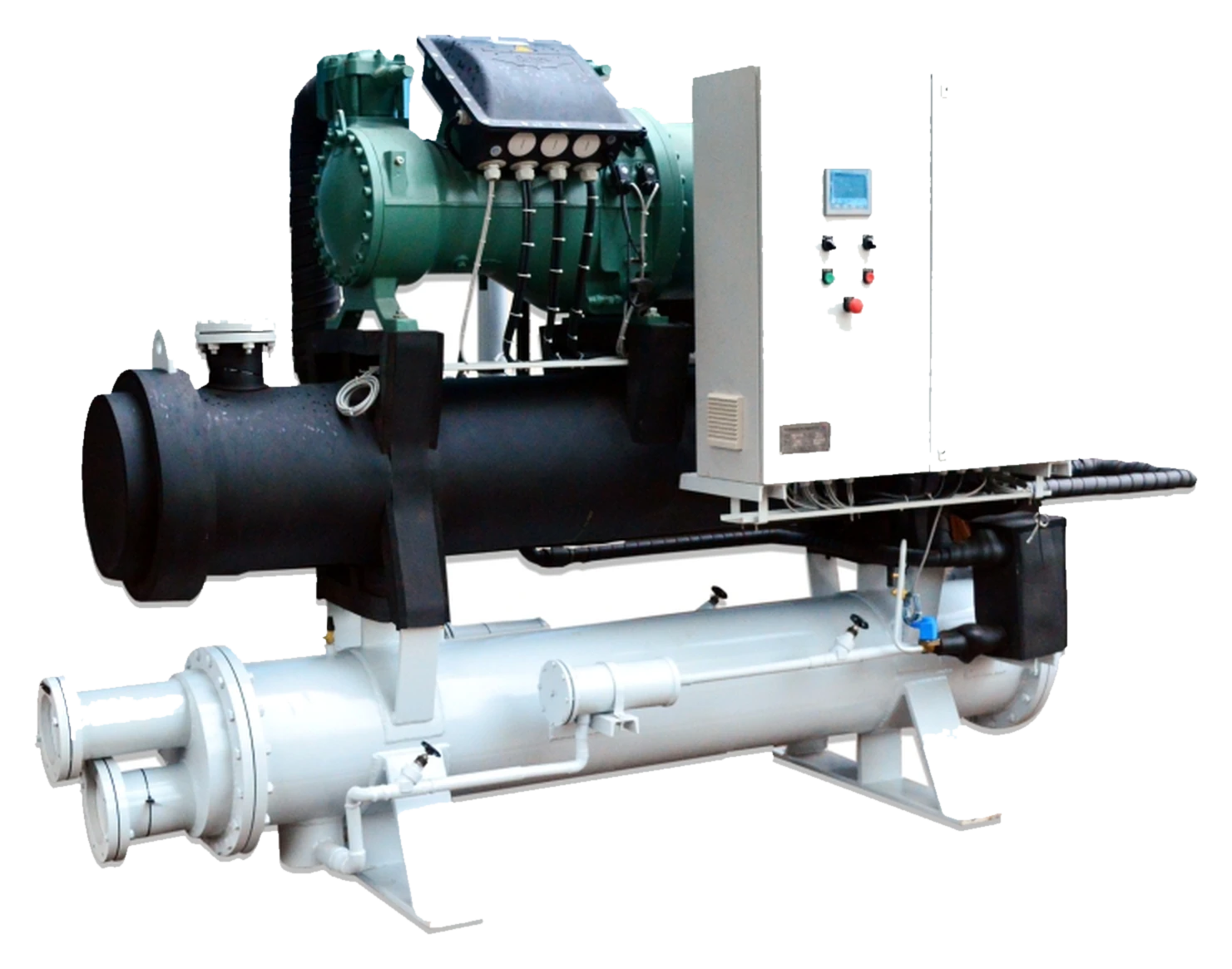
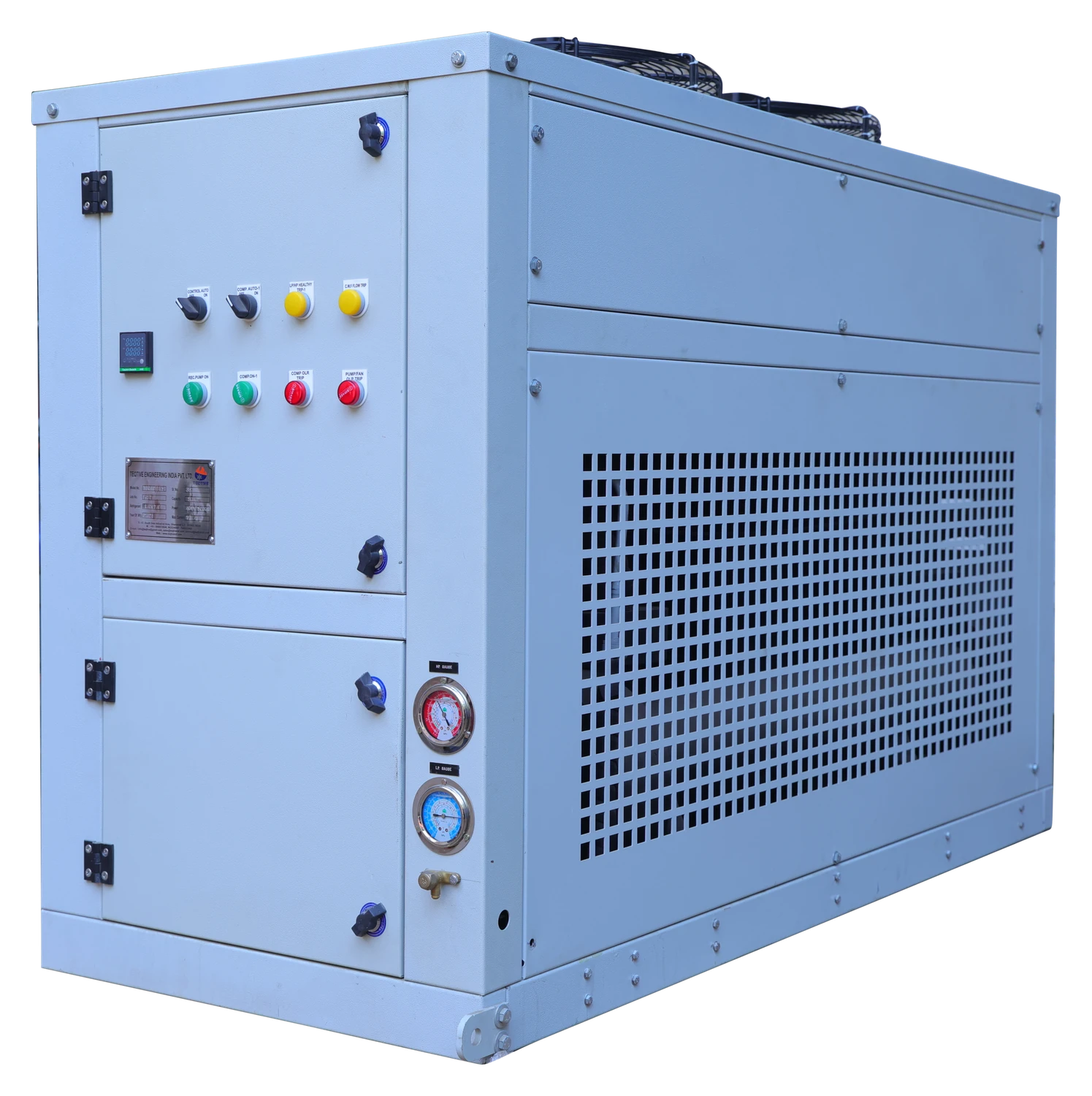
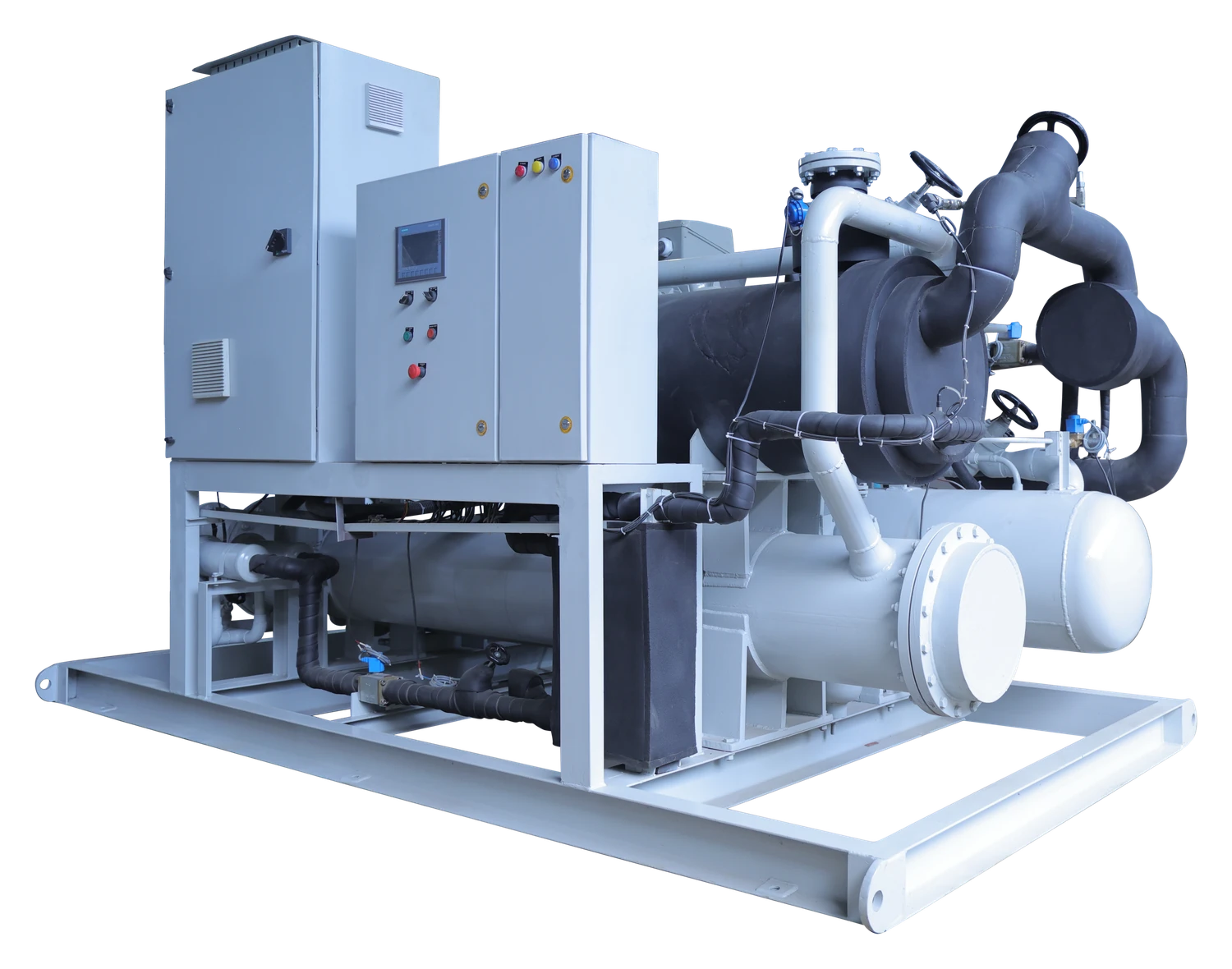
Every Teqtive water cooled screw chiller, air cooled scroll chiller and brine chiller is offered with its design flow, pressure drop and allowable flow range for the actual fluid. Share your load, fluid and temperatures and we will work out the flow and pump duty with the chiller selection.
Frequently asked questions
How do you calculate chilled water flow rate?
Flow in m³/h = TR × 3,024 ÷ (ΔT in °C × 1,000). For a 100 TR chiller with water entering at 12 °C and leaving at 7 °C, the flow is 100 × 3,024 ÷ 5,000 = 60.5 m³/h. In US units, GPM = TR × 24 ÷ ΔT in °F, which gives 2.4 GPM per ton at a 10 °F difference.
How many GPM per ton does a chiller need?
A chiller needs 2.4 US GPM per ton on the chilled water side at a 10 °F (5.6 °C) temperature difference, from GPM = 24 ÷ ΔT. At 12 °F it is 2.0 GPM per ton and at 8 °F it is 3.0 GPM per ton. The condenser water side of a water cooled chiller is usually taken as 3 GPM per ton.
What is the chilled water flow per TR in m3/hr?
At the common 5 °C temperature difference, chilled water flow is 0.605 m³/h per TR, which is about 10.1 litres per minute per TR. At 4 °C it rises to 0.756 m³/h per TR and at 6 °C it falls to 0.504 m³/h per TR. These figures are for plain water.
Does glycol change the chiller flow rate?
Yes. Glycol and brine carry less heat per litre than water, so more flow is needed for the same tonnage and temperature difference. Divide the water flow by the product of the fluid's relative density and specific heat. For 40 % ethylene glycol that product is about 0.88, so the flow is roughly 14 % higher than with water.
What is low delta T syndrome in a chilled water system?
Low delta T syndrome is when water returns to the chiller colder than design, for example a 3 °C difference instead of 5 °C. The pumps then circulate far more water for the same load, and the chiller cannot reach full capacity at its design flow. Common causes are bypassing three-way valves, oversized control valves, fouled coils and set points left too low.