Two chillers can both be rated "100 TR" and differ by 30 % in electricity consumption. The specification sheet tells you which, if you know how to read four numbers. This guide defines them, gives realistic values by chiller type, and shows how to measure your own chiller on site.
The four efficiency metrics
| Metric | Definition | Units | Better is |
|---|---|---|---|
| COP (coefficient of performance) | Cooling output ÷ electrical input | kW / kW (dimensionless) | Higher |
| kW/TR | Electrical input per ton of cooling = 3.517 ÷ COP | kW per TR | Lower |
| EER | Cooling in BTU/h ÷ input in W = COP × 3.412 | BTU/h per W | Higher |
| IPLV / NPLV | Load-weighted COP, EER or kW/TR at 100/75/50/25 % load | same as the base metric | Higher COP, lower kW/TR |
Worked example
A water cooled screw chiller cools 60 m³/h of water from 12 °C to 7 °C while the compressor draws 95 kW.
- Mass flow = 60,000 kg/h ÷ 3,600 = 16.7 kg/s
- Cooling = 16.7 × 4.19 × 5 = 349 kW = 349 ÷ 3.517 = 99.3 TR
- COP = 349 ÷ 95 = 3.67
- kW/TR = 95 ÷ 99.3 = 0.96 (or 3.517 ÷ 3.67)
- EER = 3.67 × 3.412 = 12.5
Whether 0.96 kW/TR is good depends on what is included. Compressor only, this is average for a water cooled screw at 7 °C; add condenser-water pumps, tower fans and the chilled-water pump and the plant figure is nearer 1.1–1.2 kW/TR. Always ask whether a quoted kW/TR covers the compressor alone or the whole chiller, and at what condensing and evaporating temperatures. The flow-and-ΔT arithmetic is covered in how to calculate chiller tonnage.
Typical values by chiller type
| Chiller | Conditions | Typical COP | Typical kW/TR (chiller only) |
|---|---|---|---|
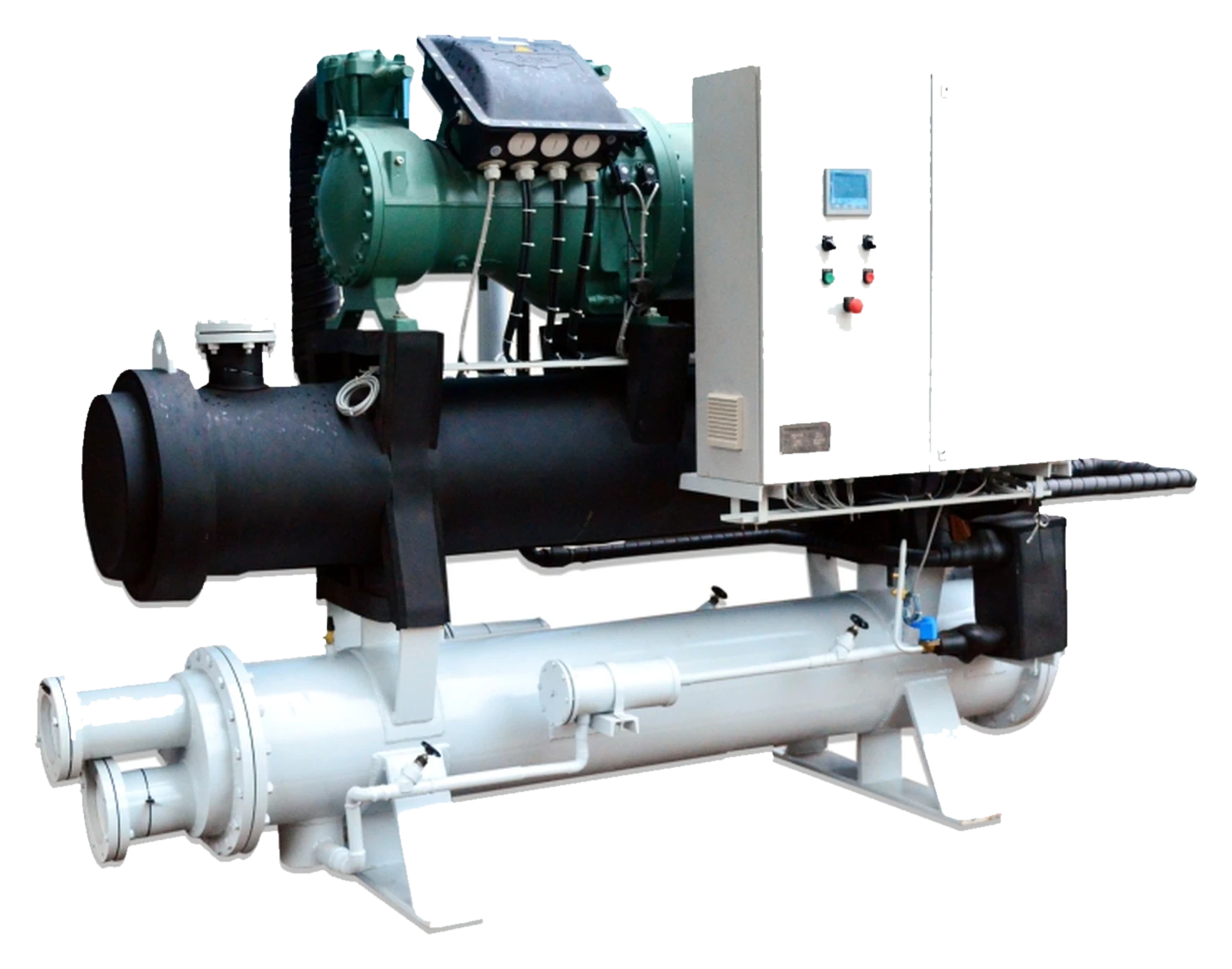
| Water cooled screw / centrifugal | +7 °C water, 30 °C tower water | 4.5 – 6.0 | 0.6 – 0.8 |
| Water cooled scroll / reciprocating | +7 °C water | 3.8 – 4.8 | 0.75 – 0.95 |
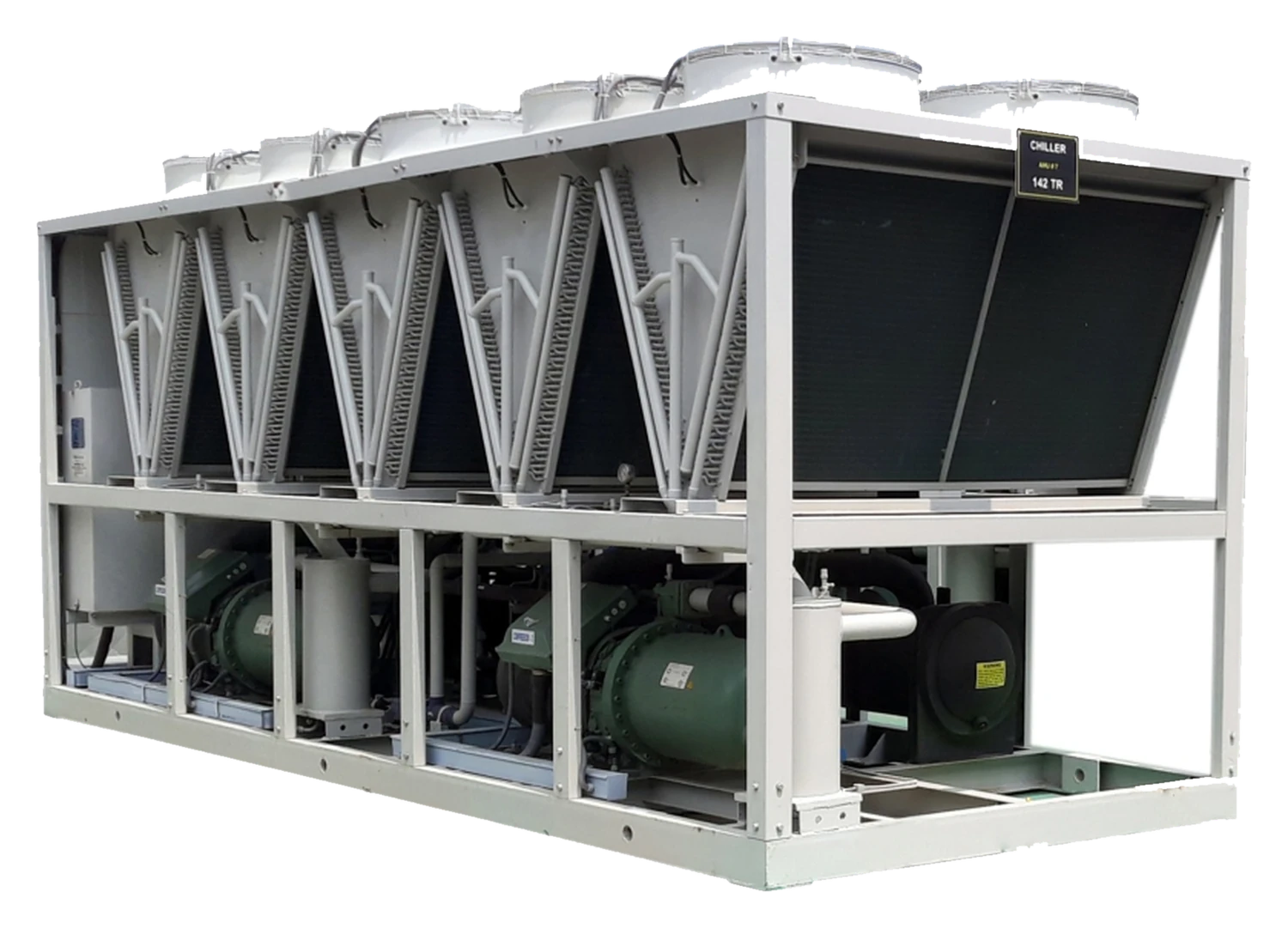
| Air cooled screw / scroll | +7 °C water, 35 °C ambient | 2.7 – 3.5 | 1.0 – 1.3 |
| Air cooled at 45 °C ambient | +7 °C water | 2.2 – 2.8 | 1.25 – 1.6 |
| Brine / glycol chiller | −10 °C brine, water cooled | 2.2 – 2.8 | 1.3 – 1.6 |
| Brine / glycol chiller | −25 °C brine, water cooled | 1.4 – 1.8 | 2.0 – 2.5 |
| Two-stage brine chiller | −40 °C brine | 1.0 – 1.3 | 2.7 – 3.5 |
| Cascade chiller | −60 °C to −70 °C | 0.6 – 0.9 | 4.0 – 6.0 |
Ranges are indicative engineering values for well-selected equipment; actual figures depend on refrigerant, compressor, approach temperatures and load.
What drives efficiency
- Temperature lift. The gap between evaporating and condensing temperature is everything. Every 1 °C of higher evaporating or lower condensing temperature improves COP by roughly 2–3 %. That is why water cooling beats air cooling (comparison) and why the set point should never be colder than the process needs.
- Condenser cleanliness. Scale and dust raise condensing temperature; a fouled condenser can add 10–20 % to the bill. See the maintenance checklist.
- Part-load behaviour. A fixed-speed screw at 40 % load may be 20 % less efficient than at full load; a VFD screw or a multi-scroll stays close to its best. IPLV captures this (screw vs scroll).
- Refrigerant. Ammonia and well-matched HFCs run closer approaches than mismatched blends (ammonia vs Freon).
- Auxiliaries. Oversized pumps and constant-speed tower fans can add 0.2–0.3 kW/TR on their own.
Measuring your own chiller
You need four readings taken at the same moment under steady load: coolant flow (ultrasonic flow meter or pump curve), inlet and outlet coolant temperatures (calibrated probes, not the panel display), and total electrical input (power analyser at the chiller feeder). Compute cooling kW and divide by input kW. Repeat at different loads and ambient conditions over a week, then compare with the manufacturer's rating at the same temperatures. A chiller 15 % or more below its rated COP almost always has a dirty condenser, a wrong charge or a control problem.
Six ways to cut chiller power
- Raise the set point to what the process truly needs
- Keep condensers clean and tower water treated
- Add VFDs on screw compressors, pumps and fans
- Use free cooling in winter where the process allows
- Fix insulation on cold lines and tanks
- Right-size: a chiller at 30 % load wastes power
Teqtive quotes every chiller with its COP and kW/TR at your actual conditions, not at a nominal rating. Send us your duty and we will include the running-cost comparison with the proposal.
Frequently asked questions
How do you calculate chiller COP?
COP = cooling capacity in kW ÷ electrical input in kW. Cooling capacity is flow (kg/s) × specific heat (kJ/kg·K) × temperature drop (K). For example, a chiller removing 350 kW of heat while drawing 100 kW has a COP of 3.5.
How do you convert COP to kW per TR?
kW/TR = 3.517 ÷ COP, because one ton of refrigeration is 3.517 kW of cooling. A COP of 3.5 equals about 1.0 kW/TR; a COP of 5 equals about 0.70 kW/TR.
What is a good kW/TR for a chiller?
At +7 °C chilled water: around 0.6–0.75 kW/TR for a good water cooled screw chiller and 1.0–1.3 kW/TR for an air cooled chiller. At −20 °C brine expect 2–3 kW/TR, and at −60 °C cascade duty 4–6 kW/TR. Compare chillers only at the same temperatures.
What is IPLV?
Integrated Part Load Value is a weighted average of efficiency at 100 %, 75 %, 50 % and 25 % load (weights 1 %, 42 %, 45 %, 12 %). Because most chillers run at part load most of the time, IPLV predicts the annual bill better than full-load COP.