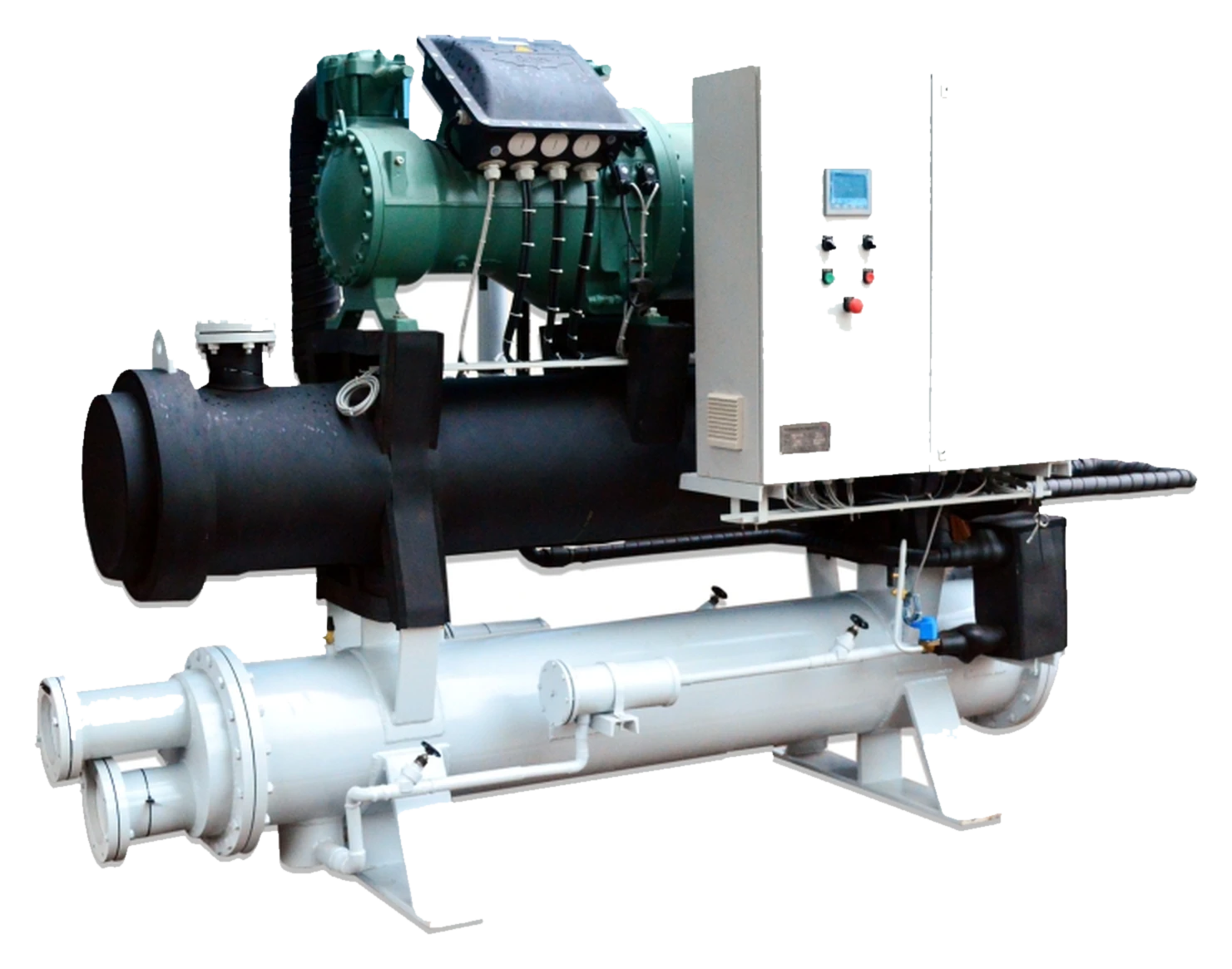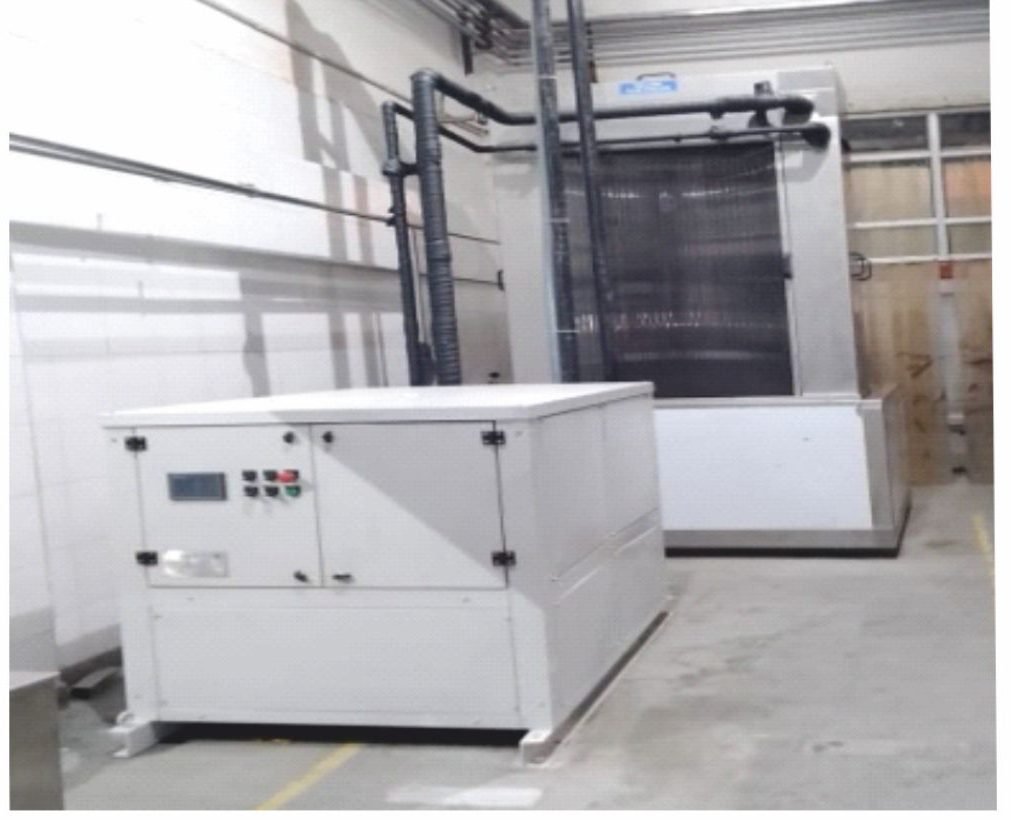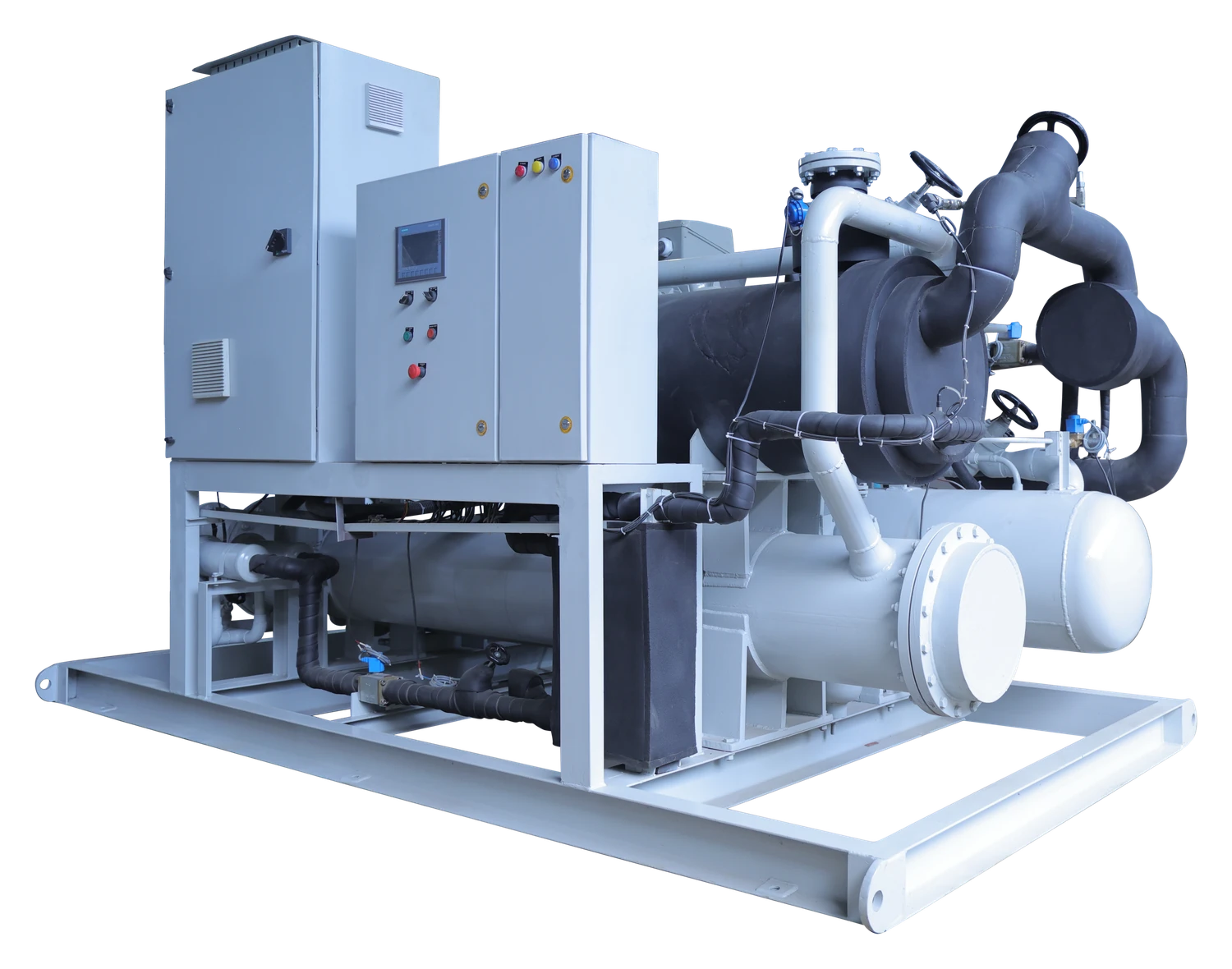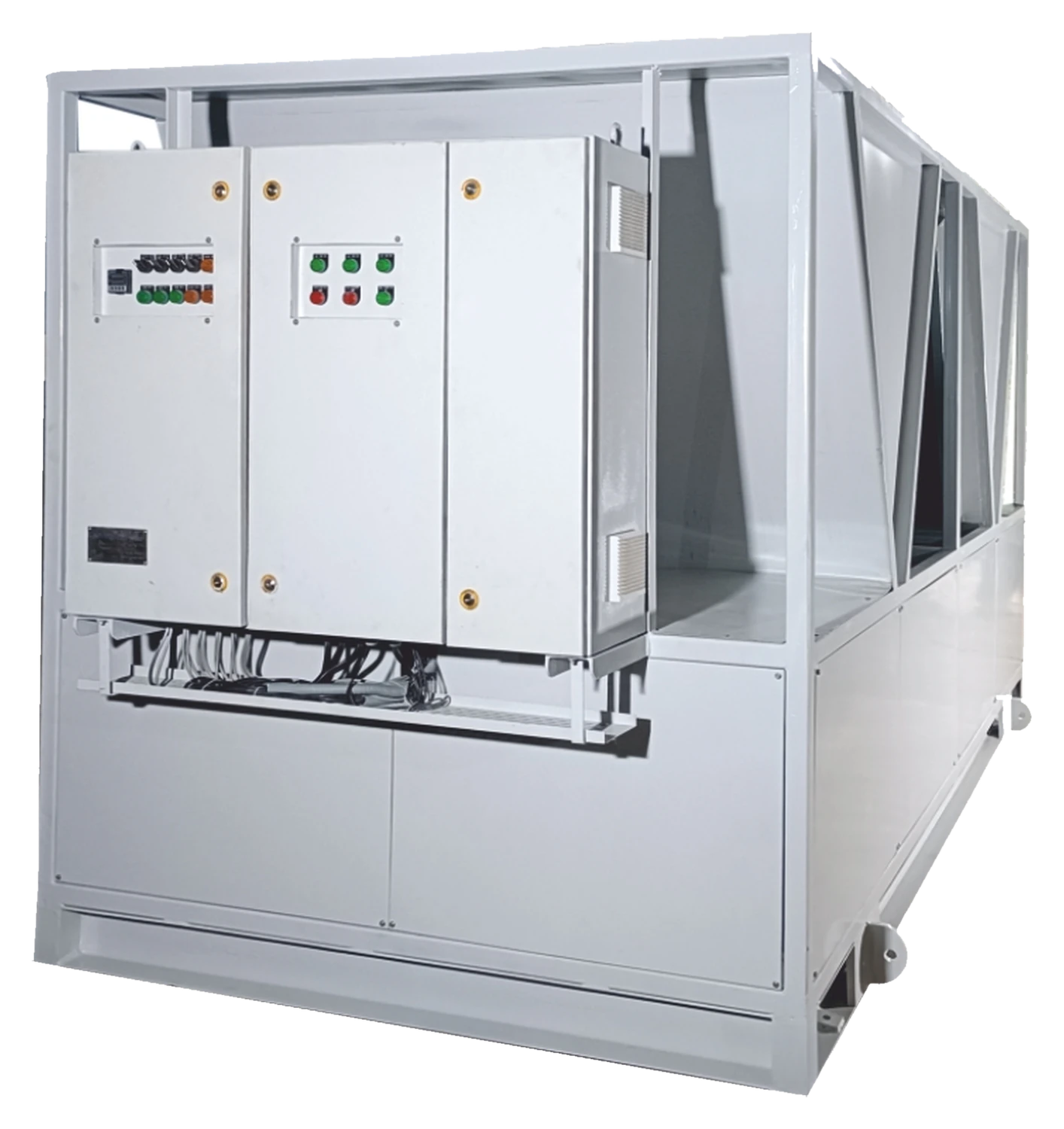
Chiller evaporators fall into five families: direct-expansion (DX) shell-and-tube, flooded shell-and-tube, plate heat exchangers, falling film evaporators and coil-in-tank evaporators. DX shell-and-tube is the general-purpose choice for process chillers, flooded units give the best efficiency on large machines, plates are the most compact, and open falling film or coil designs handle dirty water and near-freezing temperatures.
If you are new to the refrigeration cycle, start with how an industrial chiller works.
The five types
DX shell-and-tube
Refrigerant boils inside the tubes and the water or brine flows through the shell, guided back and forth across the bundle by baffles. An expansion valve meters the refrigerant so it leaves with a few kelvin of superheat. The charge is small, oil returns easily and the shell holds a useful volume of fluid, which gives thermal inertia against freezing. The shell side cannot be brushed, so cleaning is chemical.
Flooded shell-and-tube
The arrangement is reversed: fluid in the tubes, and the bundle immersed in boiling liquid refrigerant. All of the tube surface is wetted, so heat transfer is better and the evaporating temperature can run within 1–3 K of the leaving fluid. Tubes can be brushed after removing the end covers. The costs are a larger refrigerant charge, a level control, and an oil recovery arrangement with halocarbon refrigerants. Ammonia plants commonly use flooded evaporators.
Plate heat exchanger: brazed and gasketed
Corrugated plates form alternate channels for refrigerant and fluid. A brazed plate exchanger (BPHE) is sealed for life and very compact. Gasketed and semi-welded plate exchangers can be opened for cleaning and are used on larger duties, including ammonia. Channels are only a few millimetres wide, so heat transfer is excellent, the approach is close and the water volume is small. The same features make plates sensitive to dirt and to freezing.
Falling film (open pillow plate)
Water is distributed along the top of vertical refrigerated pillow plates and runs down as a thin film into a tank below. Because the water side is open, a layer of ice on the plates does no damage, and the plates can be inspected and hosed down. This allows ice water at about +0.5 °C, which a closed evaporator cannot safely give with plain water. See the falling film chiller.
The term is also used for large shell-and-tube evaporators in which refrigerant is sprayed over the tube bundle instead of flooding it, to cut the refrigerant charge. That is a different machine from the open ice-water chiller.
Coil-in-tank
A refrigerant coil is immersed in an open tank of water or brine, usually with an agitator. It is simple and tolerant of dirty or corrosive liquids if the coil material is chosen to suit, and it can deliberately build ice on the coil as an ice bank. Heat transfer is low, so it is used for small duties and batch tanks.
Comparison table
All figures are typical ranges for guidance. The approach is the leaving fluid temperature minus the evaporating temperature.
| Evaporator type | Typical capacity range | Typical approach | Fouling tolerance | Freeze risk | Typical duty |
|---|---|---|---|---|---|
| DX shell-and-tube | About 5–400 TR | 3–6 K | Moderate; chemical cleaning of shell side | Moderate; fluid volume in the shell gives some protection | Process chilled water, glycol and brine |
| Flooded shell-and-tube | About 100 TR upward | 1–3 K | Good; tubes can be brushed | Tubes can burst if flow stops while the compressor runs | Large screw and centrifugal chillers, ammonia plants |
| Brazed plate | About 1–100 TR per exchanger | 2–4 K | Poor; needs fine strainer and clean closed loop | High; small water content, plates can burst | Compact packaged chillers |
| Gasketed / semi-welded plate | Medium to very large | 2–4 K | Fair; can be opened and cleaned | High without glycol or flow protection | Ammonia and large clean-fluid duties |
| Falling film, open pillow plate | Rated by water flow | Water down to about +0.5 °C | Very good; open and washable | Low; ice on an open plate does no damage | Ice water for dairy, food, concrete |
| Coil-in-tank | About 1–30 TR | 5–10 K | Very good | Low; ice on the coil is tolerated | Small dirty or corrosive duties, ice banks |
Why approach matters: a worked example
Take a 100 TR load (351.7 kW) cooling water from 12 °C to 7 °C.
Flow: 351.7 ÷ (4.186 × 5) = 16.8 kg/s, about 60.5 m³/h.
DX evaporator, 5 K approach (evaporating at 2 °C). The temperature differences at the two ends are 12 − 2 = 10 K and 7 − 2 = 5 K. LMTD = (10 − 5) ÷ ln(10 ÷ 5) = 5 ÷ 0.693 = 7.2 K. Required UA = 351.7 ÷ 7.2 = 48.8 kW/K.
Flooded evaporator, 2 K approach (evaporating at 5 °C). The differences are 7 K and 2 K. LMTD = (7 − 2) ÷ ln(7 ÷ 2) = 5 ÷ 1.253 = 4.0 K. Required UA = 351.7 ÷ 4.0 = 87.9 kW/K.
The flooded evaporator must provide about 1.8 times the UA. Its better heat transfer coefficient supplies part of that and extra surface the rest. In return the compressor evaporates 3 K warmer. As a rule of thumb each kelvin of evaporating temperature is worth about 2–4 % in compressor efficiency, so 3 K gives roughly 6–12 %. On a large plant that runs continuously this pays for the bigger evaporator; on a 10 TR chiller it usually does not. The efficiency terms are explained in COP and kW per TR.
Fouling and freezing in practice
- Fouling adds thermal resistance, so the evaporating temperature falls to deliver the same load. A widening approach at the same load is the standard sign. Log it as part of the maintenance checklist.
- Freezing happens when the evaporating temperature is below the fluid's freezing point and flow stops or drops. Every closed evaporator needs a flow switch and a low-temperature cut-out, and glycol or brine whenever the fluid leaves below about +5 °C.
- Superheat control matters most on DX and plate evaporators. Low superheat sends liquid to the compressor and high superheat wastes surface; see superheat and subcooling.
Which evaporator for which duty
| Situation | Usual choice | Reason |
|---|---|---|
| General process water at +7 °C to +15 °C, 10–300 TR | DX shell-and-tube | Robust, forgiving, low charge |
| Small chiller on a clean closed loop, limited space | Brazed plate | Compact and economical |
| Large continuous load where power cost dominates | Flooded shell-and-tube | Closest approach, lowest kW/TR |
| Brine or glycol at −10 °C to −40 °C | DX shell-and-tube, or flooded with ammonia | Handles viscous fluids and low temperatures |
| Ice water at +0.5 °C to +2 °C | Falling film | No freeze damage, open for cleaning |
| Muddy or silty water, as in concrete batching | Falling film or cleanable shell-and-tube | Tolerates solids; see concrete cooling |
| Small corrosive or dirty tank | Coil-in-tank | Simple, material can match the liquid |
Teqtive chillers
Teqtive builds process chillers with the evaporator matched to the fluid and duty: water cooled screw chillers from 40 to 500 TR, brine chillers from 1 to 500 TR for 0 °C to −40 °C, batching plant chillers for +4 °C water, and falling film chillers from 100 to 50,000 LPH for ice water down to +0.5 °C. Tell us the fluid, its cleanliness, the outlet temperature and the load, and we will recommend the evaporator and chiller type.
Frequently asked questions
What are the types of evaporator in a chiller?
Industrial chillers use five main evaporator types: direct-expansion (DX) shell-and-tube, flooded shell-and-tube, plate heat exchangers (brazed or gasketed), falling film evaporators and coil-in-tank evaporators. They differ in where the refrigerant flows, how close the evaporating temperature runs to the fluid outlet temperature, and how well they tolerate fouling and freezing.
What is the difference between a flooded and a DX evaporator?
In a DX evaporator the refrigerant boils inside the tubes and leaves as superheated vapour, with water or brine in the shell. In a flooded evaporator the fluid is inside the tubes and the tube bundle sits in a pool of boiling refrigerant. Flooded units reach a closer approach, typically 1–3 K, but hold more refrigerant and need an oil recovery system.
Shell-and-tube evaporator vs plate heat exchanger: which is better?
A brazed plate heat exchanger is smaller and cheaper per TR, and holds less refrigerant, so it suits compact chillers on clean closed loops. A shell-and-tube evaporator holds more water, tolerates dirtier fluid and is far less likely to be damaged by a freeze-up, so it is preferred for process duty and larger capacities.
What is a falling film evaporator?
In a falling film evaporator the liquid flows as a thin film over a refrigerated surface instead of filling a shell or channel. In ice-water chillers the water falls over open pillow plates and can be cooled to about +0.5 °C without freeze damage. The name is also used for large shell-and-tube evaporators where refrigerant is sprayed over the tubes.
Which evaporator is best for dirty water?
Open designs are the most tolerant: a falling film chiller or a coil-in-tank evaporator can be inspected and washed without opening a pressure vessel. Among closed designs, a flooded shell-and-tube with water in the tubes can be brushed clean. Brazed plate evaporators are the least tolerant and need fine strainers and clean water.