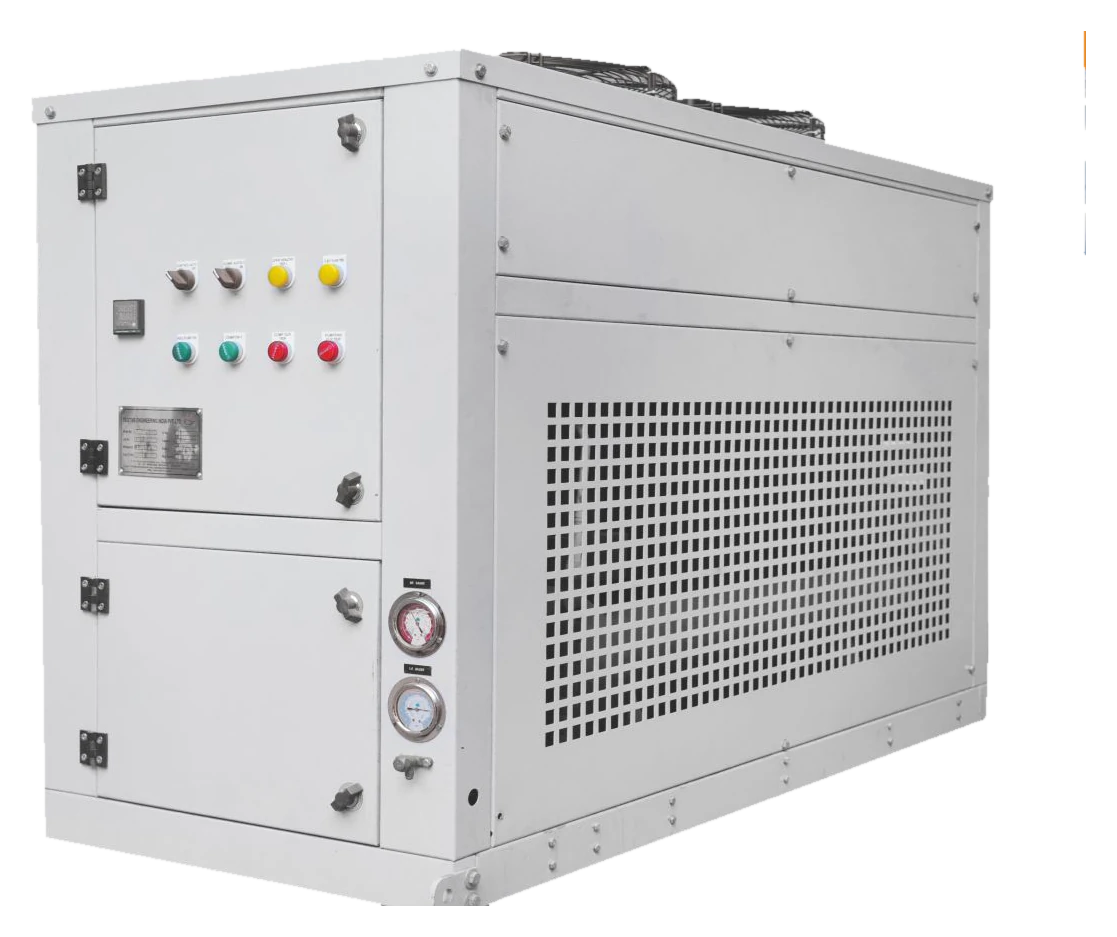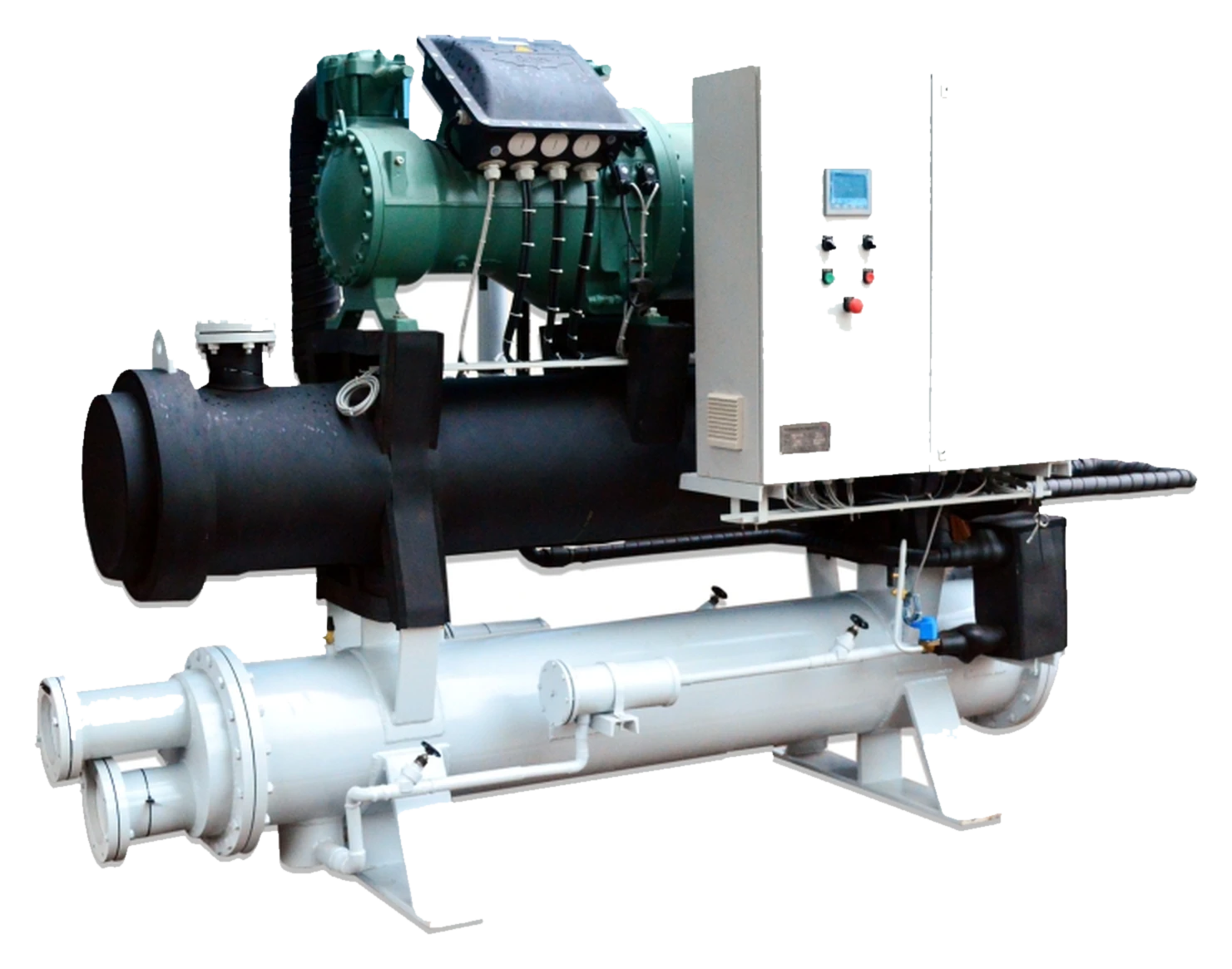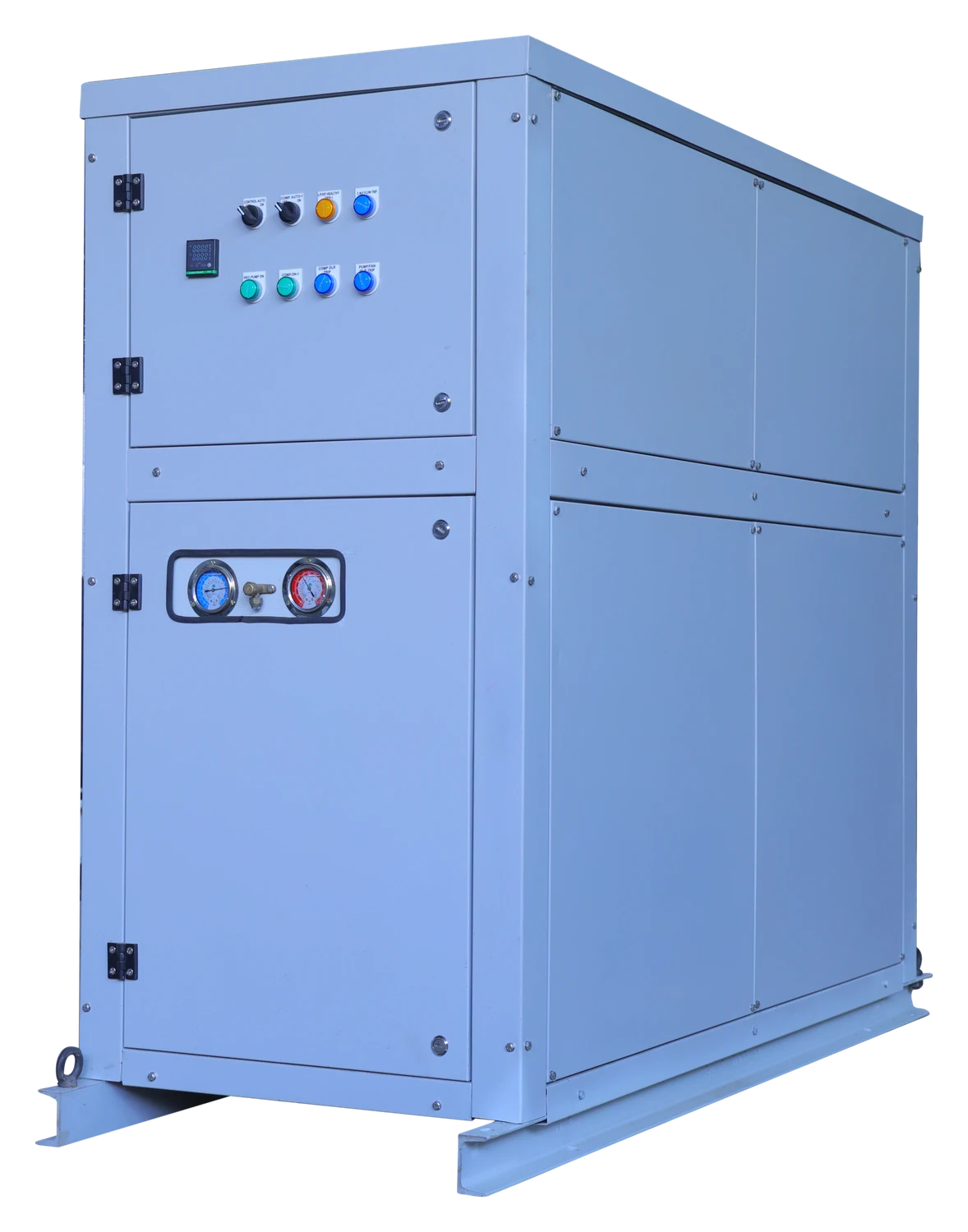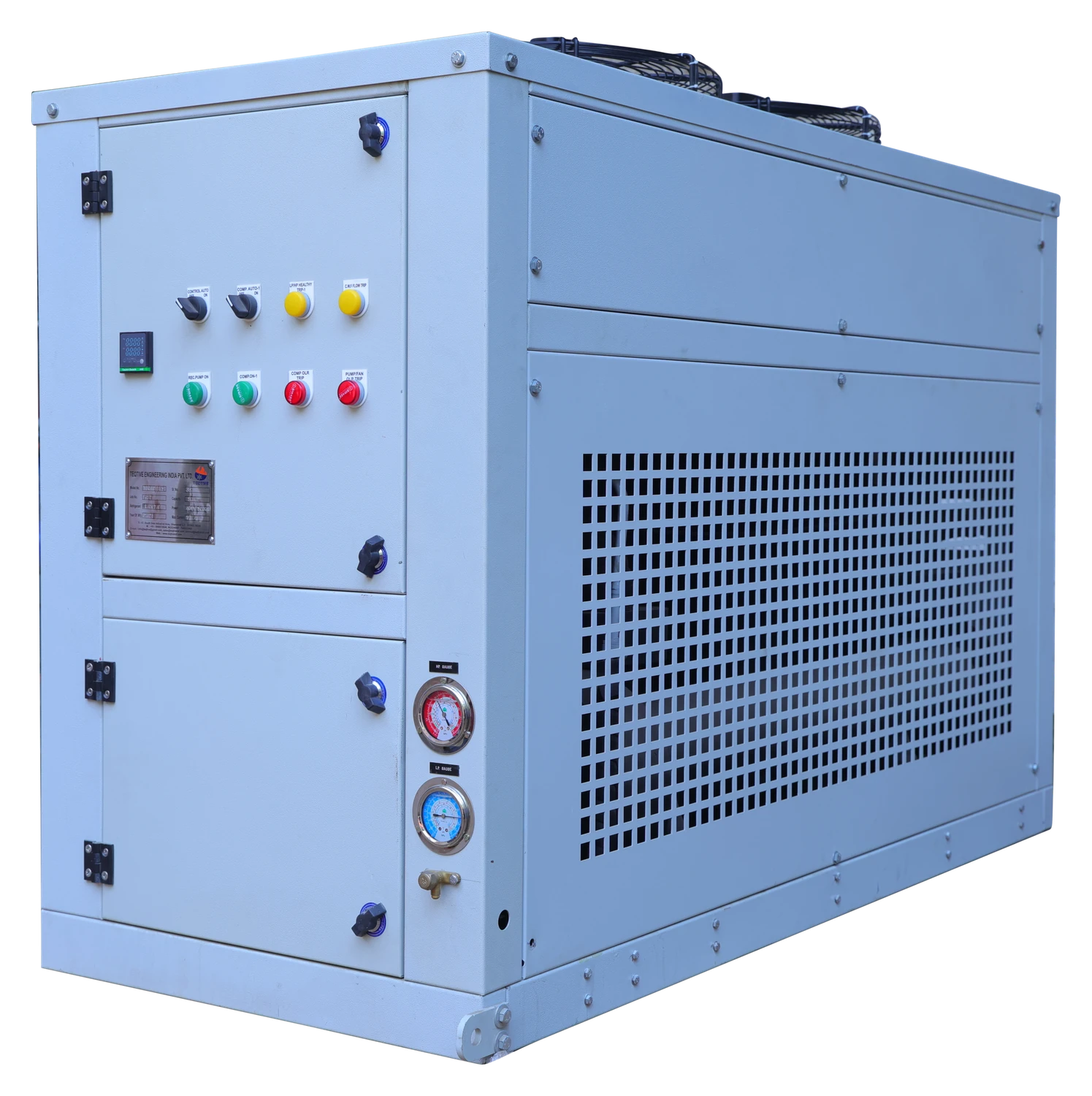
A chiller and a heat pump use the same refrigeration cycle. A chiller is built to deliver cooling at the evaporator and rejects its condenser heat to air or a cooling tower. A heat pump is built to deliver that condenser heat as hot water and treats the cooling as a by-product. When a plant needs both chilled water and hot water, one machine can supply both at the same time.
Same cycle, different useful side
Every vapour-compression machine has four parts: an evaporator that absorbs heat at low temperature, a compressor that raises the refrigerant pressure, a condenser that rejects heat at high temperature, and an expansion device. The cycle is described in how an industrial chiller works. What changes between a chiller and a heat pump is the purpose and therefore the design temperatures:
- A chiller is optimised for a low condensing temperature, because every degree of extra lift costs compressor power.
- A heat pump must condense above the required hot water temperature, so it runs at a high condensing pressure with a compressor and refrigerant chosen for it.
The working principle, COP ranges and applications of heat pumps are covered in industrial heat pump working and applications. This guide concentrates on the comparison and on recovering heat from chillers.
Heat pump vs chiller: comparison
| Aspect | Chiller | Heat pump |
|---|---|---|
| Product | Chilled water, glycol or brine | Hot water, typically 45–90 °C |
| Useful heat exchanger | Evaporator | Condenser |
| Other side | Condenser heat rejected to air or tower | Evaporator takes heat from air or a water source |
| Typical condensing temperature | About 40–50 °C | About 50–95 °C, above the hot water set point |
| Controlled variable | Leaving chilled fluid temperature | Leaving hot water temperature |
| Efficiency figure | Cooling COP or kW/TR | Heating COP |
| Sized on | Cooling load in TR | Heating load in kW |
| Typical users | Process cooling, air conditioning | Hot water for washing, CIP, baths, pre-heating |
COP: why heating COP is cooling COP plus one
Energy in must equal energy out. The condenser rejects everything the evaporator absorbed plus the electrical work put in by the compressor:
Qcondenser = Qevaporator + Wcompressor
Dividing through by the compressor power gives:
COPheating = COPcooling + 1
This is the ideal energy balance for one machine at one operating point. In practice a few percent of compressor heat is lost to the surroundings, so the measured figure is slightly lower. The relation does not mean a heat pump is more efficient than a chiller. A heat pump works across a larger temperature lift, so both of its COP figures are lower than those of a chiller making +7 °C water against 32 °C tower water. How COP relates to kW per TR is explained in chiller efficiency: COP and kW per TR.
Worked example: heat available from a 100 TR chiller
Take a 100 TR water cooled chiller with a compressor drawing 75 kW (0.75 kW per TR).
- Cooling duty = 100 × 3.517 = 351.7 kW
- Condenser heat = 351.7 + 75 = 426.7 kW
- Cooling COP = 351.7 ÷ 75 = 4.69
- Heating COP = 426.7 ÷ 75 = 5.69, which is 4.69 + 1
So about 427 kW of heat leaves this chiller continuously at full load. The catch is the temperature. With a standard condenser that heat is carried by water at only 35–37 °C, which is too cool for most uses. There are two ways to make it useful.
Partial recovery with a desuperheater. The refrigerant leaves the compressor superheated, well above the condensing temperature. A small heat exchanger in the discharge line can take typically 10–20 % of the rejected heat at 55–65 °C without changing the condensing pressure. At 15 %: 426.7 × 0.15 = 64 kW. Heating water from 25 °C to 55 °C, that is 64 × 860 ÷ 30 = about 1,835 litres per hour of hot water at no extra compressor power.
Full recovery at raised condensing temperature. If the machine is built to condense at about 60 °C, nearly all the heat is available as 55 °C water. The compressor works harder. Assume, for illustration, that it now draws 105 kW for the same 100 TR:
- Condenser heat = 351.7 + 105 = 456.7 kW
- Hot water from 25 °C to 55 °C = 456.7 × 860 ÷ 30 = about 13,090 litres per hour
- Cooling COP = 351.7 ÷ 105 = 3.35; heating COP = 456.7 ÷ 105 = 4.35
- Combined COP counting both outputs = (351.7 + 456.7) ÷ 105 = 7.7
The extra 30 kW of compressor power buys 457 kW of usable heat that would otherwise need a boiler or electric heater. The actual power at high condensing temperature depends on the compressor and refrigerant, and a standard chiller cannot simply be turned up to this condition. It has to be selected for it.
Hot water temperatures you can expect
| Source of heat | Typical hot water temperature | Share of rejected heat recovered | Notes |
|---|---|---|---|
| Standard chiller condenser water | 35–40 °C | Up to 100 % | Useful only for pre-heating |
| Desuperheater on a chiller | 55–65 °C | About 10–20 % | No penalty on chiller power; output follows chiller load |
| Heat recovery chiller (raised condensing) | 45–55 °C | Most of it | Compressor power rises; must be designed for the duty |
| Purpose-built industrial heat pump | 45–90 °C | All heat is the product | COP falls as delivery temperature rises |
These are typical ranges. The achievable temperature depends on the refrigerant and compressor envelope and should be confirmed for the specific machine.
Simultaneous heating and cooling
The best case for a heat pump chiller is a site that needs cooling and hot water in the same hours. Common examples are a dairy with chilled water for milk and hot water for CIP, a hotel with air conditioning and hot water for rooms and laundry, a pharmaceutical plant with chilled utilities and hot water loops, and a plating shop with cooling for rectifiers and heating for baths. For plant-level context see dairy and food chillers.
Two practical points decide whether it works:
- The loads must overlap. A machine controlled on cooling produces heat only while there is a cooling load, and the reverse. A hot water storage tank bridges gaps of a few hours. A backup heater or a cooling tower handles the imbalance.
- Decide which side is in control. If cooling is critical, control on chilled water and take whatever heat is available. If hot water is critical, control on the hot side and dump surplus cooling or use a separate source.
Which should you buy?
- Only cooling needed: a chiller, with the lowest practical condensing temperature. Choose the condenser type using air cooled vs water cooled chillers.
- Only hot water needed, up to about 90 °C: a heat pump, air-source or water-source.
- Mainly cooling, some hot water: a chiller with a desuperheater.
- Both needed in similar amounts at the same time: a water-to-water heat pump or heat recovery chiller, with storage on the hot side.
- Steam or water above about 90 °C: a boiler, possibly with a heat pump pre-heating the feed water.
Teqtive heat pumps and chillers
Teqtive manufactures air-to-water and water-to-water industrial heat pumps from 3 kW to 2000 kW delivering hot water from +45 °C to +90 °C, alongside water cooled scroll and water cooled screw chillers for process cooling. Send your cooling load, hot water demand, temperatures and running hours through the contact page and we will check whether one machine can serve both.
Frequently asked questions
What is the difference between a chiller and a heat pump?
Both use the same vapour-compression cycle. A chiller is designed to deliver cooling at its evaporator and throws away the heat at its condenser. A heat pump is designed to deliver heat at its condenser, usually hot water at 45–90 °C, and takes that heat from air or water at its evaporator. The difference lies in which side is useful and in the design temperatures.
Can a chiller be used as a heat pump?
Partly. A standard chiller condenses at about 40–50 °C, so its condenser water is only lukewarm. Adding a desuperheater recovers a portion of the heat at 55–65 °C. For full-flow hot water at 60 °C or more, the machine needs a compressor, refrigerant and condenser selected for high condensing pressure, which is what a purpose-built heat pump is.
What is a heat pump chiller?
A heat pump chiller is a machine that produces chilled water and hot water at the same time, or switches between the two. Water-to-water units chill one water circuit while heating another. Reversible air-source units cool in summer and heat in winter. They suit sites with both a cooling load and a hot water demand.
What is a heat recovery chiller?
A heat recovery chiller is a chiller fitted to capture condenser heat that would otherwise go to the cooling tower or the air. Partial recovery uses a desuperheater to make a small flow of hot water at 55–65 °C. Full recovery uses a second condenser bundle or raised condensing temperature to deliver most of the rejected heat as warm water.
Is heating COP higher than cooling COP?
Yes, for the same machine at the same operating point. The heat delivered at the condenser equals the cooling done at the evaporator plus the compressor power, so heating COP equals cooling COP plus one in an ideal energy balance. A machine with a cooling COP of 3.5 has a heating COP of about 4.5.