A cooling tower cools water by evaporation and can only bring it to a few degrees above the wet-bulb temperature of the air, which is about 30–33 °C in an Indian summer. A chiller uses a refrigeration cycle and can hold water, glycol or brine at any set temperature, from +25 °C down to well below zero. If your process is satisfied with 32–35 °C water, a tower is enough. If it needs anything colder or steadier, you need a chiller.
How a cooling tower works
Warm water is sprayed over fill media while a fan draws air through it. A small fraction of the water evaporates, and the latent heat it takes away cools the rest. Because the driving force is evaporation, the limit is the wet-bulb temperature of the incoming air and not the dry-bulb temperature shown on a thermometer.
Two terms describe every tower:
- Range: hot water in minus cold water out, usually 4–6 °C.
- Approach: cold water out minus wet-bulb temperature, usually 3–5 °C. A closer approach needs a much larger tower.
With a design wet bulb of 28 °C and a 4 °C approach, the tower delivers 32 °C water. No amount of extra fill or fan power will take it below 28 °C.
How a chiller works
A chiller circulates refrigerant through an evaporator, compressor, condenser and expansion valve. The refrigerant boils at low pressure in the evaporator, absorbing heat from the process fluid, and the compressor raises it to a pressure at which it can reject that heat in the condenser. Because the evaporating temperature is set by the machine and not by the weather, a chiller can supply +7 °C water in May, or −30 °C brine if it is built for it. The full cycle is explained in how an industrial chiller works.
Cooling tower vs chiller: comparison
| Aspect | Cooling tower | Chiller |
|---|---|---|
| Cooling method | Evaporation of water into air | Vapour-compression refrigeration |
| Lowest temperature | Wet bulb + 3–5 °C, about 30–33 °C in Indian summer | Any set point: +25 °C to sub-zero with glycol or brine |
| Temperature control | Follows the weather; varies by season and hour | Held at set point, typically within ±1 °C |
| Power use (typical) | Fan and pump only, well under 0.1 kW per TR | 0.6–0.8 kW/TR water cooled, 1.0–1.3 kW/TR air cooled at +7 °C |
| Water use | Continuous make-up for evaporation, drift and blowdown | None in the closed chilled loop; tower make-up if water cooled |
| Water circuit | Open: water is exposed to air, dust and algae | Closed: process water stays clean |
| Capital cost | Low per TR | Several times higher per TR |
| Maintenance | Water treatment, fill cleaning, fan, basin, scale control | Refrigerant circuit, compressor, condenser cleaning, controls |
| Typical uses | Condenser water, furnace and compressor jackets, hot process duties | Moulds, reactors, lasers, dairy, pharma, any duty below about 30 °C |
How they work together on a water cooled chiller
A chiller does not destroy heat. It moves it from the process to the condenser and adds the compressor's own power on the way. A water cooled chiller hands this heat to a cooling tower, so the two machines are partners:
- Chilled water at, say, 7 °C absorbs heat from the process and returns at 12 °C.
- The refrigerant carries that heat to the condenser.
- Condenser water enters at about 32 °C from the tower and leaves at about 37 °C.
- The tower evaporates a little water and sends 32 °C water back.
An air cooled chiller replaces the tower with a finned coil and fans. It needs no water but condenses at a higher temperature, so it draws more power. The trade-off is covered in air cooled vs water cooled chillers.
Worked example: tower for a 100 TR water cooled chiller
Take a 100 TR chiller drawing 0.7 kW per TR at the compressor.
- Cooling load = 100 × 3.517 = 351.7 kW
- Compressor power = 100 × 0.7 = 70 kW
- Heat to reject = 351.7 + 70 = 421.7 kW, which is 421.7 × 860 = 362,660 kcal/h
- Condenser water flow at a 5 °C range = 362,660 ÷ 5 = 72,530 L/h, about 72.5 m³/h
- Evaporation at about 580 kcal per kg of water = 362,660 ÷ 580 = about 625 L/h
- Blowdown at 3 cycles of concentration = 625 ÷ (3 − 1) = about 310 L/h
So the tower consumes a little under 1 m³ of make-up water every hour at full load, about 1.3 % of the circulating flow. Cooling towers are commonly rated in nominal tower tons of 3,750 kcal/h, which already allows for compressor heat. Here 362,660 ÷ 3,750 = 97 tower tons, so a tower of 100 to 120 nominal TR would normally be chosen, selected at the site design wet bulb and not at a catalogue condition.
Which one do you need? Decide by temperature
| Required supply temperature | What to use | Why |
|---|---|---|
| 35 °C and above | Cooling tower alone | Comfortably above summer wet bulb plus approach |
| About 30–35 °C | Cooling tower, checked at monsoon wet bulb | Possible, but the tower must be sized for the worst month |
| 20–30 °C | Chiller; tower can carry the load in cool, dry months | Tower cannot guarantee this in summer or monsoon |
| +5 °C to 20 °C | Water chiller, air cooled or water cooled | Below any wet bulb in India for most of the year |
| Below +5 °C | Glycol or brine chiller | Water would freeze in the evaporator |
Temperature is the first test, but three other points can push a duty from a tower to a chiller even when the temperature allows a tower:
- Stability. Tower water swings by several degrees between a dry afternoon and a humid night. Moulding, laser and reactor duties that need a repeatable temperature need a chiller.
- Water quality. Tower water is open to the air and concentrates dissolved solids. Narrow mould channels and plate heat exchangers scale and foul quickly on it. A closed chilled loop, or a plate heat exchanger between tower and process, avoids this.
- Water availability. Where make-up water is scarce or expensive, an air cooled chiller or a dry cooler may cost less over its life than a tower.
Using both to save power
Many plants split their loads. Hot duties such as hydraulic oil coolers, air compressor jackets and furnace coils run on tower water, and only the duties that genuinely need cold water go to the chiller. Since tower cooling costs a small fraction of chiller cooling per TR, moving even a quarter of the load off the chiller cuts the power bill noticeably. In north India a plate heat exchanger can also let the tower carry part of a 20–25 °C load during winter while the chiller rests.
Before sizing either machine, work out the real heat load with how to calculate chiller tonnage, and compare running costs using COP and kW per TR.
Common mistakes
- Sizing a tower on dry-bulb temperature. Only wet bulb matters.
- Expecting a larger tower to give colder water. It only narrows the approach by a degree or two.
- Running tower water directly through moulds or small heat exchangers without treatment or filtration.
- Undersizing the tower on a water cooled chiller. Every 1 °C rise in condenser water raises compressor power by roughly 2–3 % and brings the high pressure trip closer.
Teqtive chillers
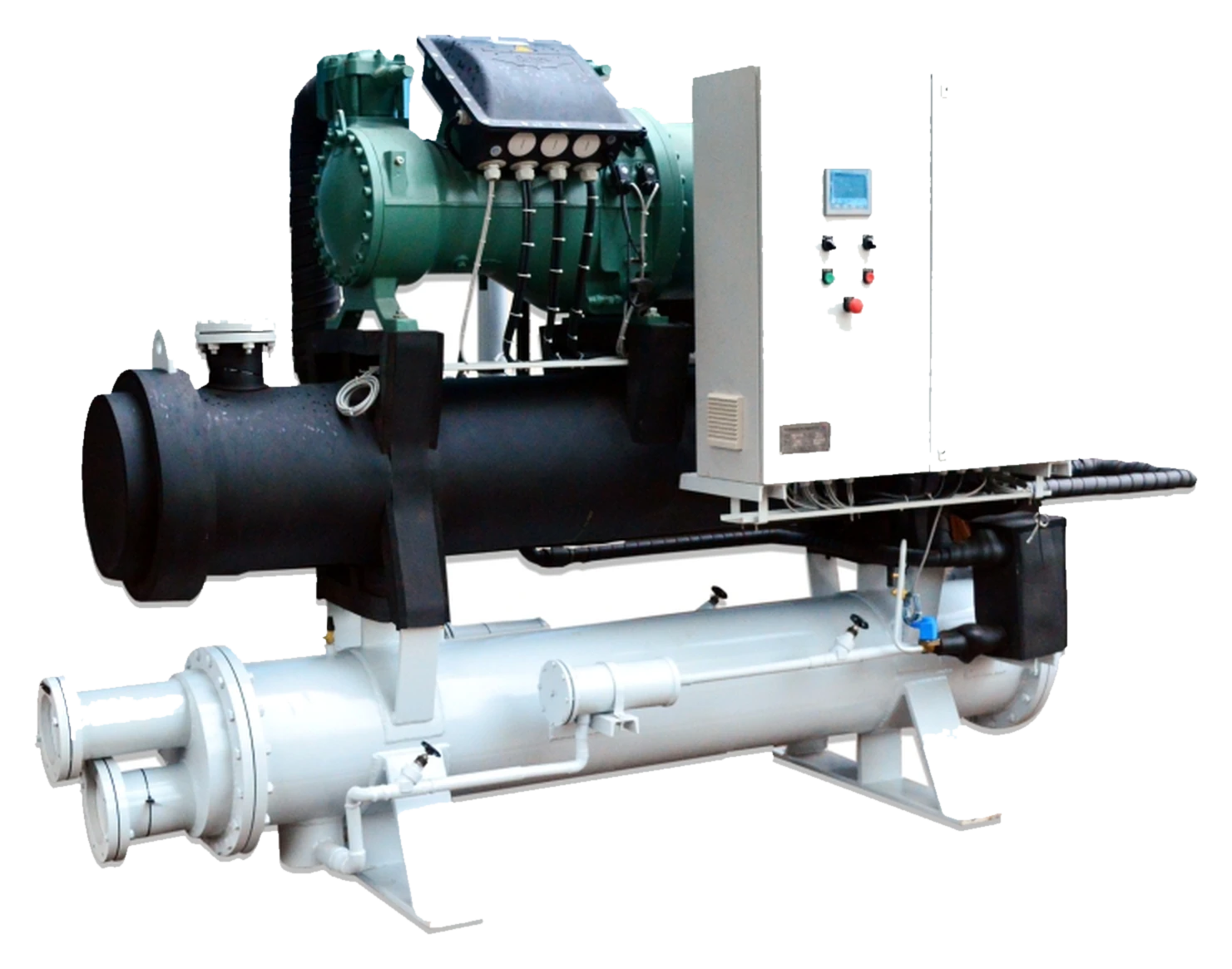
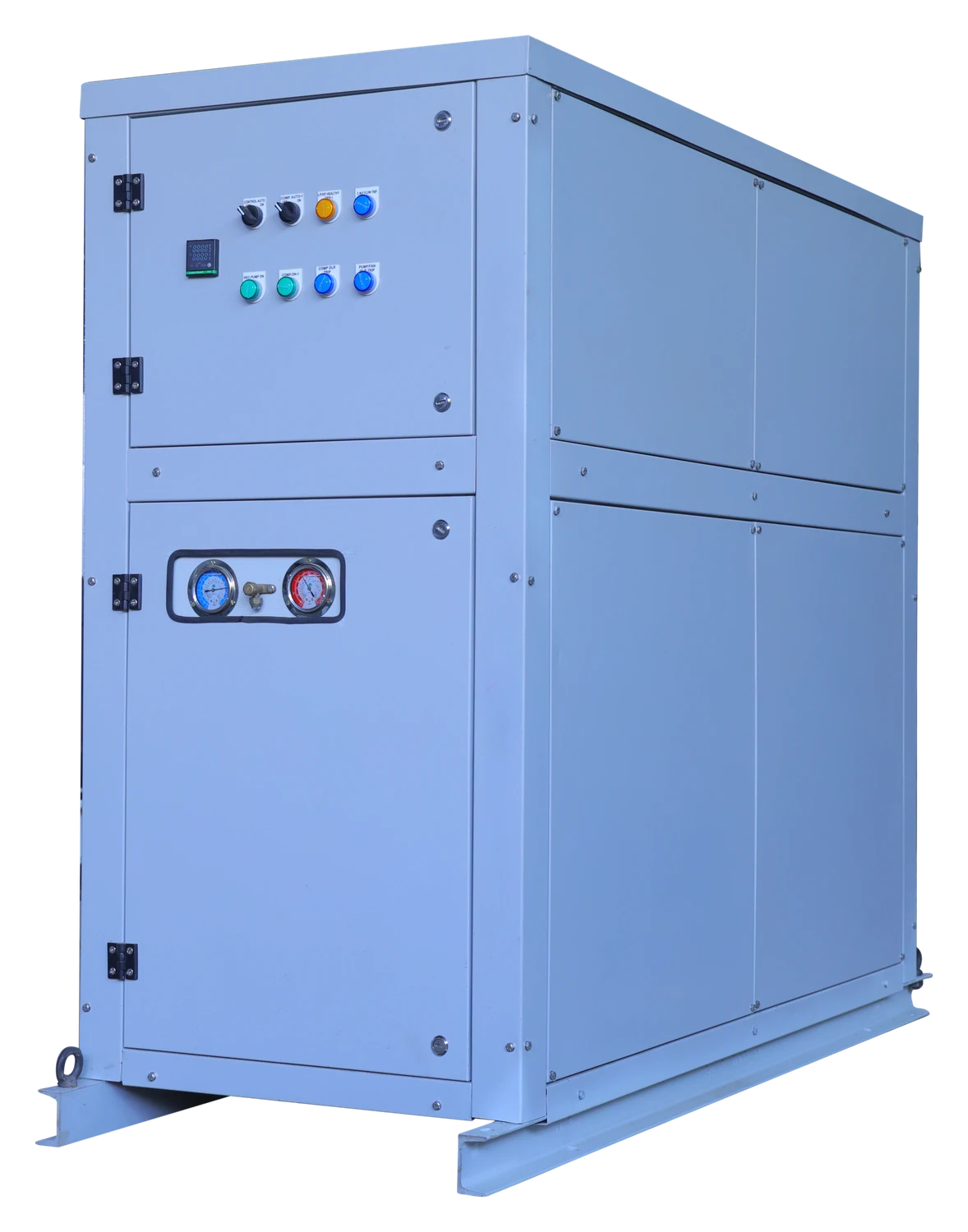
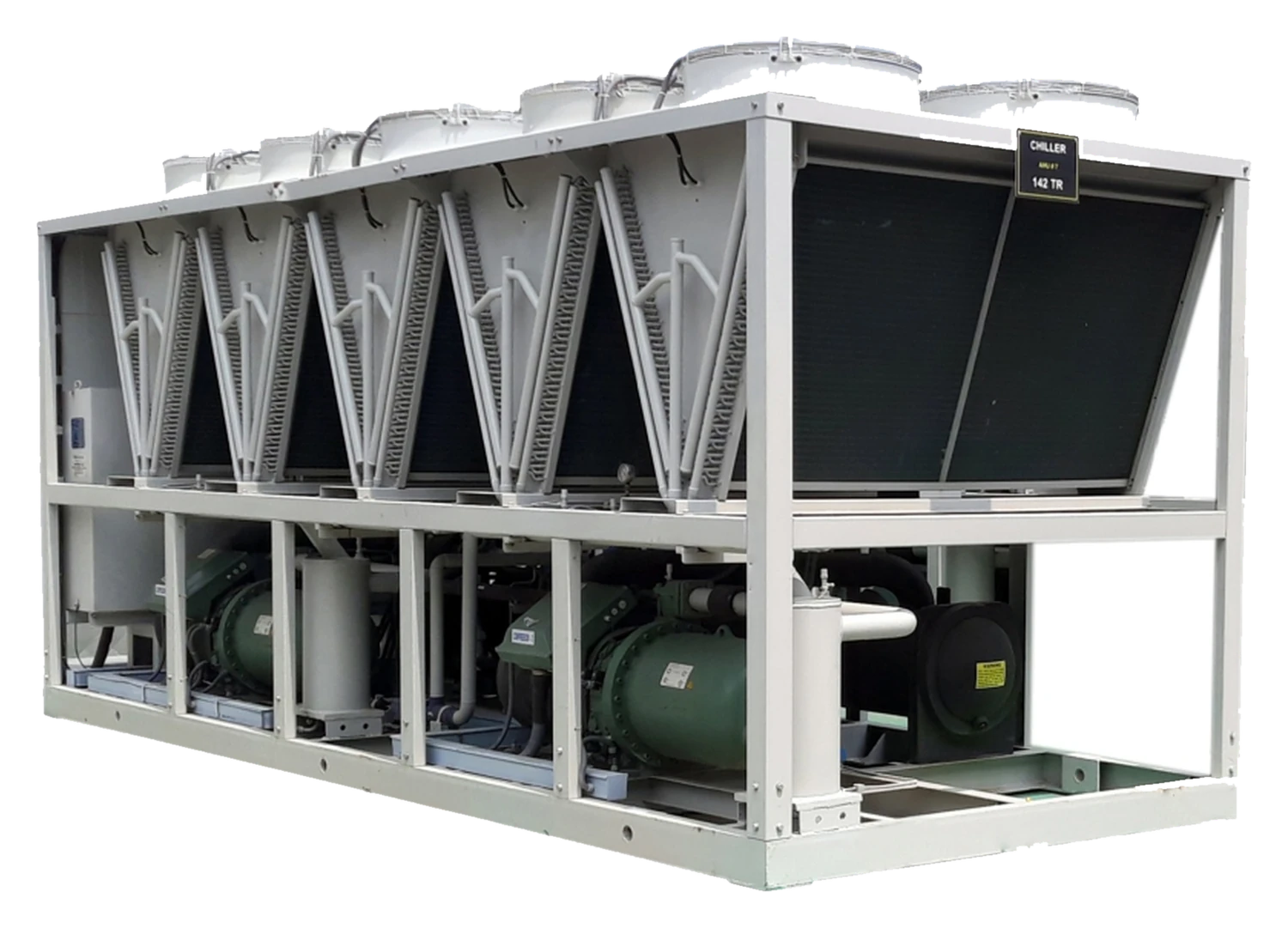
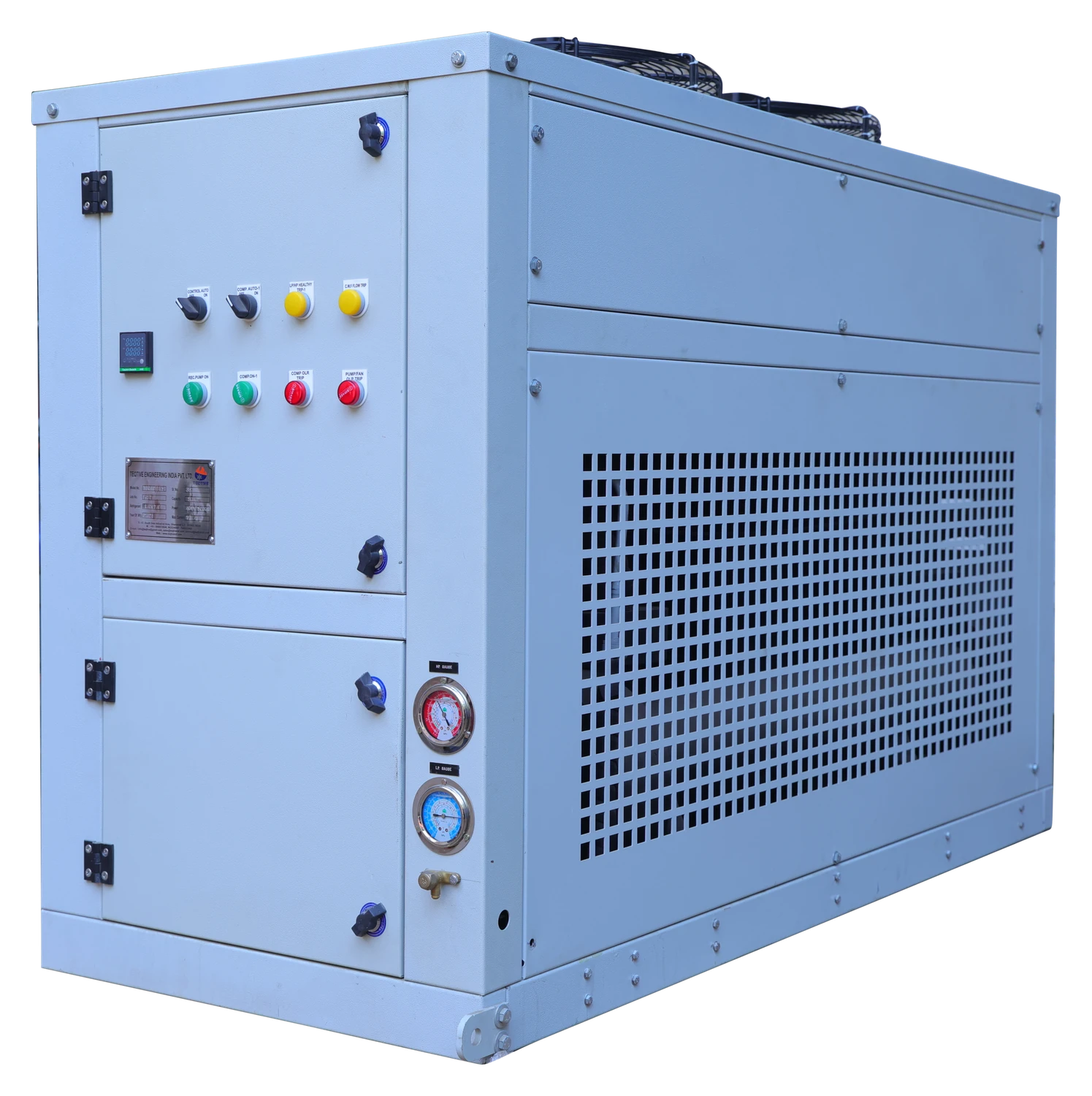
Teqtive builds water cooled scroll chillers and water cooled screw chillers that work with a cooling tower, and air cooled scroll and air cooled screw chillers for sites without one. The full range is on the industrial chillers page. Send your required temperature, heat load and water availability through the contact page and we will tell you whether a tower, a chiller or both fits the duty.
Frequently asked questions
What is the difference between a cooling tower and a chiller?
A cooling tower cools water by evaporating a small part of it into the air, so it can only reach a few degrees above the wet-bulb temperature, about 30–33 °C in Indian summer. A chiller uses a refrigeration compressor and can cool water, glycol or brine to any set temperature, including below 0 °C. The tower uses little power but consumes water; the chiller uses much more power.
Can a cooling tower replace a chiller?
Only if the process accepts water at about 32–35 °C in the worst month. A cooling tower cannot cool below the wet-bulb temperature of the air, whatever its size. If you need water at 25 °C or lower all year, or a temperature held within ±1 °C, a chiller is required. Many plants use a tower for hot duties and a chiller for the rest.
Does a chiller need a cooling tower?
A water cooled chiller does. Its condenser rejects the process heat plus the compressor heat into cooling water, and a cooling tower then releases that heat to the atmosphere. An air cooled chiller has a finned coil and fans instead, so it needs no tower and no make-up water, at the cost of higher power consumption in hot weather.
How cold can a cooling tower make water?
A well-selected tower cools water to within about 3–5 °C of the ambient wet-bulb temperature. With a monsoon wet bulb of 27–29 °C that means supply water at roughly 30–33 °C. In a dry north Indian winter the same tower may give 15–20 °C water. The result follows the weather and cannot be set on a controller.
Which uses more electricity, a chiller or a cooling tower?
The chiller, by a wide margin. A cooling tower needs only a fan and a circulation pump, typically well under 0.1 kW per TR of heat rejected. A chiller compressor draws roughly 0.6–0.8 kW per TR when water cooled and 1.0–1.3 kW per TR when air cooled at +7 °C water, and more at lower temperatures.