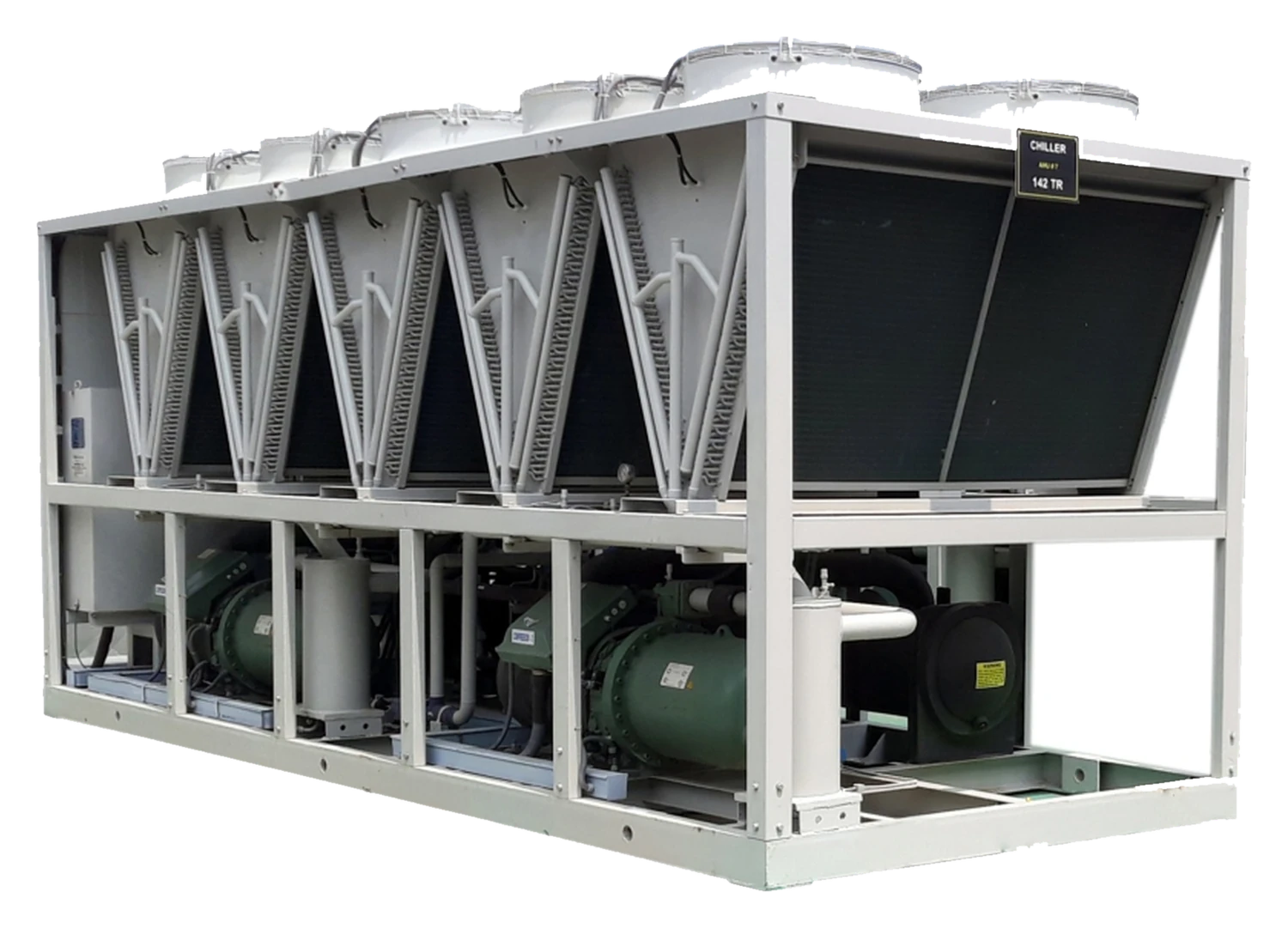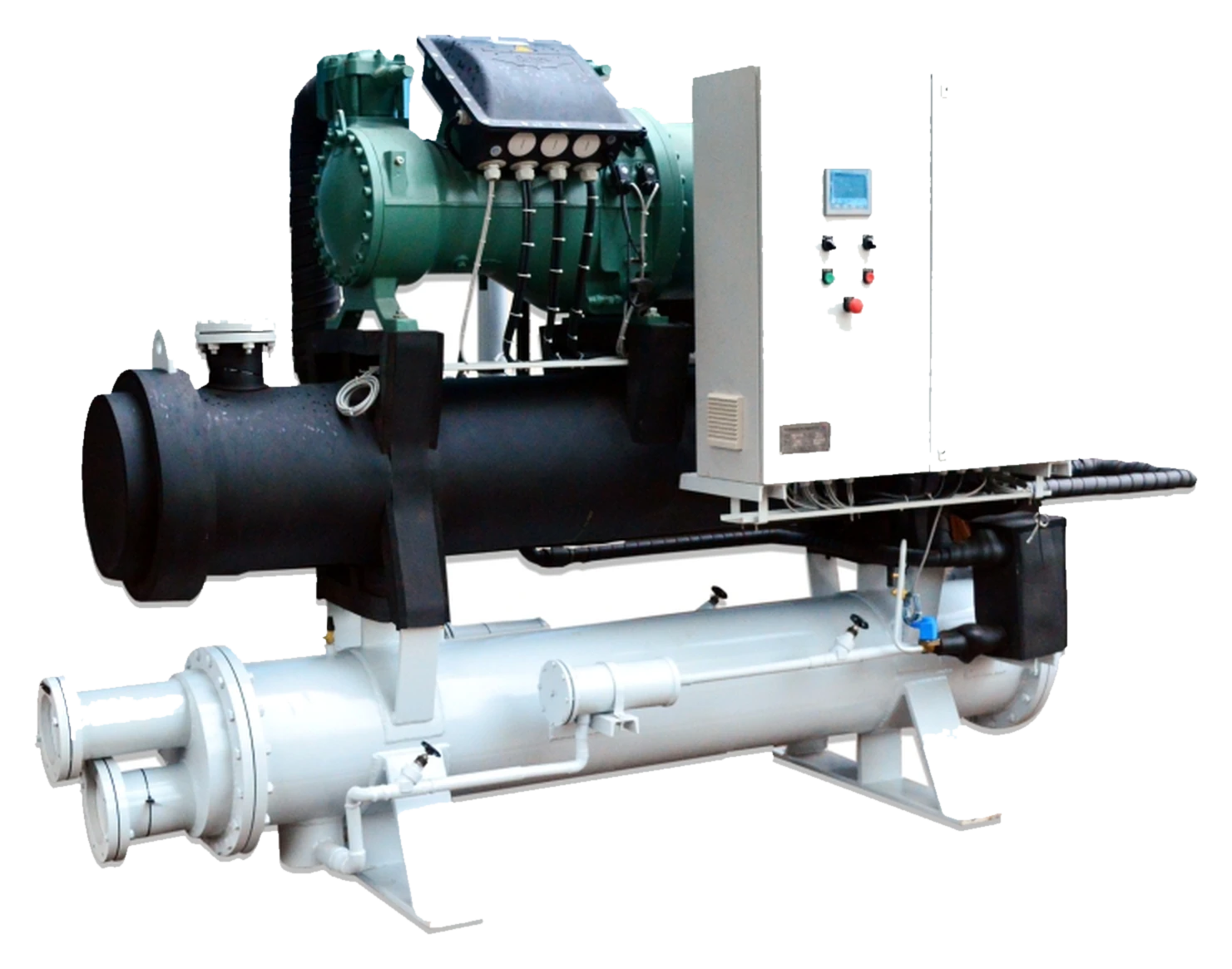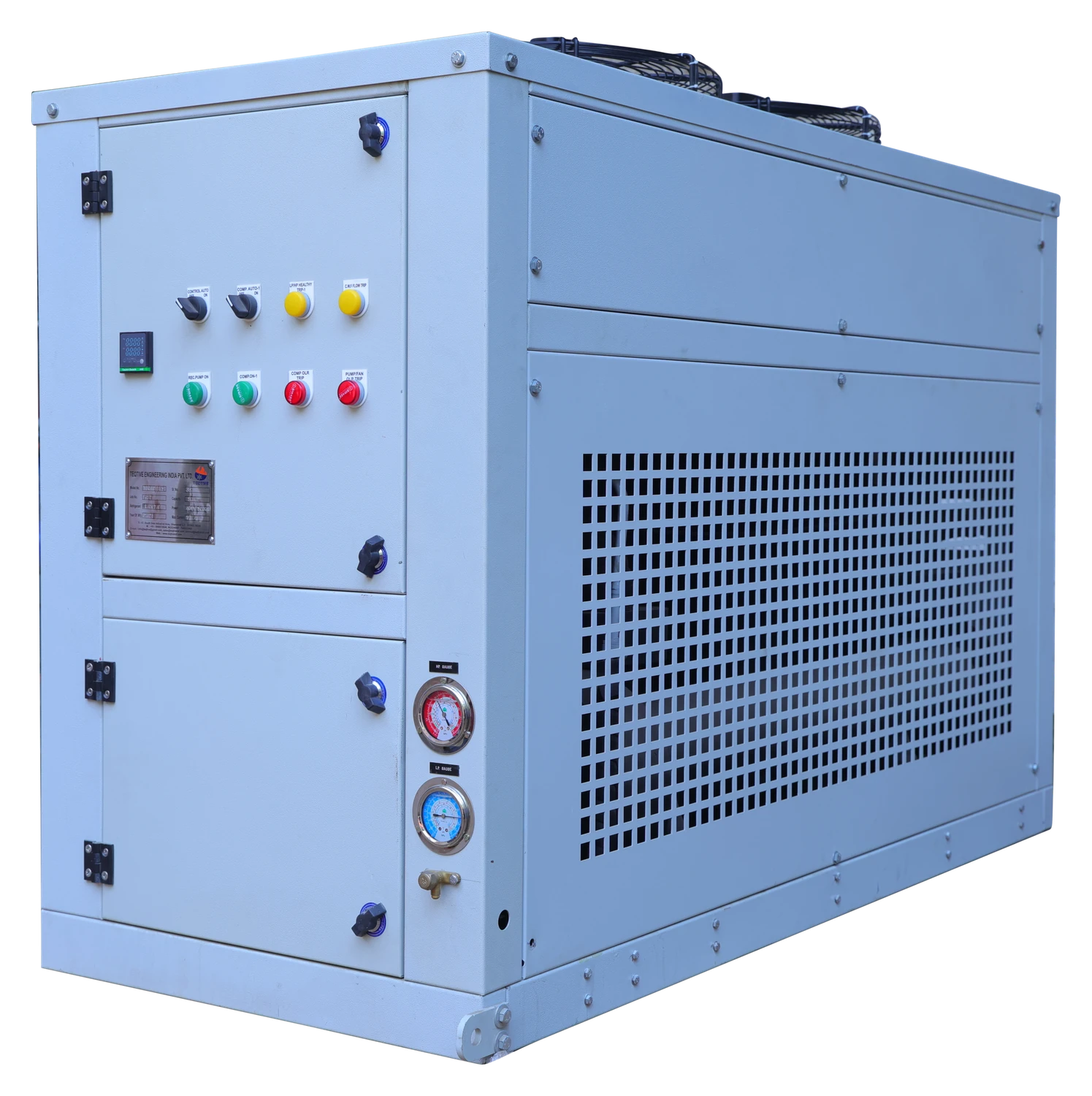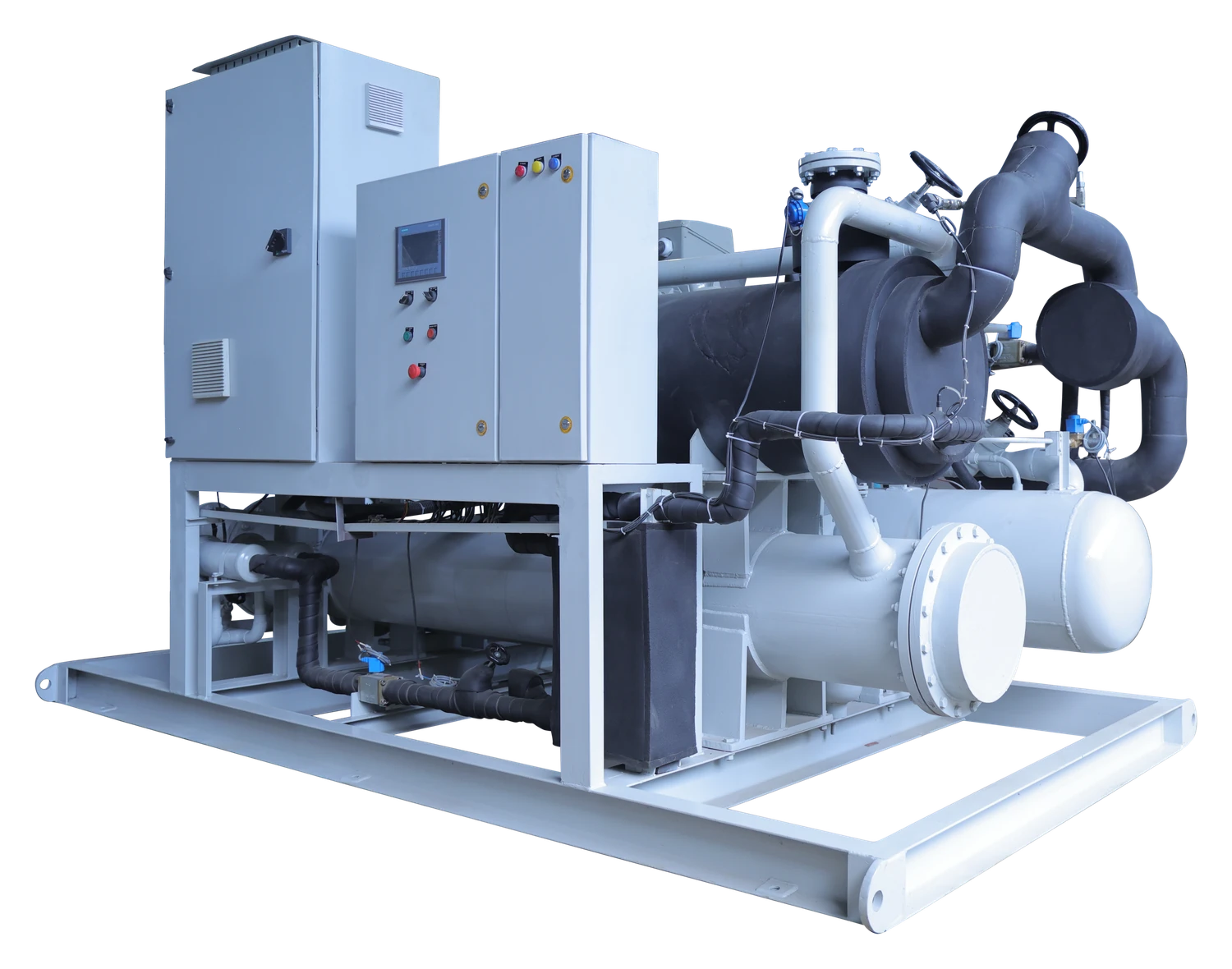
A commercial chiller provides comfort cooling for a building: an office, mall, hotel, hospital or data hall. An industrial chiller removes heat from a process: a mould, a reactor, a laser, a milk silo. They share the same refrigeration cycle, and the real differences are in running hours, temperature range, control accuracy and how much a breakdown costs. Those differences should shape your specification.
What people mean by "commercial chiller"
In the HVAC trade a commercial chiller is the chilled-water machine behind a central air-conditioning system. It sends water at about +6 °C to +7 °C to air handling units and receives it back at about +12 °C. Capacity is stated at standard rating conditions and efficiency is judged on part-load figures, because the building load follows the weather.
The phrase has a second meaning in retail and food service, where "commercial chiller" refers to display and storage refrigerators such as visi coolers, reach-in cabinets and under-counter units. Those are refrigerated cabinets and not water chillers. This guide is about water chillers.
What makes a chiller industrial
An industrial chiller, also called a process chiller, is selected around a production need. The fluid might be water, glycol, brine or oil. The temperature might be +25 °C for a spindle or −40 °C for a reactor jacket. The load is set by throughput and not by the weather, and it is often present 24 hours a day. The engineering differences in evaporators, controls and safeties are covered in detail in process chiller vs HVAC chiller. Here we stay with what matters when you are buying.
Commercial vs industrial chiller: comparison
| Aspect | Commercial (comfort) chiller | Industrial (process) chiller |
|---|---|---|
| What it cools | Air for people, through AHUs and fan coils | A machine, product, reaction or utility |
| Duty cycle | Seasonal and daily; mostly part load | Often continuous; load follows production |
| Temperature range | Chilled water around +6 °C to +12 °C | About +25 °C down to −70 °C depending on type |
| Control accuracy | A swing of 2–3 °C is acceptable | Commonly ±1 °C; tighter for moulds, lasers and reactors |
| Rated condition | Standard rating point, typically 35 °C ambient | Site design point, often 45 °C ambient in India |
| Construction | Optimised for clean plant rooms and rooftops | Heavier exchangers, tank and process pump, materials to suit the fluid |
| Redundancy | N+1 at plant level in large buildings | Dual circuits or a standby unit, because downtime stops production |
| What a failure costs | Discomfort, complaints | Scrap, lost batches, idle machines |
| Efficiency measure that matters | Part-load efficiency (IPLV) | kW/TR at the actual operating point |
Why duty cycle changes the purchase
Consider two 100 TR chillers that both average 0.7 kW per TR. These are illustrative figures, not test data.
- Office building: 2,500 running hours a year at an average of 50 % load. Energy = 100 × 0.5 × 0.7 × 2,500 = 87,500 kWh per year.
- Process plant: 8,000 running hours a year at an average of 85 % load. Energy = 100 × 0.85 × 0.7 × 8,000 = 476,000 kWh per year.
The process chiller uses about 5.4 times the energy and accumulates more than three times the compressor hours. Two consequences follow for the buyer. First, efficiency at the real operating point is worth paying for on a process chiller, since a small difference in kW per TR is multiplied by 8,000 hours. Second, a comfort chiller should be compared on part-load efficiency because it rarely sees full load. See COP and kW per TR and IPLV and NPLV explained.
Catalogue TR versus the TR you actually get
Commercial chillers are quoted at a standard rating point. An industrial enquiry should state the real leaving temperature, fluid and ambient, because capacity changes with all three. As a typical guide, an air cooled chiller loses roughly 1–1.5 % of capacity for each 1 °C rise in ambient, so a unit rated 100 TR at 35 °C may give only about 85–90 TR on a 45 °C afternoon. Lowering the leaving temperature has a larger effect: the same compressor delivers far less at −10 °C glycol than at +7 °C water. Always ask the supplier to state capacity and power at your conditions. The method for arriving at the load is in how to calculate chiller tonnage.
Where the two overlap
The line is not always sharp. Several common duties sit between the two categories, and they are where mis-specification happens most.
| Application | Looks like | Should be specified as | Reason |
|---|---|---|---|
| Data hall cooling | Commercial building | Closer to industrial | Runs every hour of the year at a steady load; needs redundancy |
| Hospital MRI and medical equipment | Commercial building | Process duty | Equipment needs stable water temperature and uninterrupted flow |
| Pharma clean-room air handling | Industrial site | Comfort-type chilled water, with redundancy | +7 °C water for AHUs, but regulated rooms cannot lose cooling |
| Commercial kitchens, bakeries, small dairies | Commercial premises | Process duty | Product cooling at low temperatures with glycol |
| Office block inside a factory | Industrial site | Comfort duty | Seasonal load; keep it off the process loop |
A site that has both kinds of load is usually better served by separate machines. A comfort loop at +7 °C and a process loop at, say, −10 °C glycol cannot share one chiller without running the whole plant at the colder and less efficient condition.
A buyer's checklist
Before sending an enquiry, write down the answers to these questions. They decide which kind of machine you need more reliably than the label does.
- What is being cooled, and with which fluid?
- What supply temperature is needed, and how much variation is acceptable?
- How many hours a year will it run, and at what typical load?
- What is the design ambient or cooling water temperature at site?
- What does one hour of lost cooling cost? This sets the level of standby.
- Is a tank and pump needed in the supplier's scope, or does the site have them?
- Is the installation area dusty, corrosive or classified as hazardous?
If the answers are +7 °C water, seasonal running and a clean plant room, a commercial-type chiller is right. If any answer mentions sub-zero temperatures, tight tolerance, glycol or brine, continuous running or production loss, ask for an industrial chiller and quote the site conditions in the enquiry.
Teqtive chillers
Teqtive manufactures chillers for process duty: air cooled scroll chillers from 5 to 78 TR, air cooled and water cooled screw chillers from 40 to 500 TR, and brine chillers for sub-zero work. The complete range is listed under industrial chillers and budget guidance is in the chiller price guide. Send your answers to the checklist above through the contact page and we will propose a selection at your site conditions.
Frequently asked questions
What is a commercial chiller?
A commercial chiller is a chiller that provides comfort cooling for buildings such as offices, malls, hotels, hospitals and airports. It produces chilled water at about +6 °C to +7 °C for air handling units and fan coil units. It is rated at standard conditions and runs at part load for most of the year. In retail, the same phrase is also used for display refrigerators.
What is the difference between a commercial chiller and an industrial chiller?
A commercial chiller cools a building for people; an industrial chiller removes heat from a machine, product or chemical reaction. Industrial chillers run longer hours, cover a wider temperature range including sub-zero, hold tighter temperature control, and are built for dusty, hot plant conditions. Both use the same refrigeration cycle and often the same compressor types.
Can I use a commercial HVAC chiller for a process application?
Sometimes, if the process needs water at +7 °C or warmer, the load is steady, and a buffer tank and process pump are added. It is a poor fit when the process needs temperatures below about +5 °C, tight control, corrosive or viscous fluids, or continuous full-load running at 45 °C ambient. In those cases specify a process chiller.
Which chiller is used in malls and hotels?
Malls, hotels and large offices generally use water cooled screw or centrifugal chillers with cooling towers for the main plant, because they give the lowest power per TR at large capacity. Smaller buildings and sites short of water use air cooled scroll or screw chillers on the roof. All supply chilled water at about +7 °C to air handling units.
Are industrial chillers more expensive than commercial chillers?
For the same nominal TR an industrial chiller often costs more, because it may include a tank and process pump, heavier heat exchangers, special materials, low-temperature components and standby circuits. Compare offers on capacity at your actual conditions and on scope of supply, not on catalogue TR. Budget guidance is in the Teqtive chiller price guide.