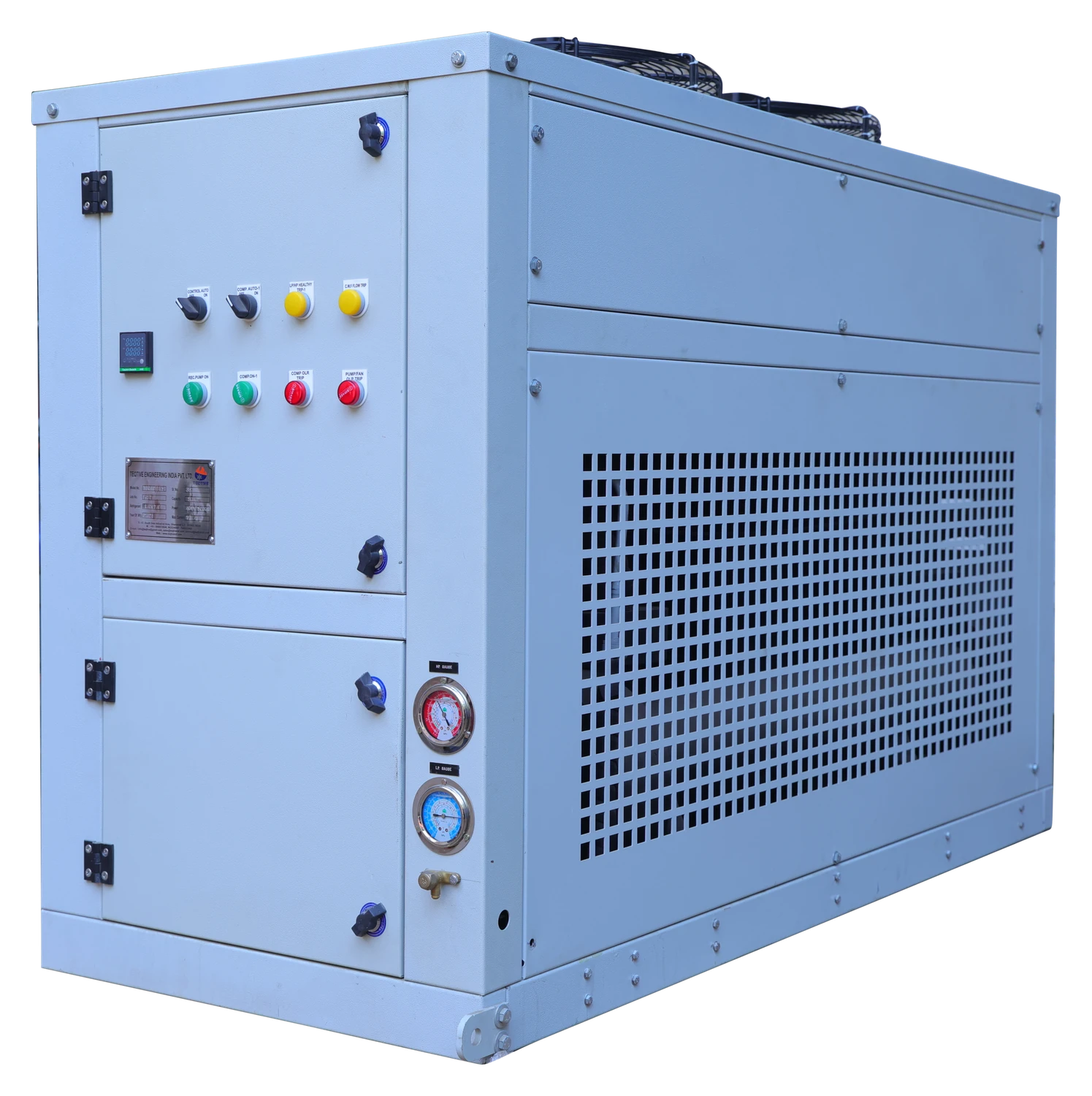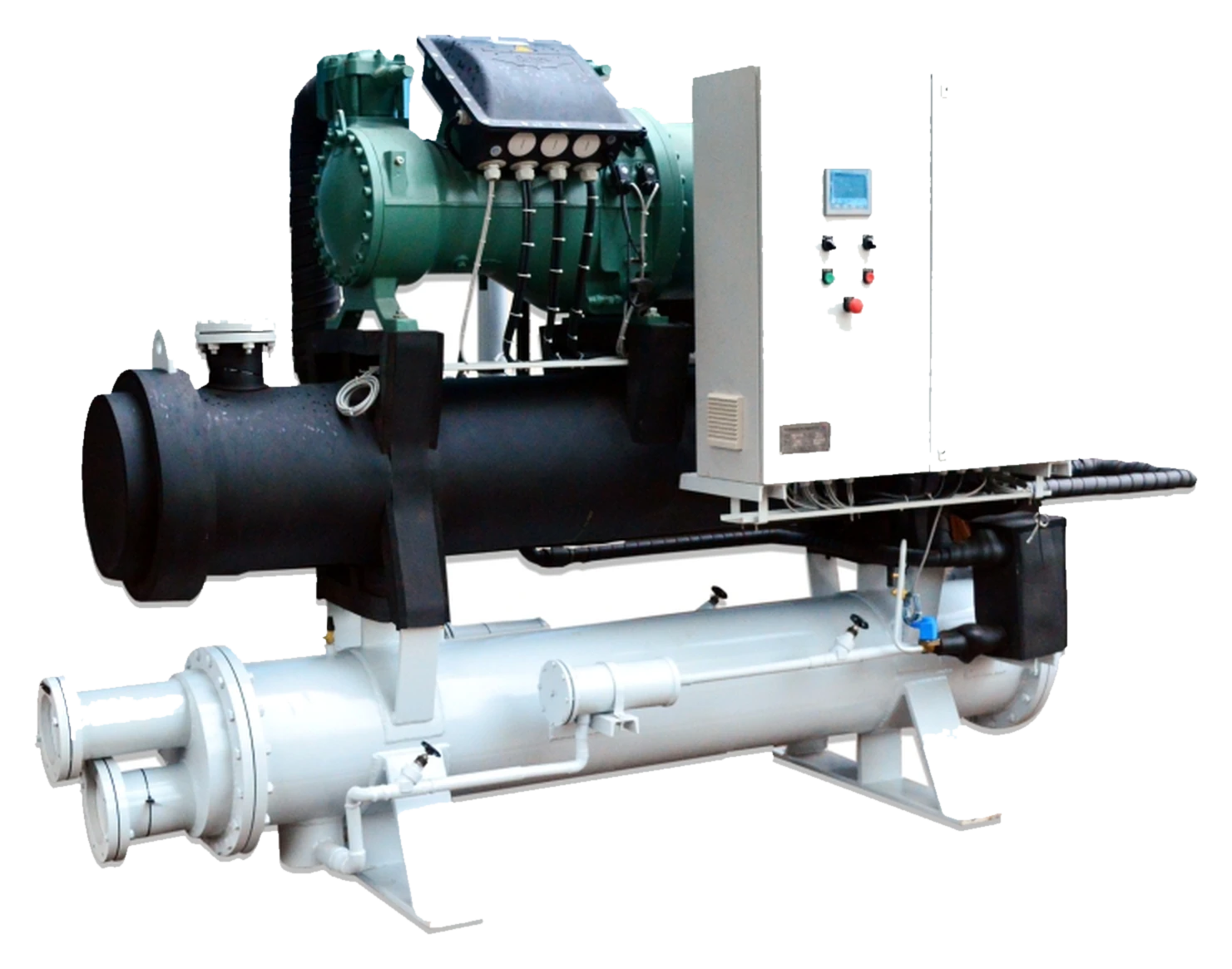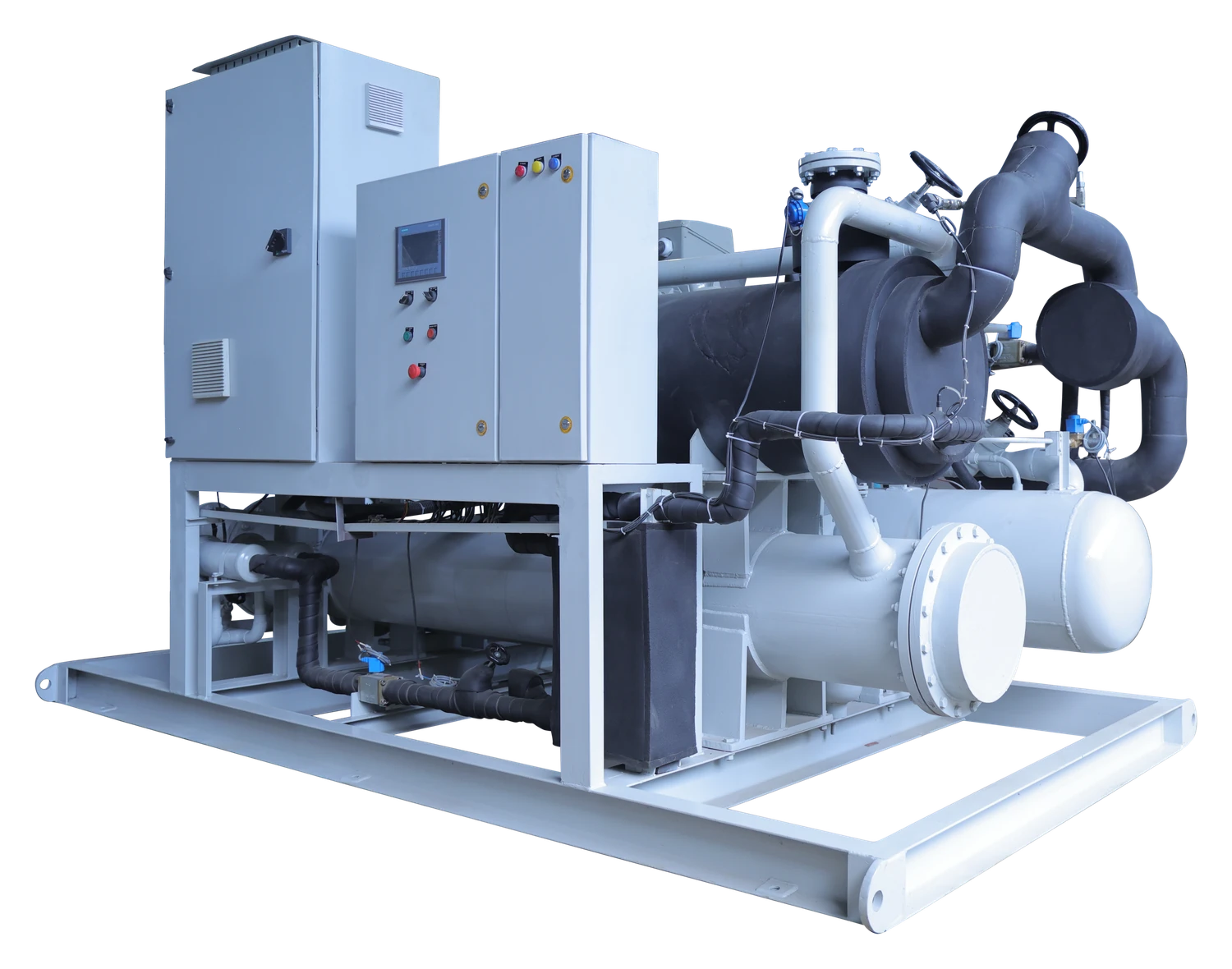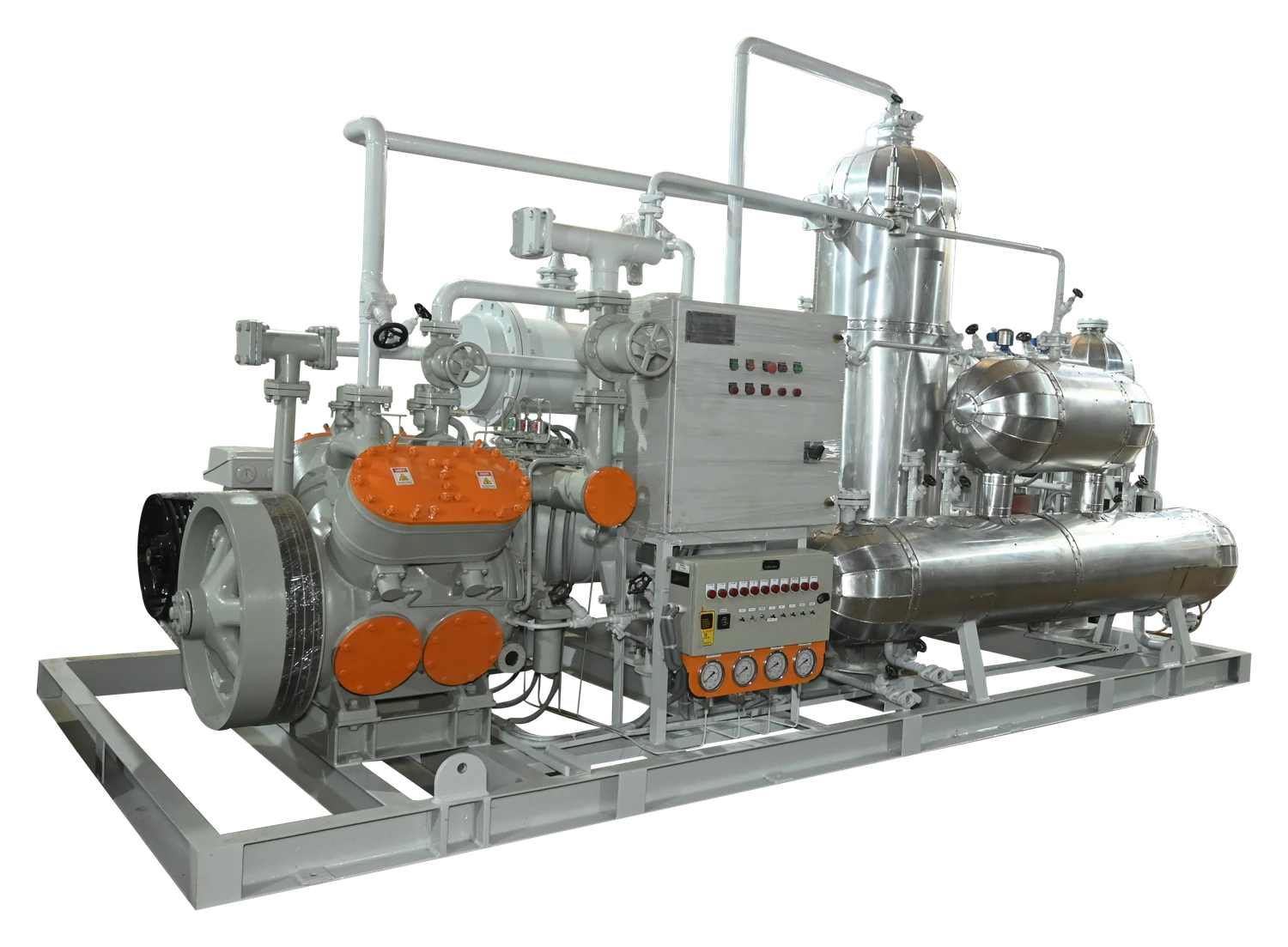
Most industrial chillers in service today use an HFC refrigerant: R-134a in screw machines, R-407C or R-410A in scroll machines, and R-404A or R-507A for low-temperature brine duty. Large plants often use ammonia (R-717), and many older chillers still run on R-22. The right choice depends on the temperature you need, the size of the plant and how long you expect to run it.
Safety, ODP and GWP at a glance
ASHRAE Standard 34 gives each refrigerant a safety class. The letter is toxicity (A lower, B higher) and the number is flammability (1 no flame propagation, 2L mildly flammable, 2 flammable, 3 highly flammable). GWP figures below are 100-year values from the IPCC Fourth Assessment Report (AR4), the set used by most regulations.
| Refrigerant | Type | ASHRAE safety class | ODP | GWP (AR4, 100-yr) | Typical chiller use |
|---|---|---|---|---|---|
| R-22 | HCFC | A1 | 0.055 | 1810 | Legacy chillers of all types; not for new equipment |
| R-134a | HFC | A1 | 0 | 1430 | Screw and centrifugal water chillers |
| R-407C | HFC blend | A1 | 0 | 1774 | Scroll and screw chillers; R-22 retrofits |
| R-410A | HFC blend | A1 | 0 | 2088 | Scroll chillers, usually up to medium sizes |
| R-404A | HFC blend | A1 | 0 | 3922 | Low-temperature brine chillers and condensing units |
| R-32 | HFC | A2L | 0 | 675 | Newer scroll chillers replacing R-410A |
| R-1234ze(E) | HFO | A2L | 0 | under 10 | Newer screw and centrifugal chillers |
| R-290 (propane) | Hydrocarbon | A3 | 0 | 3 | Small and medium chillers with limited charge |
| R-717 (ammonia) | Natural | B2L | 0 | 0 | Large industrial plants, dairies, cold stores, breweries |
| R-744 (CO₂) | Natural | A1 | 0 | 1 | Low stage of cascade plants; transcritical systems |
Pressure and temperature range
Two physical properties do most of the selection work. The normal boiling point is the temperature at which the refrigerant boils at atmospheric pressure. Evaporating below it puts the suction side in vacuum, so any leak draws in air and moisture. The condensing pressure sets the strength of the compressor, vessels and piping.
| Refrigerant | Normal boiling point | Saturation pressure at 40 °C (bar abs, approx.) | Practical fluid outlet range (typical) |
|---|---|---|---|
| R-22 | −40.8 °C | 15.3 | +20 °C to −35 °C |
| R-134a | −26.1 °C | 10.2 | +25 °C to about −10 °C |
| R-407C | −43.6 °C (bubble) | 17.5 (bubble) | +25 °C to about −10 °C |
| R-410A | −51.4 °C | 24.2 | +25 °C to about −10 °C |
| R-404A | −46.2 °C | 18.2 | 0 °C to −40 °C |
| R-32 | −51.7 °C | 24.8 | +25 °C to about −10 °C |
| R-1234ze(E) | −19.0 °C | 7.7 | +25 °C to about 0 °C |
| R-290 | −42.1 °C | 13.7 | +20 °C to −35 °C |
| R-717 | −33.3 °C | 15.6 | +10 °C to −40 °C (two-stage at the cold end) |
| R-744 | −78.4 °C (sublimes) | Supercritical above 31 °C | −30 °C to −50 °C as a cascade low stage |
The outlet ranges are typical practice, not hard limits. The actual envelope is set by the compressor maker for each model.
R-134a vs R-407C vs R-410A
R-134a
A single-component refrigerant with moderate pressure. Its low vapour density means a large swept volume per TR, which suits screw and centrifugal compressors. With a boiling point of −26.1 °C it is a poor choice for brine much below −10 °C.
R-407C
A blend of R-32, R-125 and R-134a with pressures close to R-22, which made it the standard R-22 replacement. It is zeotropic: it boils over a range of about 5–7 K (temperature glide). The blend can separate in a flooded evaporator, so it is used with direct-expansion evaporators, and it must be charged as liquid.
R-410A
A near-azeotropic blend of R-32 and R-125 with almost no glide. It runs at about 24.2 bar absolute at 40 °C against 15.3 for R-22, roughly 60 % higher, so it needs purpose-built compressors and heat exchangers. In return the high vapour density gives small compressors and pipework, which is why it dominates scroll chillers.
Low-temperature refrigerants
For brine at −20 °C to −40 °C, R-404A and R-507A have been the usual HFC choices because their suction pressure stays above atmospheric down to about −46 °C. Their GWP is the highest in the table, so they are the first HFCs to come under pressure. Ammonia covers the same range in large plants. Below about −45 °C a second refrigerant is needed in a cascade circuit; see the cascade condenser explained.
Ammonia, propane and CO₂
Ammonia has a very high latent heat and excellent efficiency, costs little and has zero ODP and GWP. It is toxic and mildly flammable, attacks copper, and needs steel pipework, open-drive compressors and a properly ventilated machine room. That overhead is justified on large plants. The comparison is in ammonia vs Freon refrigeration.
Propane performs much like R-22 but is highly flammable, so charge size is limited and electrical components must be suitable for a flammable atmosphere. CO₂ is non-flammable and non-toxic but works at very high pressure and cannot condense above 31 °C, so in industrial refrigeration it mainly serves as the low stage of a cascade.
Worked example: what a charge means in CO₂ terms
CO₂-equivalent = charge (kg) × GWP. Take a chiller holding 40 kg of refrigerant:
- R-410A: 40 × 2088 = 83,520 kg, about 83.5 tonnes CO₂e
- R-134a: 40 × 1430 = 57,200 kg, about 57.2 tonnes CO₂e
- R-290: 40 × 3 = 120 kg CO₂e
If 5 % of the R-410A charge leaks in a year, that is 2 kg, or 2 × 2088 = 4,176 kg CO₂e. In practice the charge differs between refrigerants for the same capacity, but the order of magnitude explains why regulation is aimed at high-GWP gases and why leak-tightness matters.
Phase-out and phase-down
- R-22 is an HCFC being phased out under the Montreal Protocol. Do not specify it for new equipment, and plan for rising service-gas cost on existing plants.
- HFCs have zero ODP but are being phased down globally under the Kigali Amendment, which India has ratified. India's schedule starts later than that of developed countries, so HFC chillers remain legal and serviceable, but supply will tighten over the life of a new machine.
- Retrofits: R-407C can replace R-22 with a change from mineral to POE oil. R-410A cannot be put into an R-22 system.
How to choose
- Fix the fluid outlet temperature; it rules out refrigerants that would evaporate in vacuum.
- Match the compressor: scroll machines favour R-410A, R-407C and R-32; screws favour R-134a, R-407C and ammonia.
- Check site constraints for flammable or toxic refrigerants.
- Compare efficiency at your conditions using COP and kW/TR, and confirm charge and pressures with superheat and subcooling readings at commissioning.
Teqtive chillers and refrigerant selection
Teqtive selects the refrigerant for each machine from the duty temperature and capacity: packaged scroll and screw chillers for chilled water, brine chillers to −40 °C, cascade chillers to −70 °C and ammonia chillers from 20 to 1000 TR. Tell us your temperature, load and any site restriction on refrigerants, and we will recommend a suitable option.
Frequently asked questions
Which gas is used in a chiller?
Most packaged industrial water chillers use an HFC refrigerant: R-134a in screw chillers, and R-407C or R-410A in scroll chillers. Low-temperature brine chillers commonly use R-404A or R-507A. Large industrial plants often use ammonia (R-717). Older machines still run on R-22, and newer designs are moving to R-32, R-1234ze(E) and propane (R-290).
What is the difference between R-134a, R-407C and R-410A?
R-134a is a single-component, medium-pressure refrigerant suited to screw compressors. R-407C is a three-component blend with pressures close to R-22 and a temperature glide of about 5–7 K. R-410A works at roughly 60 % higher pressure than R-22, has almost no glide and gives compact scroll chillers. Their GWP values are 1430, 1774 and 2088.
Is R-22 still used in chillers?
Many existing chillers still run on R-22, but it is an ozone-depleting HCFC being phased out under the Montreal Protocol and should not be specified for new equipment. Service gas is becoming scarcer and more expensive. Existing plants are usually kept running until a major repair and then retrofitted or replaced.
Which chiller refrigerant has the lowest GWP?
Among common chiller refrigerants, ammonia (R-717) has a GWP of 0, CO₂ (R-744) has 1, propane (R-290) has 3 and R-1234ze(E) is under 10. All four have zero ozone depletion potential. Each brings a design constraint: toxicity for ammonia, very high pressure for CO₂, and flammability for propane and, mildly, for R-1234ze(E).
Can I replace R-22 with R-407C or R-410A in an old chiller?
R-407C is the common retrofit choice because its pressures are close to R-22, but the mineral oil must be changed to POE oil and capacity may drop slightly. R-410A cannot be used as a retrofit, because its pressures are far above what R-22 compressors, vessels and piping were designed for.