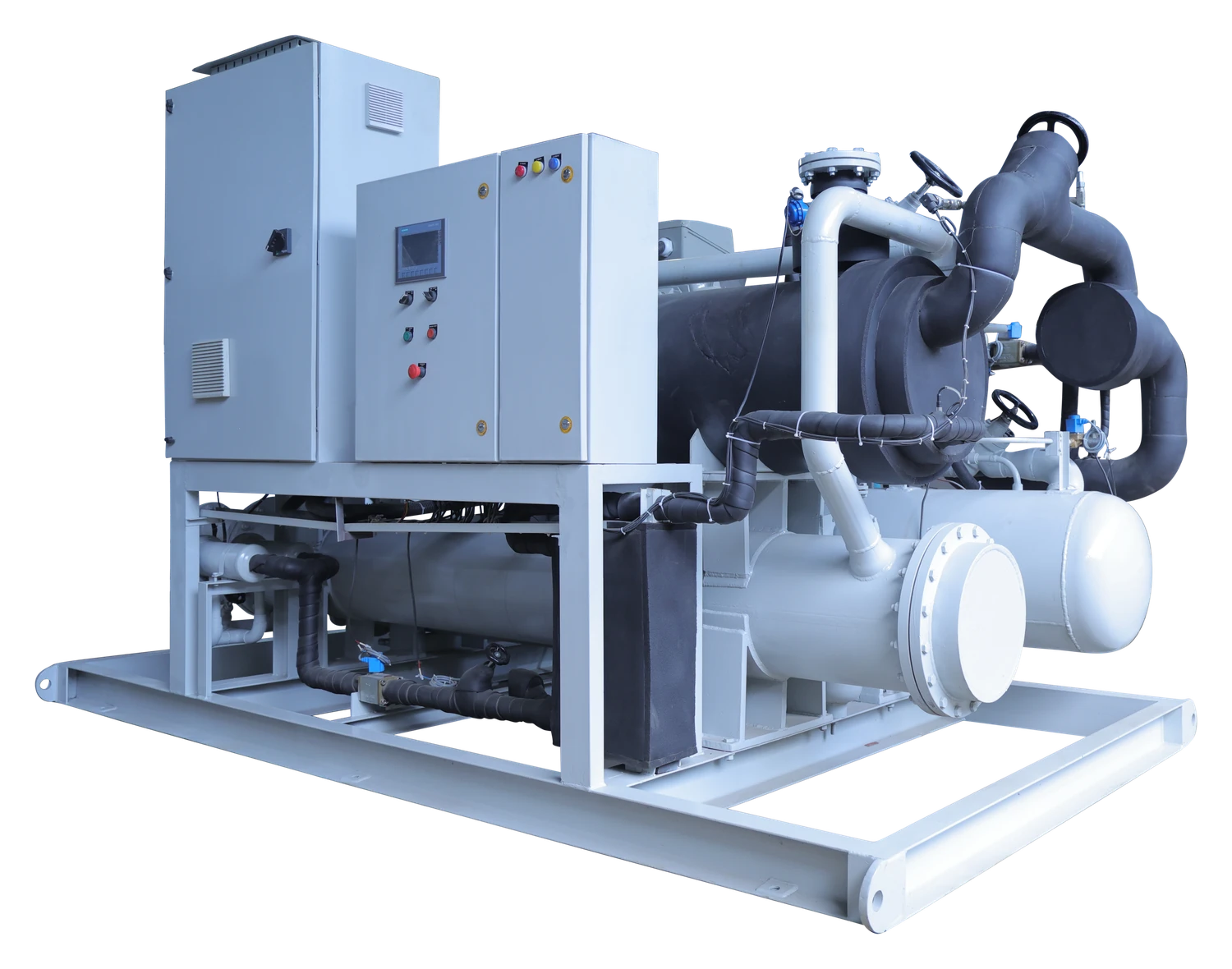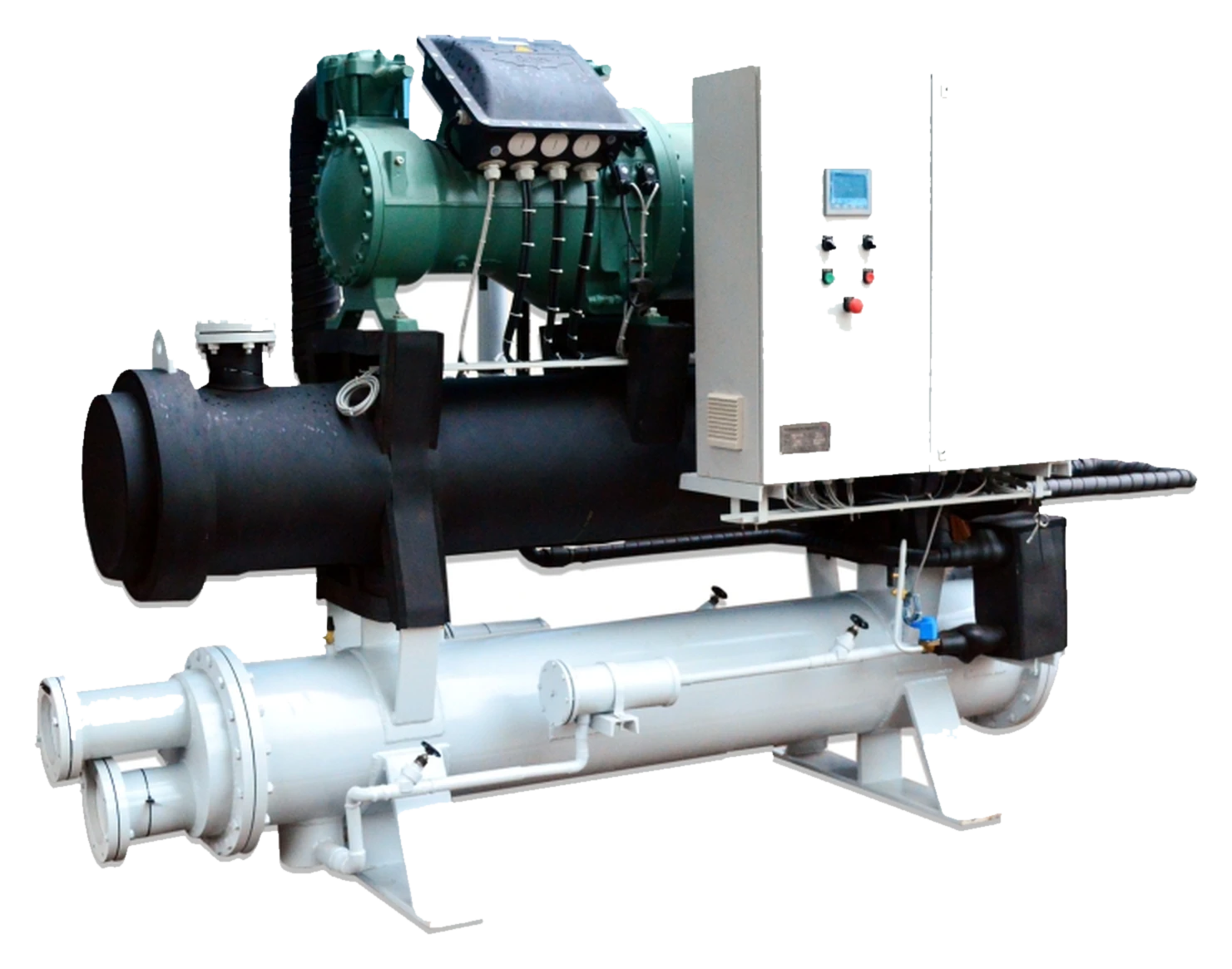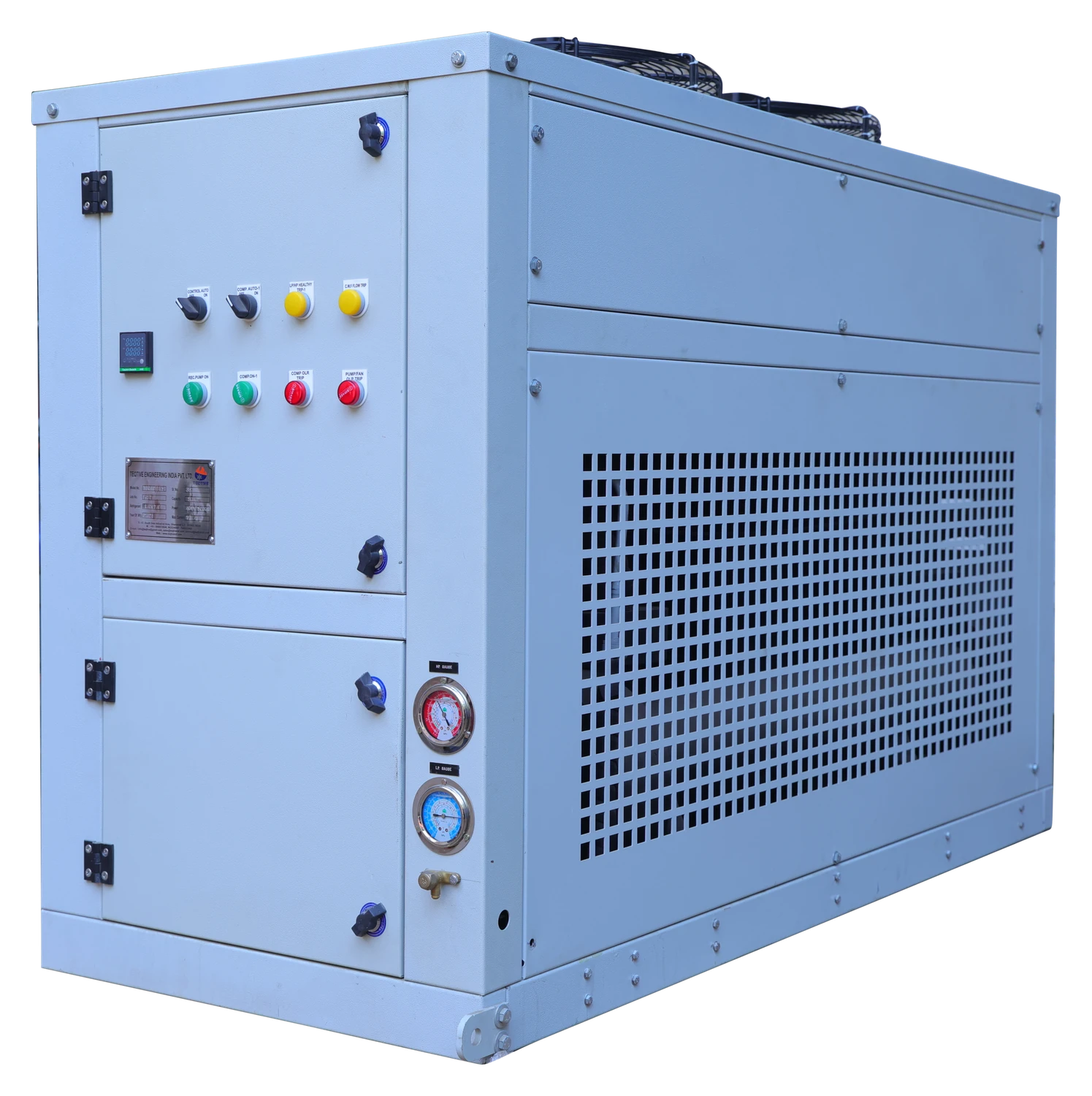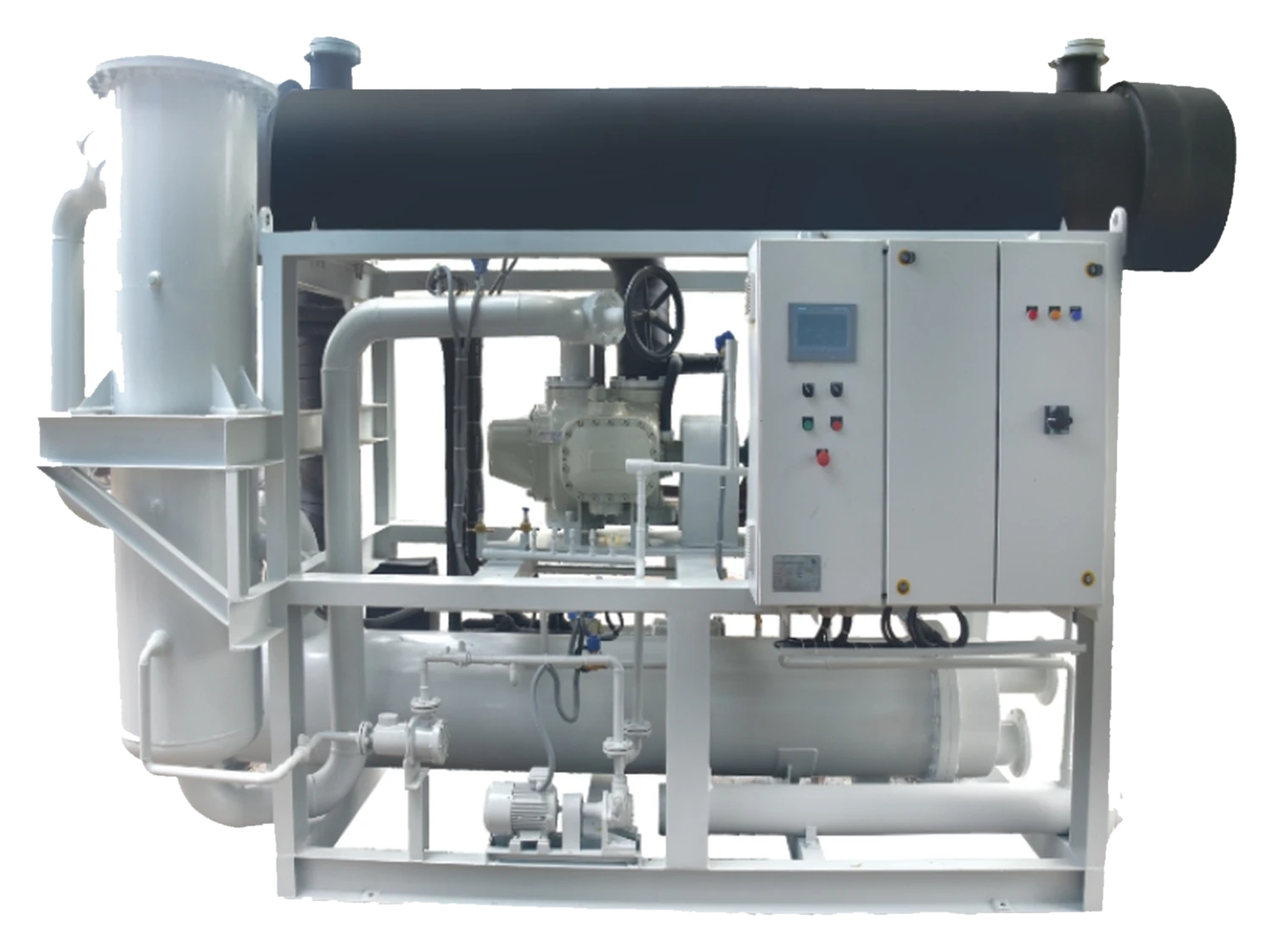
If your process needs coolant above +5 °C, you need a water chiller. If it needs anything colder, you need a brine chiller. That one-line rule covers most enquiries, but the engineering behind it explains why the two machines differ so much in size, power and price for the same nameplate tonnage.
Quick comparison
| Aspect | Water chiller | Brine chiller |
|---|---|---|
| Coolant | Plain or treated water | Glycol, methanol, calcium chloride or other antifreeze solution |
| Outlet temperature | +5 °C to +25 °C | 0 °C to −40 °C single stage; to −70 °C with cascade |
| Evaporating temperature | About 0 °C to +2 °C | About −8 °C to −48 °C |
| Compressor | Scroll or screw selected for medium/high temperature | Reciprocating or screw selected for low temperature, often with economiser |
| Evaporator | Sized for water | Larger surface for viscous brine; SS options for corrosive brines |
| Insulation | 19–25 mm nitrile rubber | 50–100 mm PUF or nitrile with vapour barrier |
| Power per TR | About 0.7–1.2 kW/TR | About 1.3–3.5 kW/TR, rising as temperature falls |
| Typical users | Plastics, lasers, machine tools, HVAC, food process water | Pharma and chemical reactors, condensers, dairies, breweries, cold rooms, ice rinks |
Why water stops at +5 °C
For heat to flow, the refrigerant in the evaporator must be about 4–6 °C colder than the liquid leaving it. Water leaving at +5 °C already means refrigerant at about 0 °C. Go lower and ice forms on the tube wall, blocks flow and can split the tubes. The fix is to circulate a liquid that does not freeze at the working temperature: a brine. In refrigeration the word covers salt solutions (calcium chloride, sodium chloride) and also glycol–water and methanol–water mixtures. The choice between them is explained in brine vs glycol chiller.
What changes inside a brine chiller
- Compressor duty. As evaporating temperature drops, suction gas becomes thin and each stroke moves less refrigerant. A compressor that gives 100 TR at +2 °C evaporating may give about 45 TR at −15 °C and about 20 TR at −35 °C. Brine chillers therefore carry far more compressor for the same output.
- Compression ratio. Below about −25 °C the pressure ratio is too high for one stage, so the design moves to two-stage and then cascade circuits. See two-stage vs cascade refrigeration.
- Evaporator. Brines are thicker than water and carry less heat per litre, so the evaporator needs more surface and the pump more head. Calcium chloride needs corrosion-resistant materials and inhibitors.
- Oil management. Oil thickens at low temperature and tends to stay in the evaporator. Brine chillers use oil separators, suitable oil grades and piping velocities that carry it back.
- Insulation and condensation. Every cold surface must be insulated and vapour-sealed or it grows ice.
- Protection. Antifreeze thermostat, flow switch, low-pressure cut-out set for the brine strength, and often a brine concentration check in the maintenance routine.
Capacity and power: the same compressor at different temperatures
| Coolant outlet | Relative capacity | Approximate kW per TR |
|---|---|---|
| +7 °C water | 100 % | 0.8–1.0 |
| 0 °C glycol | About 75 % | 1.1–1.3 |
| −10 °C glycol | About 50 % | 1.5–1.8 |
| −20 °C brine | About 35 % | 2.0–2.4 |
| −30 °C brine | About 22 % | 2.6–3.2 |
These are indicative values for a single-stage water cooled machine; exact figures depend on refrigerant, compressor and condensing temperature. The lesson is that a "20 TR chiller" means little without the temperature. Always state TR at the required outlet temperature, and budget power accordingly using COP and kW/TR.
Which one do you need?
- Injection moulding, extrusion, lasers, hydraulic oil, MRI and CT, comfort cooling: water chiller at +7 °C to +20 °C.
- Dairy ice water, beverage, milk chilling to +2 °C: falling film chiller or a glycol chiller at −2 °C.
- Brewery fermenters, cold rooms, batch cooling to 0 °C: glycol or brine chiller at −5 °C to −10 °C.
- Pharma and chemical reactor jackets, solvent condensers: brine chiller at −15 °C to −40 °C.
- Freeze drying, cryogenic crystallisation: cascade brine chiller at −45 °C to −70 °C.
Common mistakes
- Buying a water chiller and adding glycol later to reach sub-zero temperatures. It will run, lose most of its capacity, and usually fail early.
- Specifying a colder set-point than the process needs. Each 10 °C lower costs roughly 25–35 % more power per TR.
- Comparing quotes on TR alone when the vendors have rated their machines at different temperatures.
Teqtive brine and water chillers
Teqtive manufactures brine chillers from 1 TR to 500 TR for 0 °C to −40 °C with glycol, methanol or calcium chloride, alongside air cooled and water cooled water chillers with scroll, reciprocating and screw compressors. Tell us the fluid, flow and temperatures and we will confirm the right machine.
Frequently asked questions
What is the difference between a brine chiller and a water chiller?
A water chiller cools plain water, normally to between +5 °C and +25 °C. A brine chiller cools an antifreeze solution such as glycol, methanol or calcium chloride brine to between 0 °C and −40 °C, or lower with two-stage and cascade designs. The brine chiller has a lower evaporating temperature, a compressor selected for that duty, a larger evaporator, thicker insulation and extra freeze and oil-return protection.
Can I put glycol in a water chiller to make it a brine chiller?
Only within narrow limits. Adding glycol lets a water chiller go a few degrees lower, but its compressor, expansion valve, evaporator and safeties were selected for about +2 °C evaporating. Pushed to −10 °C or below it loses most of its capacity, may not return oil properly and can damage the compressor. For sub-zero duty specify a brine chiller from the start.
Why does a brine chiller cost more than a water chiller of the same TR?
At low evaporating temperature each compressor delivers far less cooling, so a brine chiller needs a much larger compressor, motor and condenser for the same TR. It also needs a larger evaporator for viscous brine, thicker insulation and, below about −25 °C, two-stage or cascade compression.
What is the lowest temperature a water chiller can reach?
About +5 °C leaving water with a shell-and-tube or plate evaporator, because the refrigerant inside must be colder than the water and the tubes would freeze. Falling film chillers can produce ice water at +0.5 °C because the water flows over open plates where a little ice does no damage.