Air at 35 °C and high humidity holds a large amount of water vapour, and compressing it to 7 bar concentrates that vapour eightfold. As the air cools in the pipework the water condenses, rusting pipes, washing lubricant out of cylinders, spoiling paint finishes and blocking instruments. A 100 CFM compressor in monsoon conditions can put tens of litres of water into the air system every day. The refrigerated air dryer is the standard way to remove it.
Working principle, step by step
- Pre-cooling (air-to-air heat exchanger). Incoming air at 35–45 °C passes against the cold dry air that is leaving the dryer. The incoming air is cooled, which reduces the refrigeration load by as much as half, and the outgoing air is warmed.
- Chilling (air-to-refrigerant evaporator). The pre-cooled air is chilled to about +3 °C by evaporating refrigerant. At this temperature most of the water vapour, and some oil vapour, condenses into droplets.
- Separation and drain. A centrifugal or demister separator removes the droplets and an automatic drain valve discharges the condensate without losing air.
- Reheating. The cold, dry air returns through the air-to-air exchanger and leaves at about 8–10 °C below the inlet temperature. Reheating prevents the outside of the pipework from sweating and lowers the air's relative humidity further.
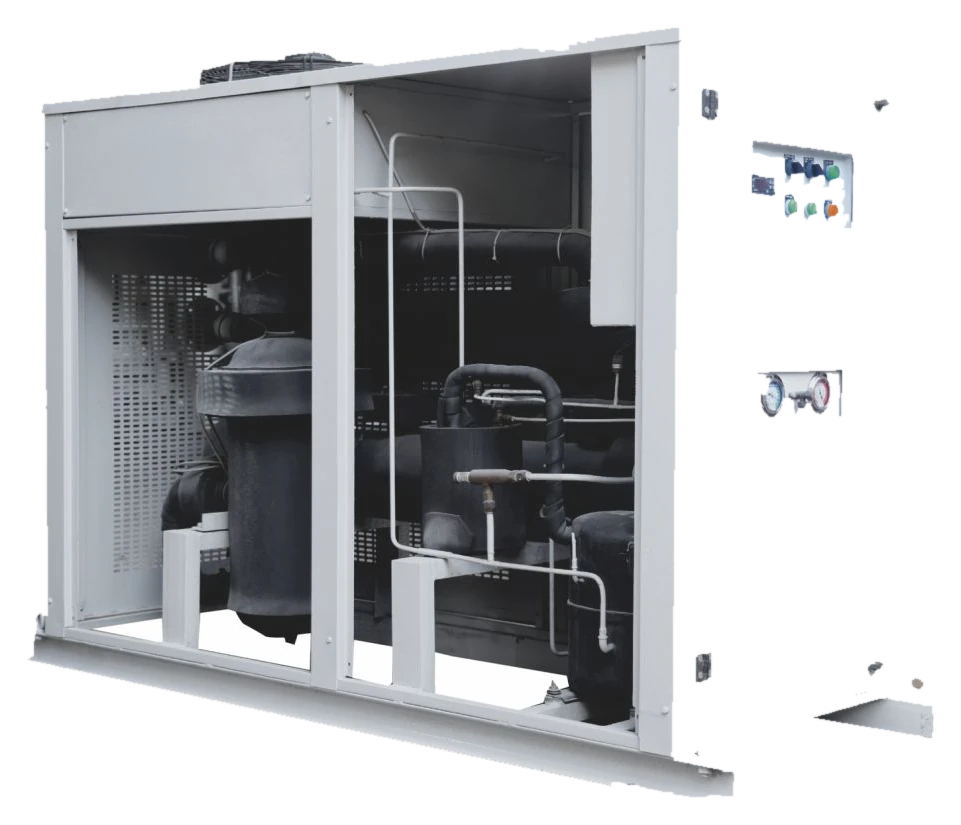
- Refrigeration circuit. A compressor, condenser (air or water cooled) and expansion device keep the evaporator cold, exactly as in a chiller. A hot gas bypass valve or thermal mass prevents the evaporator from dropping below 0 °C at low air flow, which would freeze the condensate.
Pressure dew point explained
Pressure dew point (PDP) is the temperature at which water starts to condense from the air at line pressure. With a PDP of +3 °C, no water will form in the pipework unless the pipe itself falls below +3 °C. Expanded to atmospheric pressure the same air has a dew point of roughly −20 °C, which is why two figures often appear on a dryer data sheet.
ISO 8573-1 water classes
| Class | Pressure dew point | Typical dryer |
|---|---|---|
| 1 | −70 °C or lower | Desiccant (heat regenerated or special) |
| 2 | −40 °C or lower | Desiccant |
| 3 | −20 °C or lower | Desiccant or membrane |
| 4 | +3 °C or lower | Refrigerated |
| 5 | +7 °C or lower | Refrigerated |
| 6 | +10 °C or lower | Refrigerated |
Refrigerated vs desiccant dryers
| Aspect | Refrigerated dryer | Desiccant dryer |
|---|---|---|
| Pressure dew point | +3 °C | −40 °C to −70 °C |
| Running cost | Low: a small refrigeration compressor | High: 10–18 % purge air for heatless types, or heater power |
| Maintenance | Clean condenser, check drain | Desiccant change, valves, pre- and after-filters |
| First cost | Lower | Higher |
| Use when | General plant air, pneumatics, tools, painting, packaging | Outdoor lines in freezing weather, instrument air to strict specs, electronics, pharma product contact, low-temperature processes |
A common arrangement is a refrigerated dryer for the whole plant with a small desiccant dryer only on the branch that needs very dry air.
Cycling and non-cycling designs
- Non-cycling (direct expansion). The refrigeration compressor runs continuously and a hot gas bypass valve holds the evaporator just above freezing. Simple, steady dew point, but power is nearly constant regardless of air flow.
- Cycling (thermal mass). A glycol or thermal store is chilled and the compressor switches off when it is cold enough. Saves energy when air demand varies widely.
- Variable speed. The compressor slows to match the load, combining stable dew point with part-load savings on larger dryers.
Sizing: why nominal CFM is not enough
Dryers are rated at standard reference conditions, commonly 35 °C inlet air, 25 °C ambient and 7 bar(g). Real plants differ, and each deviation changes capacity:
| Condition | Effect on dryer capacity | Why |
|---|---|---|
| Inlet air hotter than rated | Capacity falls steeply | Hotter air carries far more water and more heat to remove |
| Ambient hotter than rated | Capacity falls | The air cooled condenser rejects heat less effectively |
| Pressure lower than rated | Capacity falls | Lower-pressure air holds more water per unit of free air |
| Pressure higher than rated | Capacity rises | More water has already condensed in the aftercooler and receiver |
Suppliers publish correction factors for each. As an illustration, a dryer rated at 35 °C inlet may handle only about 70 % of its nominal flow at 45 °C inlet, and less again in a 45 °C compressor room. For Indian summers always state the real inlet temperature after the aftercooler and the real room temperature, and expect the selected dryer to be larger than the compressor's CFM suggests.
Installation tips
- Fit an aftercooler and moisture separator before the dryer and keep the inlet temperature as low as possible.
- Install a pre-filter to keep oil and dirt off the heat exchangers, and an after-filter suited to the air quality class.
- Place the dryer after a wet receiver where demand is steady, so the receiver cools the air and removes bulk water first.
- Give an air cooled dryer clean, cool ventilation; a hot, dusty compressor room is the main cause of high dew point.
- Test the automatic drain weekly. A stuck drain sends all the separated water straight back down the line.
- Fit a bypass so the dryer can be serviced without stopping the plant.
Troubleshooting a wet air line
- Drain blocked or failed
- Condenser choked, or ambient too high
- Air flow or inlet temperature above the dryer's corrected capacity
- Refrigerant low, or hot gas bypass valve out of adjustment
- Bypass valve left open
Teqtive refrigerated air dryers
Teqtive manufactures air cooled and water cooled refrigerated air dryers from 50 CFM to 50,000 CFM for 5 to 50 bar(g), with a pressure dew point of +2 °C, and air chillers and dehumidifiers for process air. Send us your compressor flow, pressure, inlet temperature and ambient and we will select the dryer with the correction factors applied.
Frequently asked questions
How does a refrigerated air dryer work?
Hot, wet compressed air is first pre-cooled by the outgoing dry air in an air-to-air heat exchanger. It then passes through an air-to-refrigerant evaporator where it is chilled to about +3 °C. The water vapour condenses, is removed by a separator and automatic drain, and the cold dry air is reheated by the incoming air before leaving the dryer.
What dew point does a refrigerated air dryer give?
A pressure dew point of about +2 °C to +3 °C, which meets ISO 8573-1 Class 4 for water. That is equivalent to an atmospheric dew point of roughly −20 °C once the air is expanded to atmospheric pressure. It cannot go below 0 °C because the condensate would freeze inside the dryer.
What is the difference between refrigerated and desiccant air dryers?
A refrigerated dryer cools the air to condense water and reaches about +3 °C pressure dew point at low running cost. A desiccant dryer adsorbs water onto beads of activated alumina or molecular sieve and reaches −40 °C or −70 °C, but it consumes purge air or heat for regeneration and costs more to buy and run. Use desiccant only where the dew point demands it.
How do I size a refrigerated air dryer?
Start with the compressor's free air delivery in CFM, then correct for the actual inlet air temperature, ambient temperature and working pressure. Higher inlet temperature, higher ambient and lower pressure all reduce a dryer's capacity. In Indian conditions, with 45 °C inlet and 40–45 °C ambient, the dryer typically needs to be one or two sizes above the compressor's nominal flow.