Pharma freeze dryers, API crystallisers, cold-trap condensers, −80 °C storage and gas liquefaction all need temperatures that an ordinary chiller cannot reach. The answer is not a bigger compressor but a different architecture: cascade refrigeration. This guide explains why, how it works, and how a cascade chiller is specified.
Why a single circuit stops at about −45 °C
Every refrigerant has a pressure–temperature curve. To evaporate at −70 °C and condense at +40 °C in one circuit, a refrigerant like R-404A would have to be compressed through a pressure ratio of well over 30:1. Three things go wrong at that ratio:
- Discharge temperature climbs past 120–140 °C, breaking down compressor oil and damaging valves.
- Volumetric efficiency collapses: the gas trapped in the clearance volume re-expands and the cylinder draws in almost nothing, so capacity falls to a few percent of nameplate.
- Suction pressure drops below atmospheric, so any leak pulls air and moisture into the system.
Two-stage compression with an intercooler fixes the discharge temperature and stretches a single refrigerant to about −45 °C. Beyond that, the refrigerant itself is the limit — its pressure at −60 °C is simply too low — and the only answer is to change refrigerant, which means cascading.
How a cascade system works
- High-temperature (HT) circuit. A conventional circuit using R-404A, R-507, R-134a, ammonia or propane. Its condenser is water cooled or air cooled as usual. Its evaporator, however, does not cool brine — it cools the condenser of the second circuit.
- Cascade condenser. A shell-and-tube or plate heat exchanger where the HT refrigerant boils (at, say, −35 °C) and the low-temperature refrigerant condenses (at, say, −30 °C). It is the only thermal link between the two circuits; the refrigerants never mix.
- Low-temperature (LT) circuit. A separate sealed circuit with a refrigerant such as R-23, R-508B, CO₂ or ethane that has a workable pressure at −70 °C to −90 °C. Its evaporator cools the process brine, air or product. Because it condenses at −30 °C instead of +40 °C, its pressure ratio stays around 5–8:1.
- Expansion tank / fade-out vessel. At standstill the LT refrigerant warms to room temperature and its pressure would rise to dangerous levels. An expansion vessel gives it somewhere to go, or a small auxiliary unit keeps it cold.
| Stage | Typical refrigerant | Evaporating | Condensing | Pressure ratio |
|---|---|---|---|---|
| High-temperature | R-404A / R-507 / R-717 / propane | −35 °C to −40 °C | +35 °C to +45 °C | ≈ 7–9 : 1 |
| Low-temperature | R-23 / R-508B / R-744 (CO₂) / ethane | −70 °C to −85 °C | −30 °C to −35 °C | ≈ 5–8 : 1 |
Choosing the refrigerant pair
The LT refrigerant must still have a pressure above atmospheric at the lowest evaporating temperature, and a condensing pressure the cascade condenser can hold at the temperature the HT stage can deliver. CO₂ (R-744) is increasingly popular for the low stage down to about −50 °C because it is cheap, non-toxic and has a very low GWP; R-23 and R-508B go deeper, to −80 °C and below, but carry a high GWP and are being phased down. The HT stage follows the same rules as any brine chiller: ammonia for large plants, R-404A/R-507 or propane for packaged units.
Control and start-up
A cascade chiller must start the HT circuit first and bring the cascade condenser down to temperature before the LT compressor is allowed to run; otherwise the LT discharge pressure trips immediately. Teqtive's PLC sequences this automatically, then holds the cascade condenser temperature with the HT expansion valve and the brine outlet with the LT capacity control. Safeties include high-pressure cut-outs on both circuits, an LT standstill pressure relief or fade-out vessel, and antifreeze protection on the brine evaporator.
Where cascade chillers are used
- Lyophilisers & freeze dryers (−55 °C to −80 °C condensers)
- Pharma API crystallisation at −60 °C to −70 °C
- Solvent & vent cold traps
- Ultra-low-temperature cold rooms
- Blast and IQF freezing of high-value product
- Gas liquefaction & CO₂ recovery
- Environmental test chambers
Capacity, cost and efficiency
Because the heat removed at −70 °C passes through two compressors, the overall coefficient of performance is low — often 0.6 to 1.0 compared with 3 to 5 for a +7 °C water chiller. That is unavoidable physics, so cascade chillers should be sized tightly, insulated heavily (100 mm or more of PUF with a vapour barrier) and run only as cold as the process truly needs: every 10 °C of unnecessary set-point costs roughly 20–30 % in power. For the kW per TR arithmetic see chiller efficiency, COP and kW/TR.
Teqtive cascade chillers
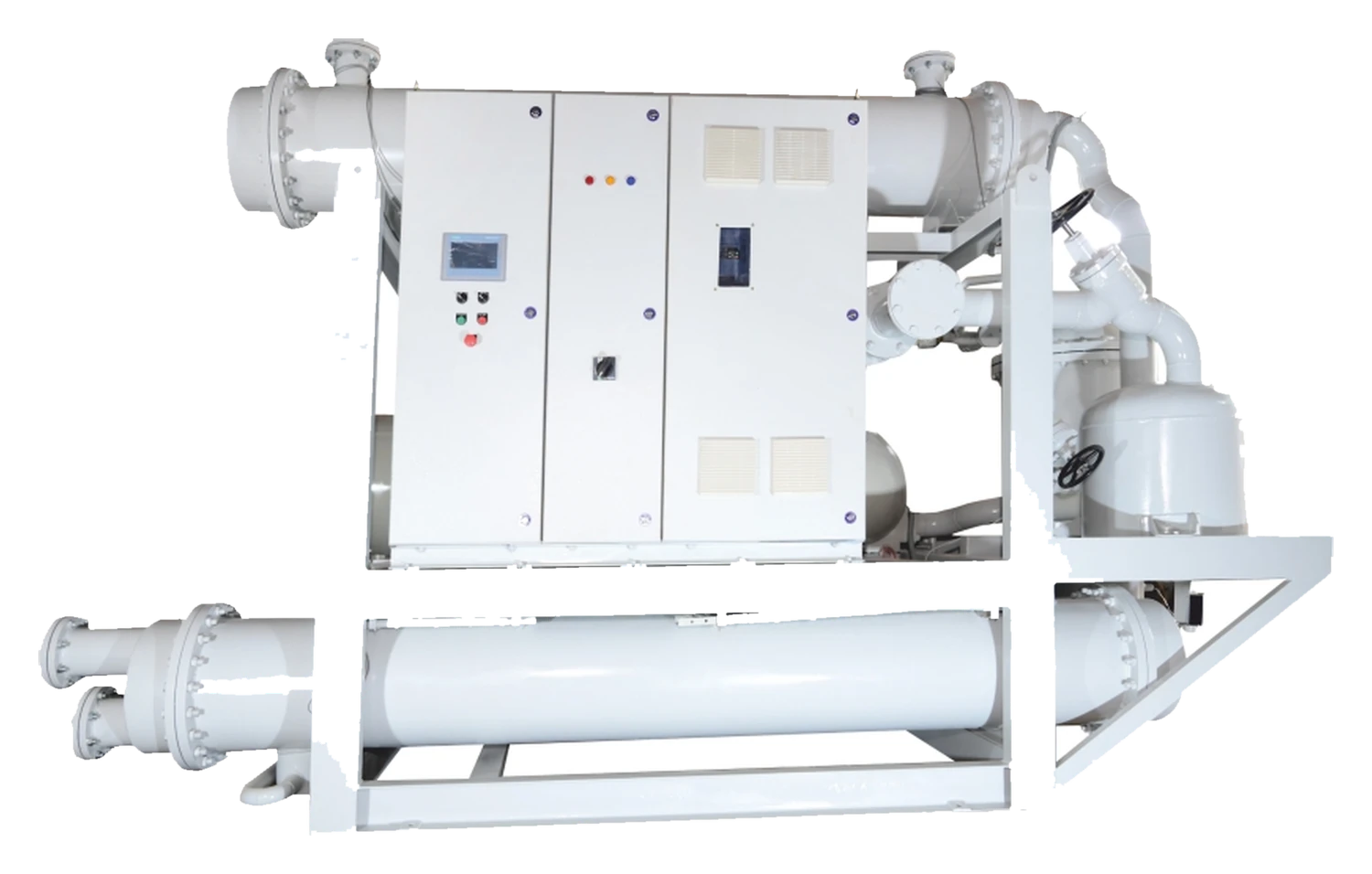
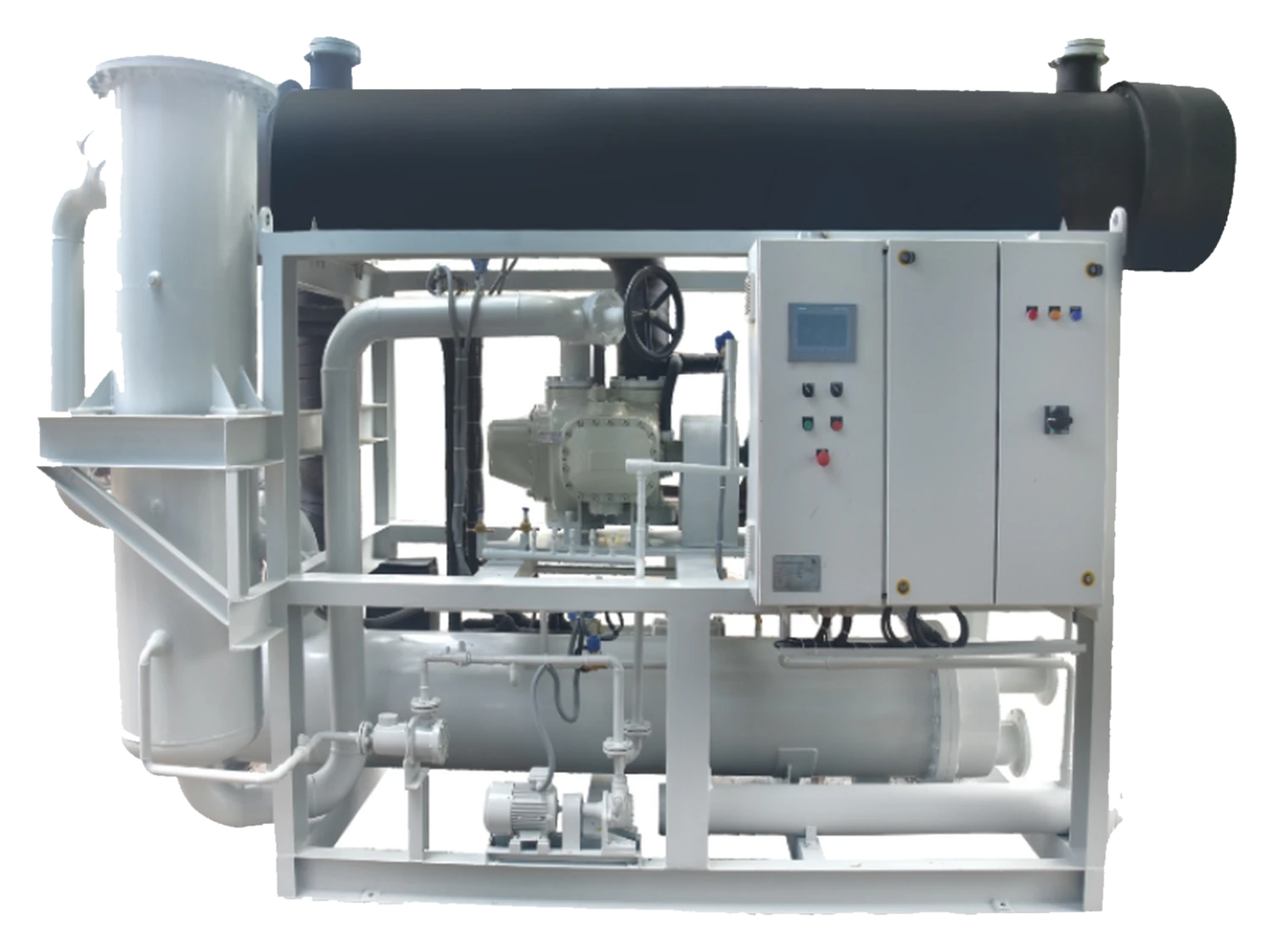
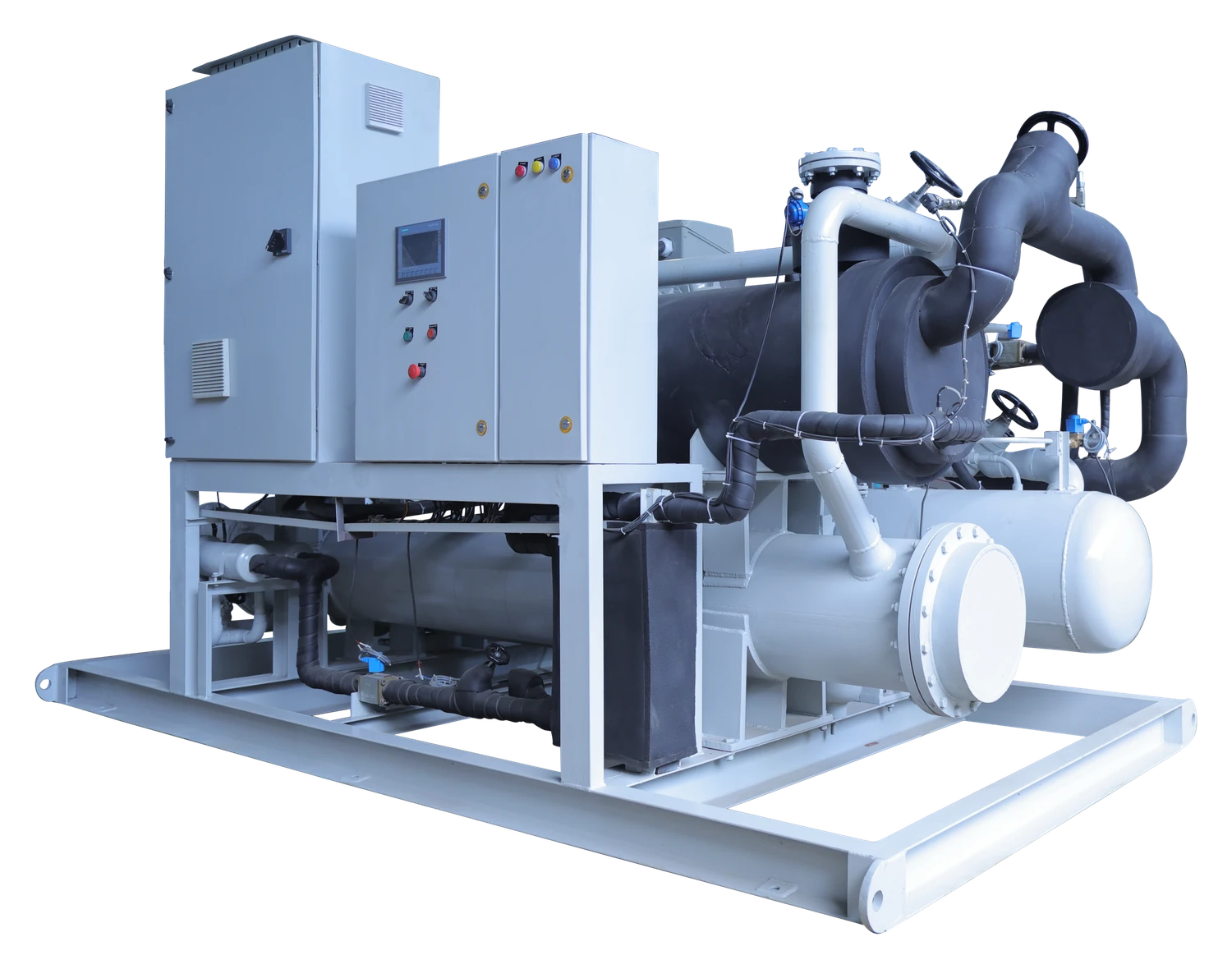
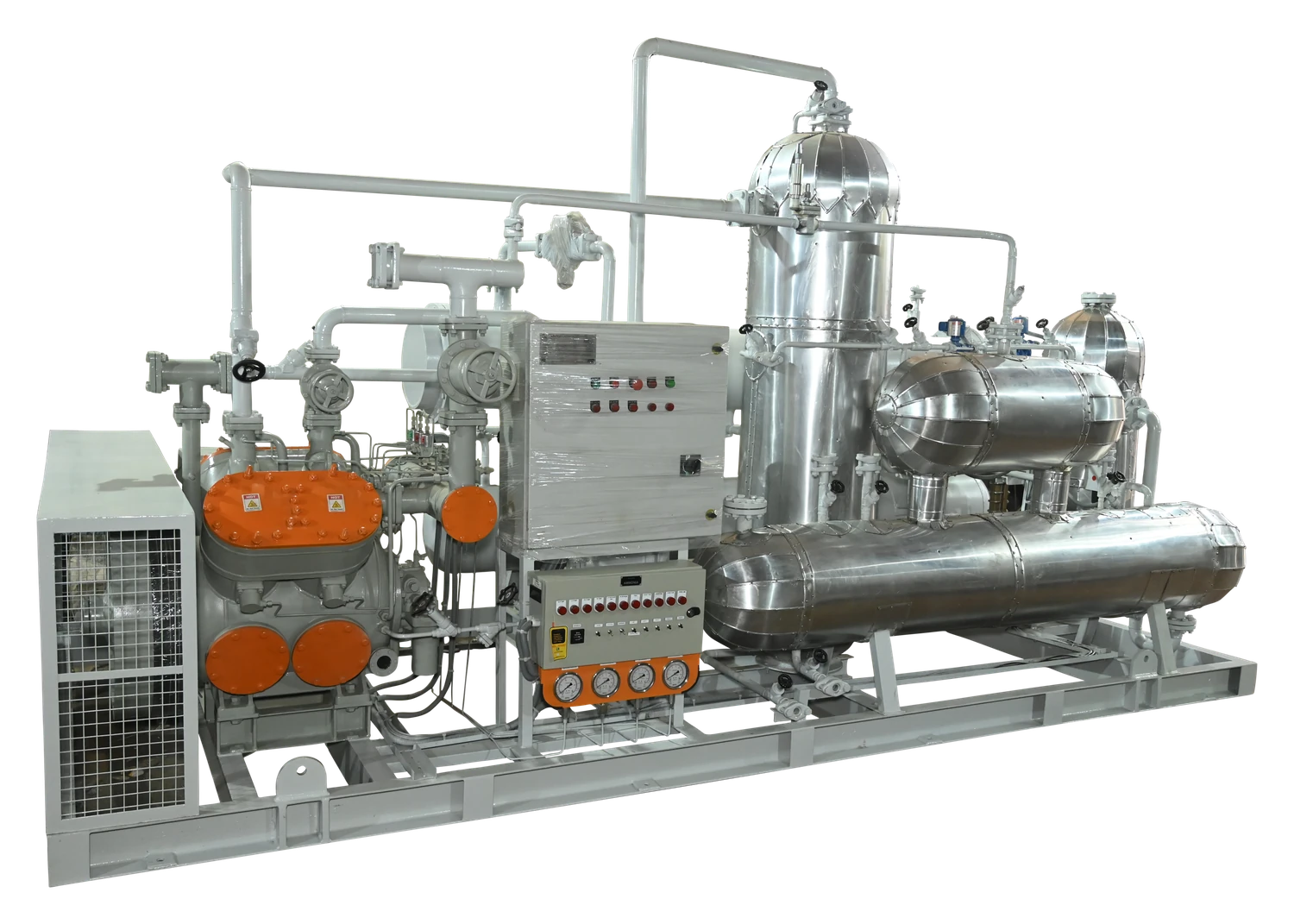
Teqtive builds cascade brine chillers from −35 °C to −70 °C, water cooled, with screw or reciprocating compressors on both stages, alongside two-stage brine chillers for −25 °C to −45 °C and single-stage brine chillers to −40 °C. Tell our process team the heat load, outlet temperature and coolant and we will recommend the right architecture — many "−60 °C" enquiries turn out to need −45 °C and a much cheaper machine.
Frequently asked questions
What is a cascade refrigeration system?
A cascade refrigeration system uses two (sometimes three) separate vapour-compression circuits with different refrigerants. The evaporator of the high-temperature circuit cools the condenser of the low-temperature circuit in a heat exchanger called the cascade condenser. The low-temperature circuit then reaches −60 °C to −80 °C, which a single circuit cannot do efficiently.
Why not just use one compressor for −70 °C?
Between −70 °C evaporating and +40 °C condensing a single refrigerant would need a pressure ratio of 30:1 or more. Discharge temperatures would exceed the oil's limit, volumetric efficiency would collapse, and the suction pressure would fall below atmospheric, drawing in air and moisture. Splitting the lift across two circuits keeps each compressor in its safe range.
What is the difference between cascade and two-stage refrigeration?
Two-stage compression uses one refrigerant and two compression stages with an intercooler; it works down to about −45 °C. A cascade system uses two different refrigerants in two sealed circuits, linked only by a heat exchanger, and covers −45 °C to −80 °C and below.
Which refrigerants are used in cascade chillers?
The high-temperature stage typically uses R-404A, R-507, R-134a, R-717 (ammonia) or propane. The low-temperature stage uses R-23, R-508B, R-744 (CO₂) or ethane. The pair is chosen so the low-stage refrigerant condenses comfortably at the temperature the high stage can provide, usually −30 °C to −40 °C.